- New
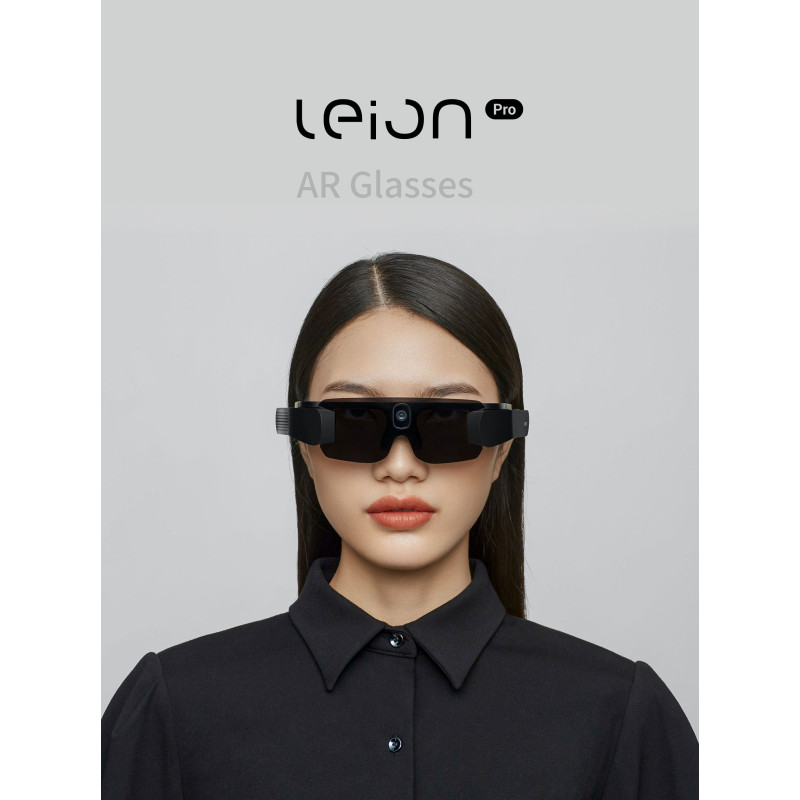
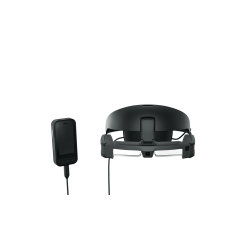
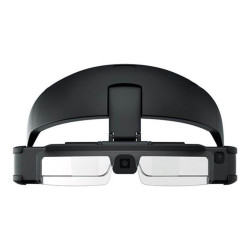
LLVision Leion Pro are professional, binocular augmented reality glasses designed primarily for industrial and business applications.
The device overlays digital information onto the real-world image without obscuring the user's entire field of view.
The glasses can be used for remote technical support, operational procedures, inspections, training, AR model visualization, object recognition, and employee documentation display, among other things.
LLVision Leion Pro AR Glasses
LLVision Leion Pro are professional, binocular augmented reality glasses designed primarily for industrial and business applications.
The device overlays digital information onto the real-world image without obscuring the user's entire field of view.
The glasses can be used for remote technical support, operational procedures, inspections, training, AR model visualization, object recognition, and employee documentation display, among other things.
The Leion Pro features a decoupled design: the glasses connect via USB-C to a compatible Android smartphone or tablet. The mobile device is responsible for power, connectivity, and running the control app.
The "5G" designation does not indicate that the glasses have their own 5G modem. They utilize the network connection of the connected smartphone or tablet.
The glasses incorporate a proprietary Intel Movidius Myriad X VPU (Vision Processing Unit), designed to perform tasks related to image analysis and artificial intelligence.
Technical Specifications
Display
Display design: binocular.
Optical technology: L-PAT optical waveguide.
Field of view: 30° diagonal.
Image resolution: 640 × 400 pixels.
Maximum brightness: 4000 nits.
Contrast ratio: 10,000:1.
Light transmittance: 85%.
Image distortion: less than 2%.
Declared external light leakage: less than 1%.
Brightness adjustment: five levels.
Brightness adjustment on the Leion Pro is manual and is performed via the mobile app; the SDK manual does not confirm automatic brightness adjustment for this model.
Camera
Camera resolution: 13 MP.
Supported video resolutions: 4K, 1080p, and 720p.
Maximum 4K resolution: 3840 × 2160 pixels.
Image stabilization: EIS [Electronic Image Stabilization].
Declared camera field of view: 120°.
Camera image transfer format in the SDK: H.264.
According to the SDK manual, 4K recording can run at 5, 10, or 15 frames per second, while 1080p and 720p recording can run at up to 30 frames per second.
Image Processing and Artificial Intelligence
Image Processor: Intel Movidius Myriad X VPU.
AI Engine: LLVision Laffe AI Engine.
Hardware acceleration of object tracking and optical flow.
Ability to perform selected object recognition operations without a cloud connection.
Supported AI modeling frameworks: TensorFlow, Caffe, PyTorch, and MXNet.
The manufacturer provides tools for creating custom applications using the glasses' camera, display, and sensors.
Memory
RAM: 512 MB LPDDR3.
The manufacturer does not publicly disclose the internal storage capacity on its website.
The glasses are not designed as a completely standalone computer – the application and some calculations run on a connected Android device.
Sensors
Accelerometer, referred to by the manufacturer as a G-Sensor.
Gyroscope.
Digital compass.
ALS [Ambient Light Sensor]
The SDK allows access to data on head movement, acceleration, and device orientation.
Control
Physical button.
Head movements.
Voice commands.
Gestures.
Control via the mobile app.
Two display modes are available: mirroring the phone screen and extended display mode, in which the glasses display information other than the mobile device.
Audio
Audio input: digital microphone.
Noise cancellation.
Echo cancellation available via SDK.
Audio output: two stereo speakers.
When the glasses are connected, Android can treat them similarly to a USB-C audio headset, switching to their microphone and speakers.
Connectivity and ports
Connector: USB-C.
USB 2.0 and USB 3.0 support.
USB OTG [USB On-The-Go] support required on the mobile device.
Connection to a smartphone or tablet is via a wired connection.
Internet connectivity, GPS location, cellular network, Wi-Fi, and potentially 5G come from the connected mobile device.
Dimensions and weight
Dimensions: 186 x 175 x 47 mm.
Weight: 90 g.
Manufacturer-declared power consumption: approximately 1.7 W.
The glasses do not have a heavy, built-in battery, as they are powered by a connected smartphone or tablet.
Manufacturer-replaceable accessories:
Tinted optical filter.
Myopia inserts or lenses.
Replaceable nose pads.
Security strap or mounting element.
The exact contents of the kit should be confirmed before ordering, as the manufacturer does not publish a clear, up-to-date list of components included in each kit.
Software Required for Operation
Compatible Android smartphone or tablet.
The public LLVision product data sheet specifies Android 8.0 or later.
The 2023 SDK manual lists Android 7–13. Due to this discrepancy, compatibility with your specific phone and Android version should be confirmed with LLVision before purchase.
The mobile device must support USB OTG.
An LLVision-specific app or an enterprise app using the LLVision Leion Pro SDK is required.
For basic controller functionality, the app may require permissions for the camera, microphone, memory, background operation, and displaying content over other apps.
The manufacturer provides an Android SDK for developing custom apps.
The SDK documentation specifies Java 1.8 and C/C++ as the programming languages and Android Studio as the development environment.
The manufacturer also states support for Unity and Vuforia for creating 3D AR apps.
LLVision ARISE Platform
Leion Pro is compatible with the LLVision ARISE Enterprise Service Platform.
The official Chinese product data sheet for the current ARISE 2.3.1 release lists Leion Pro as a compatible device.
The platform can be delivered as a cloud-based, private, or customized solution.
Available features include remote collaboration, E-SOP (Electronic Standard Operating Procedure), image recognition, digital twins, AR workstation, and a knowledge base.
The platform can be integrated with enterprise systems through development.
ARISE access, licenses, private implementation, and integrations are likely separate offerings and should be included in the quote.
LLVision Leion Pro are professional, binocular augmented reality glasses designed primarily for industrial and business applications.
The device overlays digital information onto the real-world image without obscuring the user's entire field of view.
The glasses can be used for remote technical support, operational procedures, inspections, training, AR model visualization, object recognition, and employee documentation display, among other things.