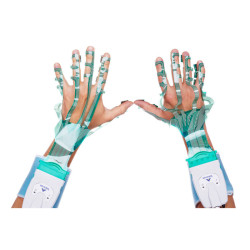
Tekscan is a family of advanced measurement systems that utilize thin, flexible sensors to measure force, contact pressure, contact pressure, and load distribution between contacting surfaces.
The systems enable the recording of static and dynamic data and their real-time presentation in the form of pressure maps, graphs, and 2D and 3D visualizations.
A typical Tekscan system consists of a sensor or sensor array, data acquisition electronics, and dedicated analysis software.
Tekscan – Pressure, Force, and Pressure Distribution Measurement Systems
Tekscan is a family of advanced measurement systems that utilize thin, flexible sensors to measure force, contact pressure, contact pressure, and load distribution between contacting surfaces.
The systems enable the recording of static and dynamic data and their real-time presentation in the form of pressure maps, graphs, and 2D and 3D visualizations.
A typical Tekscan system consists of a sensor or sensor array, data acquisition electronics, and dedicated analysis software.
This technology allows for the determination of parameters such as total force, contact pressure, maximum pressure, contact area, location of maximum pressure, and the position and trajectory of the center of force/center of pressure.
Tekscan offers over 200 standard matrix pressure sensors in various sizes, shapes, resolutions, and measurement ranges; custom sensors can also be manufactured. Pressure mapping sensors are very thin and flexible – the manufacturer specifies a thickness of approximately 0.1 mm (0.004") for pressure mapping technology, ensuring their presence has little impact on the tested surface contact.
The systems are used in applications including biomechanics, ergonomics, medicine, rehabilitation, dentistry, sports, robotics, automotive, product design, quality control, manufacturing, tire testing, battery testing, prosthetic testing, and human and animal gait analysis.
Specifications – Key Technology Features
Measurement: Force, contact pressure, and contact pressure distribution; selected systems also enable surface temperature measurement.
Sensors: Thin-film, flexible matrix sensors and FlexiForce single-point force sensors.
Number of matrix sensors available: Over 200 standard configurations.
Minimum typical pressure mapping sensor thickness: Approximately 0.1 mm.
Data visualization: 2D and 3D pressure maps.
Data logging: Real-time measurements and recording of measurements for later analysis.
Analyzed parameters can include: total force, contact area, contact pressure, maximum pressure, maximum force, center of force, and its trajectory.
Calibration: Single- or multi-point calibration, depending on the system.
Data export: Depending on the software, including ASCII, Excel, MATLAB, AVI, or MP4.
Ability to synchronize selected systems with external testing equipment, such as EMG, motion capture systems, and ground reaction force platforms. Communication: USB or wireless, depending on configuration.
Standard Tekscan computer requirements: Windows 10 or Windows 11, 64-bit; ARM/Snapdragon processors not supported.
RAM: Minimum 8 GB, 16 GB recommended.
Port: Minimum 1 × USB-A 2.0 or later; USB-C adapter may be used.
Wireless systems require 802.11 b/g/n Wi-Fi.
Tekscan System Models/Main Families
I-Scan™ – a universal pressure mapping system for two surfaces; the basic Tekscan platform for industrial research, R&D, and quality control; compatible with over 200 sensor types.
I-Scan – Evolution/high-speed configurations – depending on the electronics and configuration, the system enables very fast acquisition; the manufacturer states a maximum sensor scan rate of up to 20 kHz.
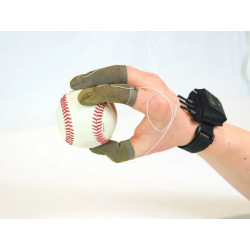
Grip™ – a system for measuring pressure and force when gripping objects; designed for hand, finger, ergonomics, and handle and tool design. The wired version has a scanning rate of up to 750 Hz; it uses, among others, the 4256E sensor.
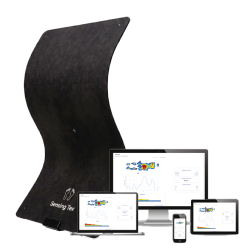
Body Pressure Measurement System – BPMS™ – a body pressure mapping system designed for testing mattresses, beds, seats, pillows, strollers, and body-supporting surfaces. The system can utilize one to eight sensors.
BPMS Research – research configurations utilizing, among others, 5315 and 5400N sensors; single- and multi-sensor configurations available.
CONFORMat™ – a flexible pressure mapping system designed specifically for advanced studies of seating, positioning, cushions, and body support surfaces; it utilizes sensors such as the 5330 and 5330D.
ErGO-Scan™ – a system for clinical seating assessment and wheelchair positioning; it utilizes the 7300 sensor and TekDAQ 200 electronics, with the option of wired or Wi-Fi operation.
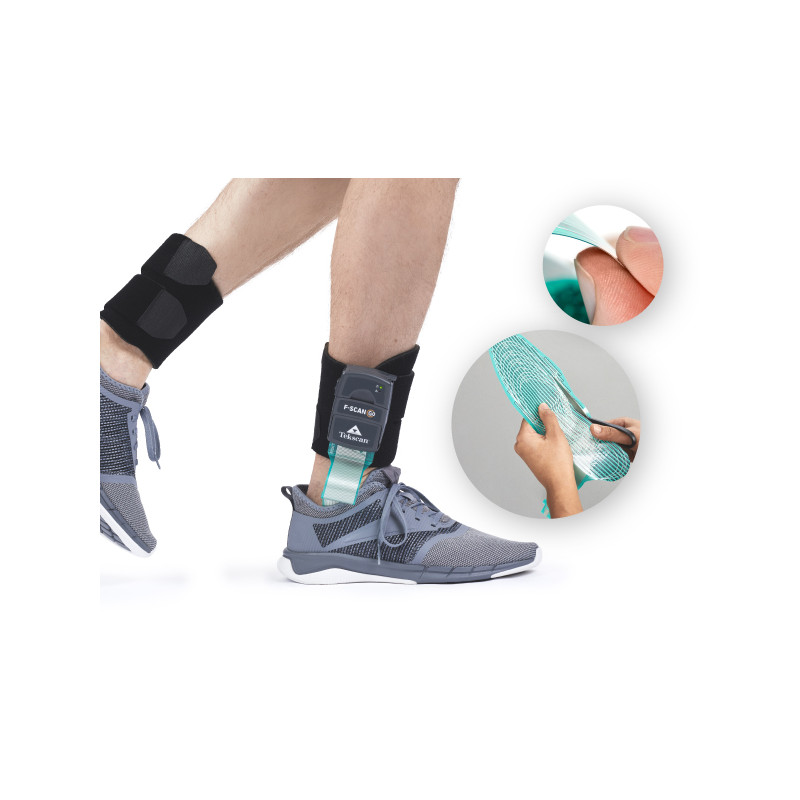
F-Scan™ GO – a wireless in-shoe pressure measurement system for gait and foot function analysis; it utilizes pre-cut 3010 sensors, TekDAQ electronics, and data storage on microSD cards.
F-Scan GO / FootVIEW Pro – the research configuration allows for recording at up to 500 Hz and synchronization with EMG systems, motion capture, and other laboratory equipment. Strideway™ – a modular gait analysis platform that records step by step, force, pressure, time, and spatial parameters; available in various resolutions and lengths from approximately 1 to 5 m.
MobileMat™ 3140 – a portable mat for measuring plantar pressure; active area approximately 48.7 x 44.7 cm, resolution 1 sensel/cm², and scanning speed up to 100 Hz.
MobileMat™ HR 7101E – a high-resolution version of the mat; 8448 measurement elements, resolution 3.9 sensel/cm², and scanning speed up to 185 Hz.
F-Socket™ – a pressure mapping system used in the design, fitting, and evaluation of prosthetic devices.
K-Scan™ – a system designed to analyze pressures and loads occurring between joint surfaces.
TireScan™ – a family of systems for examining tire pressure distribution and tire contact patches; the offering includes, among others. TireScan CrossDrive, VersaTek, and High Speed TireScan configurations.
Nip Pressure Alignment Tool™ – a system for measuring and monitoring pressure distribution between rollers.
Wiper™ System – a system for analyzing the pressure distribution of wiper blades.
FlexiForce™ – thin, flexible single-point force sensors designed for research, prototyping, and OEM integration.
ELF™ – Economical Load & Force Measurement System – a force measurement system using FlexiForce sensors; the standard version allows sampling up to 200 Hz, and the High-Speed ELF up to 6000 Hz; a maximum of 16 points can be measured using multiple modules.
WELF 2 – a wireless data acquisition system compatible with FlexiForce force sensors.
T-Scan™ Novus™ – a digital dental occlusion analysis system measuring time and relative bite force distribution; the maximum recording frequency is up to 500 Hz in Turbo mode. T-Scan™ Novus Core™ – a simplified version of the digital occlusion analysis system designed for basic dental applications. Animal Strideway™ and Hoof™ – systems designed for gait analysis and load distribution in animals.
Software Required for Operation
Tekscan systems do not require a single, common program – the software is selected for the specific measurement platform.
I-Scan™ – I-Scan Software / I-Scan Evolution – basic software for data acquisition, calibration, visualization, and analysis, including 2D/3D presentation, force, pressure, contact area, and center of force analysis. Each sensor type uses a dedicated Sensor MAP file defining the sensor array geometry.
F-Scan GO – FootVIEW™ – clinical software for foot and gait function analysis.
F-Scan GO – FootVIEW™ Pro – research version enhanced with features such as 500 Hz sampling, ASCII export, synchronization with external devices, and a Data Reader Toolkit for integration with MATLAB, Python, C#, and LabVIEW.
MobileMat / MobileMat HR – FootMat™ Software for Clinicians – software for clinical foot and gait function analysis.
MobileMat / MobileMat HR – FootMat™ Software for Researchers – an extended research version enabling export to ASCII, Excel, and MATLAB, as well as synchronization with external biomechanical systems.
Grip – Grip Software – software for recording and analyzing hand pressure and forces, with 2D/3D visualization, center of force analysis, and data export capabilities.
BPMS / CONFORMat – dedicated Tekscan software for body pressure mapping – 2D/3D visualization, measurement of mean and maximum pressure, contact area, and center of pressure.
ErGO-Scan – ErGO-Scan Software – simplified clinical software for recording and documenting pressure maps during seat assessments.
ELF – ELF Software – Windows software for force measurement from FlexiForce sensors, calibration, data storage, and ASCII export.
T-Scan Novus / Novus Core – T-Scan Software – dedicated dental software for analyzing bite force and contact time; The current version supports Windows 10 and Windows 11.
For integration applications, the Tekscan Pressure Mapping SDK – Software Development Kit – is also available, allowing you to create your own applications that work with Tekscan electronics. The SDK runs on Windows 10 or later and uses .NET libraries; the manufacturer provides integration examples with C#, MATLAB, LabVIEW, and Visual Basic, among others.
Tekscan is a family of advanced measurement systems that utilize thin, flexible sensors to measure force, contact pressure, contact pressure, and load distribution between contacting surfaces.
The systems enable the recording of static and dynamic data and their real-time presentation in the form of pressure maps, graphs, and 2D and 3D visualizations.
A typical Tekscan system consists of a sensor or sensor array, data acquisition electronics, and dedicated analysis software.