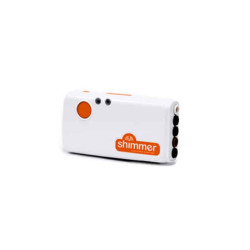
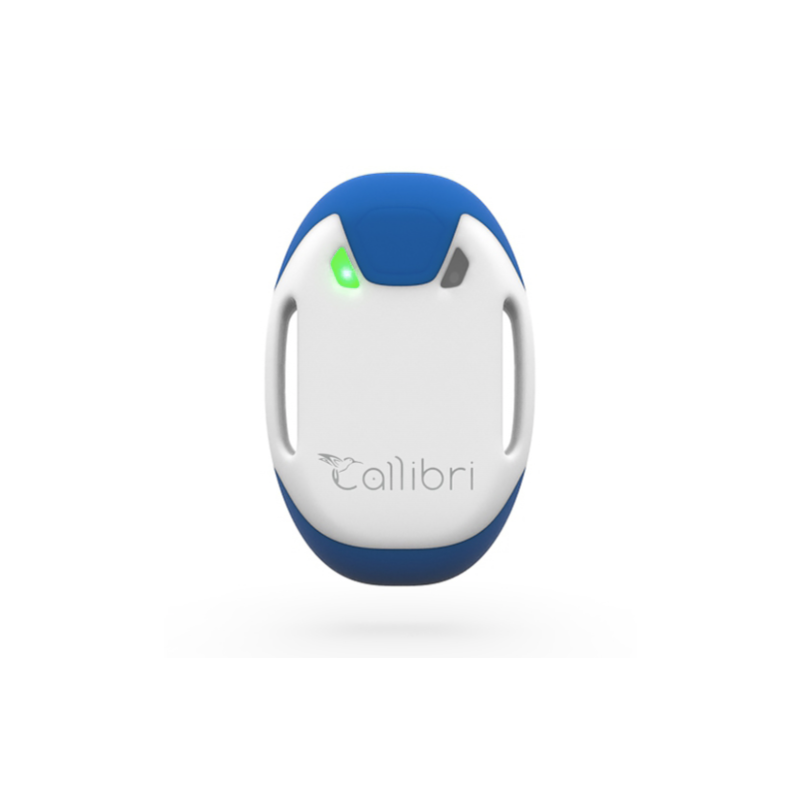
BrainBit Callibri Sensors is a compact, wireless system designed to record various physiological signals and movement parameters.
A single Callibri module can be used to measure EEG, ECG/EKG, EMG, GSR, respiration, and movement parameters, depending on the equipment, electrodes, and measurement configuration used.
EEG (Electroencephalography) records the electrical activity of the brain.
ECG/EKG (Electrocardiography) records the electrical activity of the heart and uses the signal to analyze HR and HRV.
BrainBit Callibri Sensors – Wireless Multifunctional Biosignal Sensor
BrainBit Callibri Sensors is a compact, wireless system designed to record various physiological signals and movement parameters.
A single Callibri module can be used to measure EEG, ECG/EKG, EMG, GSR, respiration, and movement parameters, depending on the equipment, electrodes, and measurement configuration used.
EEG (Electroencephalography) records the electrical activity of the brain.
ECG/EKG (Electrocardiography) records the electrical activity of the heart and uses the signal to analyze HR and HRV.
HR (Heart Rate) refers to the heart rate.
HRV (Heart Rate Variability) refers to the variability of heart rate.
EMG (Electromyography) measures the electrical activity of muscles and analyzes their tension and relaxation. GSR (Galvanic Skin Response), also known as electrodermal conductivity, can be used to observe changes in skin conductance related to, among other things, body arousal.
Respiration measurement allows for monitoring breathing frequency and rhythm using an appropriate accessory.
For EEG measurement, Callibri can operate as a single-channel brain activity sensor.
The system can be used in scientific research, biofeedback, neurofeedback, psychophysiological studies, education, sports, movement analysis, and for developing custom applications using biosignals.
Its small size and wireless data transmission allow for measurements both in the laboratory and outside of a traditional research setup.
The sensor communicates with a computer, smartphone, or tablet via Bluetooth Low Energy.
Callibri can transmit recorded data in real time to a compatible application.
Up to eight Callibri sensors can be used simultaneously, allowing for the creation of more complex measurement configurations. Multiple sensors can be used, for example, to simultaneously monitor different muscle groups or physiological parameters.
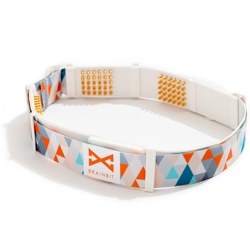
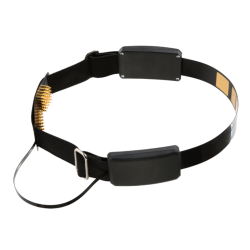
The manufacturer offers accessories that allow you to customize Callibri for a specific measurement type, including disposable electrodes, EEG electrodes, an ECG/HRV belt, a breathing belt, and GSR electrodes/clips.
Callibri is an open platform for developers – the manufacturer provides a free SDK enabling direct access to the device's data and integration with custom software.
The device is intended primarily for research, education, training, wellness, and the development of new applications.
The manufacturer describes Callibri as a non-medical product, not intended for the diagnosis or treatment of diseases.
Possible applications
EEG signal recording,
ECG/EKG recording,
HR and HRV analysis,
EMG muscle activity measurement,
muscle tension and relaxation analysis,
GSR/skin conductance measurement,
respiration monitoring,
movement analysis,
biofeedback,
neurofeedback,
breathing training,
relaxation training,
stress and arousal monitoring,
psychophysiological research,
sports and training research,
education,
research laboratories,
wearable device prototyping,
creating custom applications using biosignals,
integration with research systems and IoT solutions.
Technical Specifications
Device Type: Wireless, Multifunctional Biosignal Sensor.
Platform: BrainBit Callibri.
Supported Measurement Types: EEG, ECG/EKG, HR/HRV, EMG, GSR, Respiration, and Movement – depending on configuration and accessories used.
EEG: Single-channel recording.
ECG/EKG: Records electrical heart activity.
EMG: Records electrical muscle activity.
GSR: Measures skin electrodermal conductance using appropriate electrodes.
Respiration: Ability to monitor respiratory rhythm using a compatible breathing belt/sensor.
Biopotential Recording: Bipolar.
Manufacturer-specified voltage range for the electrophysiology platform: 0–0.2 V.
Input-referenced noise: No more than 12 μVpp with shorted inputs.
Wireless Communication: Bluetooth Low Energy.
Bluetooth version: BLE 4.0 or higher.
Simultaneous operation: up to 8 Callibri sensors.
Mounting: using skin electrodes or appropriate measurement accessories.
Support for disposable surface electrodes: yes.
Sensor versions available in the current store card: with or without MEMS.
MEMS (Micro-Electro-Mechanical System) refers to an integrated microelectromechanical system used to record movement.
The MEMS-equipped version offers acceleration and angular velocity measurement.
Accelerometer: available in MEMS configuration.
Angle velocity measurement: available in MEMS configuration.
Data transmission: real-time wireless.
Continuous operation time: the manufacturer's official specifications state at least 6 hours; the current BrainBit website indicates up to approximately 8 hours depending on configuration and use.
Battery: built-in rechargeable battery.
Charging: via USB cable.
Design: compact and designed for wearable applications.
Useability: The manufacturer describes the device as sweat-resistant/splash-resistant.
Manufacturer's warranty: 1 year.
Declared markings/certifications: CE and FCC.
MEMS Version
Includes additional MEMS motion sensors.
Enables simultaneous recording of biosignals and movement data.
Provides accelerometer data.
Provides information on the sensor's angular velocity/movement.
Can be used to study muscle activity in conjunction with movement analysis.
It is particularly useful in sports, biomechanics, exercise rehabilitation, exercise analysis, and applications utilizing a combination of EMG and movement data.
Non-MEMS Version
Primarily designed for recording biosignals without the need for simultaneous movement data collection.
Can be used for EEG, ECG, EMG, and other electrophysiological measurements using appropriate electrodes and accessories.
Software Required for Operation
Callibri does not require a single, mandatory paid software program from the manufacturer. Compatible software that supports the Callibri sensor is required to receive, display, or process data.
The basic solution for device integration is the free Callibri/BrainBit SDK provided by the manufacturer.
The SDK (Software Development Kit) allows you to search for the device, connect to it, configure parameters, and receive measurement data.
The SDK includes a portable core written in C++ and libraries/wrappers enabling the device to be used on various platforms.
Supported systems include Windows, macOS, Linux, Android, and iOS.
The manufacturer provides tools for .NET/C#, C++, Java, Python, React Native, and Unity, among others.
The SDK allows you to create your own research, biofeedback, neurofeedback, fitness, wellness, and systems utilizing recorded biosignals applications. To use Callibri, it's not necessary to develop your own app – the device can also work with existing, compatible BrainBit software.
NeuroFit PRO
BrainBit officially designates NeuroFit PRO as compatible software for Callibri sensors.
NeuroFit PRO is designed for conducting biofeedback and neurofeedback sessions.
It supports the use of Callibri to measure EMG, HRV, GSR, and respiration, among other things.
It enables real-time parameter monitoring.
It enables standardized training sessions.
It provides training protocols and games using biofeedback/neurofeedback.
It provides reporting and progress tracking features.
It allows data export to CSV and EDF/EDF+ formats in supported scenarios.
NeuroFit PRO is a paid solution and is not required if Callibri is used with proprietary SDK-based software.
NeuroFit PRO Minimum Requirements
Operating System: Windows 10, 32- or 64-bit, build 1903 or newer.
Processor: Intel Core i3, i5, i7, or comparable AMD quad-core processor.
RAM: Minimum 4 GB.
Hard Drive: Minimum 120 GB, SSD recommended.
Screen Resolution: Minimum 1600 x 900.
The NeuroFit PRO configuration requires two monitors.
USB Ports Required: Minimum 2.
Key Software Information
Callibri requires software capable of communicating with the device and receiving data via Bluetooth.
To create your own solutions, use the free BrainBit/Callibri SDK.
If you have a ready-made biofeedback station, you can use the compatible NeuroFit PRO software.
NeuroFit PRO is not required for the sensor itself.
BrainBit Callibri Sensors is a compact, wireless system designed to record various physiological signals and movement parameters.
A single Callibri module can be used to measure EEG, ECG/EKG, EMG, GSR, respiration, and movement parameters, depending on the equipment, electrodes, and measurement configuration used.
EEG (Electroencephalography) records the electrical activity of the brain.
ECG/EKG (Electrocardiography) records the electrical activity of the heart and uses the signal to analyze HR and HRV.