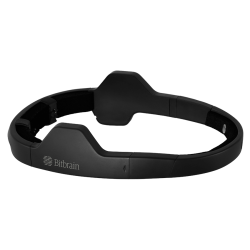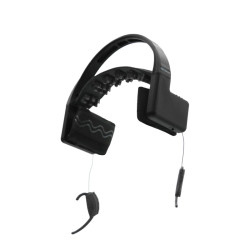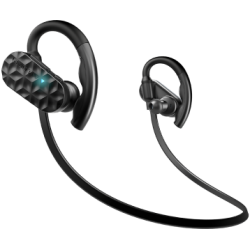
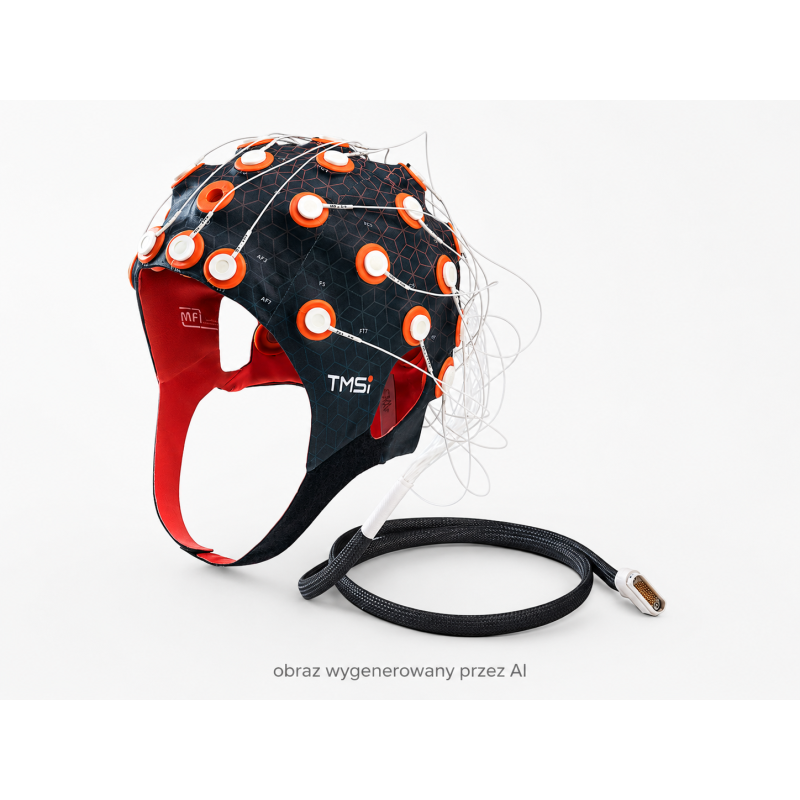
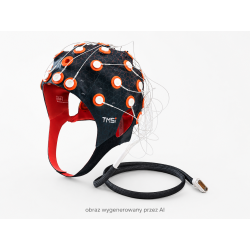
TMSi EEG / HD-EMG is a family of professional research systems designed for recording electrophysiological signals, specifically EEG and high-density electromyography (HD-EMG). TMSi solutions – an Artinis company – enable measurements both in laboratory settings and during mobile experiments and movement-related studies.
TMSi EEG and HD-EMG – Professional Systems for Brain and Muscle Activity
TMSi EEG / HD-EMG is a family of professional research systems designed for recording electrophysiological signals, specifically EEG and high-density electromyography (HD-EMG). TMSi solutions – an Artinis company – enable measurements both in laboratory settings and during mobile experiments and movement-related studies.
EEG – Electroencephalography (EEG) enables the recording of electrical brain activity using electrodes placed on the surface of the head.
HD-EMG – High-Density Electromyography (HD-EMG) uses multi-electrode arrays placed on the skin surface. Unlike classic bipolar EMG, it allows for observing the spatial and temporal distribution of muscle activity, analyzing motor units, muscle fiber conduction, fatigue, and neuromuscular coordination.
The TMSi family includes systems with varying degrees of portability and channel count – from the compact APEX for EEG, through the versatile SAGA for EEG and HD-EMG, to the portable wireless SPIRE system designed specifically for HD-EMG measurements during movement.
The devices are designed, manufactured, and manufactured in the Netherlands.
Available Models
TMSi APEX – Mobile EEG System
APEX is a compact, portable EEG system available in 24- and 32-channel configurations. It can be used for both traditional laboratory measurements and mobile studies.
The device can be used with a variety of electrode solutions, including gel caps, water-based caps, and cEEGrid electrodes placed around the ear.
TMSi APEX Technical Specifications
Number of EEG channels: 24 or 32 unipolar channels,
Trigger input: 1 × 4-bit,
Transducer resolution: 24 bits,
Maximum sampling rate: 1024 Hz,
Analog bandwidth: DC – 350 Hz,
RMS noise floor: less than 1 µV,
Input range: -150 mV to +150 mV,
Input impedance: greater than 2 GΩ, less than 1 pF,
CMRR – common mode rejection ratio: 100 dB at 50/60 Hz,
Built-in memory: 32 GB,
Storage capacity for approximately 50 measurement sessions,
Wired and wireless operation,
Continuous electrode impedance measurement,
Active cable shielding to reduce interference,
Typical battery life: approximately 4 hours,
Extended battery life possible Using a certified power bank,
Dimensions: 150 × 75 × 30 mm,
The device can be mounted on the subject's body,
Synchronization via Lab Streaming Layer (LSL),
TTL triggers can be used,
Integration with external devices is possible.
TMSi SAGA – Multi-Channel EEG / HD-EMG System
SAGA is the most versatile system in the TMSi family. It enables the recording of EEG, HD-EMG, and additional electrophysiological and physiological signals within a single measurement environment.
The system can operate as a stationary solution in the laboratory or as a portable recorder worn on the subject's body.
Depending on the configuration, SAGA enables the measurement of:
EEG – 32 or 64 channels,
HD-EMG – up to 128 channels,
EOG – electrooculography,
bipolar EMG,
ECG/EKG,
additional physiological parameters.
The family is available in SAGA 32+, SAGA 64+, and SAGA 128+ configurations, selected according to the type of planned measurements.
TMSi SAGA Technical Specifications
Application: EEG and/or HD-EMG,
EEG: 32 or 64 channels,
HD-EMG: up to 128 channels depending on configuration,
Basic configuration inputs: 32 or 64 unipolar inputs,
Additional inputs: 4 bipolar,
Auxiliary inputs: 9,
Digital input: 1,
Resolution: 24 bits,
Supported sampling rates: 4096 / 2048 / 1024 / 512 Hz or 4000 / 2000 / 1000 / 500 Hz,
Maximum sampling rate: approximately 4 kHz,
Analog bandwidth: DC – 800 Hz at 4 kHz sampling,
For other settings, bandwidth: DC – 0.35 × sampling rate,
RMS noise level: less than 1 µV in the range 0.1–100 Hz,
Input range: -150 mV to +150 mV,
Input impedance: above 1 GΩ,
CMRR: 100 dB at 50/60 Hz,
Built-in memory: 32 GB,
Wired communication,
Fiber optic communication,
Wireless operation possible,
Active signal shielding,
Electrode impedance measurement possible,
Data logger can be attached to the subject's body,
Recorder weight: approximately 700 g without batteries,
Recorder dimensions: 179 × 179 × 41 mm,
Recorder power supply: 1 or 2 Li-Ion batteries,
Typical operating time: approximately 6 hours per battery,
Docking station: 179 × 179 × 47 mm,
Docking station weight: approximately 700 g,
Synchronization possible via LSL,
compatible with the SAGA Synchronization Module,
compatible with the USB TTL Module,
trigger inputs and synchronization outputs.
Additional Sensors Supported by SAGA
Depending on the configuration, the system can be paired with, among others:
GSR – Galvanic Skin Response / EDA sensor for measuring electrodermal activity,
3-axis accelerometer,
respiration sensor,
SpO₂ sensor for measuring blood oxygen saturation,
ECG/EKG sensors,
EOG sensors,
bipolar EMG electrodes,
DBS solutions,
NIRS/fNIRS systems,
eye tracking systems,
external motion measurement systems.
TMSi SPIRE – Wireless HD-EMG System
SPIRE is a compact, wearable system designed specifically for recording high-density HD-EMG electromyography.
Unlike traditional EMG, which uses single pairs of electrodes, SPIRE works with multi-channel textile electrode arrays. This allows for the creation of spatial maps of muscle activity and detailed analysis of motor unit activity.
The system is particularly well-suited for real-world motion studies, such as walking, running, sports training, rehabilitation, and human-machine interaction.
A single recorder supports up to 64 channels. Up to four synchronized recorders can be wirelessly connected to a single SPIRE Hub station, providing a maximum of 256 HD-EMG channels.
TMSi SPIRE Technical Specifications
Number of channels per recorder: 64 unipolar channels,
Maximum system channels: 256,
Simultaneous synchronization of up to 4 recorders,
Resolution: 24 bits,
Voltage resolution: less than 20 nV,
Supported sampling rates: 2048 Hz or 2000 Hz,
Analog bandwidth: DC – 500 Hz,
RMS noise level: less than 1.8 µVrms,
Differential input range: -150 mV to +150 mV,
Common mode range: -1 V to +1 V,
Input impedance: greater than 1 GΩ,
Input capacitance: less than 10 pF,
CMRR: greater than 90 dB,
Electrode impedance measurement capability,
Common Reference configuration,
Trigger input: 4-bit TTL,
Sync input,
AUX analog input,
2 1D inputs for force sensors/load cells,
Recorder → Hub Station transmission: wireless Wi-Fi,
Hub Station → computer transmission: USB,
Synchronization possible with Artinis PortaSync,
Synchronization possible with external devices,
Recorder power supply: built-in battery,
Wireless charging,
Operating time: up to approximately 5 hours,
Recorder dimensions: 91 × 65.5 × 21 mm,
Recorder weight: approximately 120 g,
SPIRE Hub Station dimensions: 125 × 108 × 25 mm with ports,
Hub Station weight: approximately 147 g,
Hub Station power supply: USB-C.
HD-EMG Textile Arrays for SPIRE
SPIRE uses flexible Ag/AgCl textile electrode arrays that conform to the body's surface and can also be used during dynamic movements.
Available configurations include:
64 channels – 8 × 8 array,
4 mm electrode spacing, 2 mm electrode diameter,
64 channels – 8 × 8 array,
8.74 mm electrode spacing, 4 mm electrode diameter,
64 channels – 4 × 16 array,
8.74 mm electrode spacing, 4 mm electrode diameter,
Additional configurations available upon request,
The ability to combine two arrays to increase the area of interest.
Required Software
Basic configuration and data recording software is provided by the manufacturer and does not require the purchase of MATLAB or external analysis packages.
APEX User Application – for TMSi APEX
The basic application for operating the APEX system.
Device configuration,
Connection control,
Electrode impedance measurement,
Real-time EEG signal viewing,
Data recording,
Measurement session management,
Preparing data for subsequent analysis,
Compatibility with TMSi Python,
Application provided by the manufacturer at no additional charge.
The APEX kit also includes the appropriate PC driver and File Viewer.
SAGA User Application – for TMSi SAGA
Basic software for conducting EEG and HD-EMG measurements using SAGA.
Device configuration,
Setting recording parameters,
Impedance measurement and visualization,
Real-time signal preview,
Recording EEG and HD-EMG data,
Visualization of signal maps,
Possibility of post-processing data in other environments.
The SAGA user package also includes:
Device driver,
SAGA User Application,
File Viewer,
User documentation.
SPIRE Connect – for TMSi SPIRE
Basic application for operating the SPIRE system.
Recorder configuration,
HD-EMG session configuration,
Simultaneous operation of up to 4 recorders,
Control of all electrode impedance,
Starting and stopping recording,
Controlling the data acquisition process.
SPIRE Connect is data acquisition software.
WaveView – for TMSi SPIRE
A program designed for viewing recorded data.
Opening SPIRE recordings,
Viewing recorded signals,
Exporting data,
Preparing data for further processing in external analytical environments.
For the current SPIRE system, the manufacturer lists Windows 11 as the supported operating system.
Optional Research and Development Software
Matlab or Python are not required for standard device operation. These tools are designed for users who require their own measurement procedures, automation, or advanced data analysis.
TMSi Python
open programming library,
direct communication with TMSi devices,
data acquisition,
impedance reading,
EEG and EMG visualization,
heatmap generation,
the ability to create custom research software,
integration with other Python libraries.
TMSi SAGA Interface for MATLAB
integration of the SAGA device with MATLAB,
direct data acquisition,
measurement configuration,
EEG and HD-EMG signal visualization,
impedance visualization,
HD-EMG heatmaps,
integration with custom experimental procedures.
MATLAB is required to use the TMSi SAGA Interface for MATLAB. For this integration, the manufacturer specifies a computer with Windows 10/11 64-bit and MATLAB version 9 or newer.
Integration with external software
TMSi systems can work with popular research and analytical environments, including:
MNE,
MNELAB,
EEGLAB,
OpenHDemg,
I-Spin,
MUedit,
BESA,
AcqKnowledge,
Clinical Science Systems,
Lab Streaming Layer – LSL.
The selection of a specific environment depends on the type of study being conducted and the required data analysis methods.
EEG Applications
The TMSi APEX and SAGA systems can be used for, among other things:
EEG studies,
brain activity studies,
cognitive neuroscience,
behavioral neuroscience,
neuropsychology,
BCI (Brain-Computer Interface) studies,
brain-computer interface design,
sleep studies,
developmental studies,
ERP (Event-Related Potentials) studies,
hyperscanning (simultaneous measurement of brain activity in several individuals),
mobile EEG experiments,
multimodal studies,
simultaneous EEG and fNIRS studies,
EEG integration with eye tracking,
EEG integration with motion capture systems,
Human-Computer Interaction studies,
Human Factors studies.
HD-EMG Applications
SAGA and SPIRE systems can be used for, among other things:
high-density electromyography,
spatial muscle activity mapping,
motor unit analysis,
Motor Unit Decomposition,
motor unit recruitment studies,
muscle fiber conduction velocity studies,
muscle innervation zone localization,
muscle fatigue analysis,
neuromuscular coordination analysis,
biomechanics,
human movement analysis,
sport science,
sports performance analysis,
rehabilitation,
ergonomics,
motor studies,
gait analysis,
neuromuscular studies,
robotics,
robot control using muscle activity,
prosthesis control,
exoskeleton control,
Human-Computer Interaction,
Human-Machine Interface,
muscle adaptation studies.
Multimodal Studies
TMSi systems can be synchronized and combined with other research technologies, enabling the creation of comprehensive measurement stations.
Integration with:
fNIRS / NIRS,
eye tracking,
motion capture systems,
IMU sensors,
force sensors,
GSR / EDA,
respiration measurement,
SpO₂,
ECG,
EOG,
stimulus presentation systems,
E-Prime Chronos,
Lab Streaming Layer is possible, among others.
A particularly interesting solution is the ability to combine SPIRE HD-EMG with Artinis PortaMon mNIRS, enabling simultaneous analysis of muscle electrical activation and oxygenation during exercise.
System Selection
TMSi APEX – recommended for EEG studies where portability, small device size, and 24 or 32 channels are important.
TMSi SAGA – the most versatile solution for extensive EEG, HD-EMG, and other physiological signal testing. Suitable for laboratories requiring a large number of channels and the integration of multiple research methods.
TMSi SPIRE – recommended for HD-EMG testing, especially during movement. The wireless design and ability to support up to 256 synchronized channels allow for simultaneous analysis of single muscles or multiple muscle groups.
Intended Use Information
TMSi / Artinis EEG and HD-EMG systems are intended for research purposes only. The manufacturer states that these devices are not designed, offered, or authorized for the diagnosis, prevention, or treatment of diseases or other medical conditions.
TMSi EEG / HD-EMG is a family of professional research systems designed for recording electrophysiological signals, specifically EEG and high-density electromyography (HD-EMG). TMSi solutions – an Artinis company – enable measurements both in laboratory settings and during mobile experiments and movement-related studies.