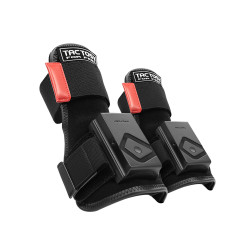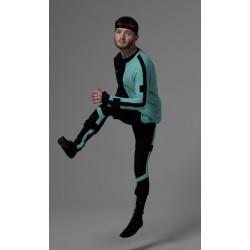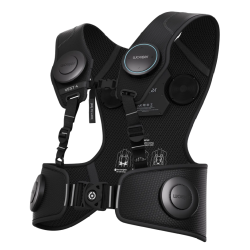
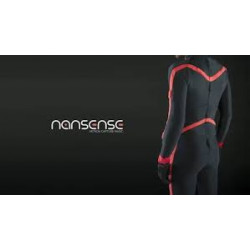
NANSENSE R2 Suits are professional, inertial full-body motion capture systems—or mocap for short. Sensors located on the suit measure the orientation of individual body parts, and NANSENSE Studio software transforms the data into a digital skeleton animation.
The system requires no optical cameras, markers, or a dedicated studio. It can operate wirelessly or wired, indoors or outdoors. Three configurations are available: Indie, Pro, and BioMed, differing in the number of physical sensors and the accuracy of the representation of individual body segments.
NANSENSE R2 Suits are professional, inertial full-body motion capture systems—or mocap for short. Sensors located on the suit measure the orientation of individual body parts, and NANSENSE Studio software transforms the data into a digital skeleton animation.
The system requires no optical cameras, markers, or a dedicated studio. It can operate wirelessly or wired, indoors or outdoors. Three configurations are available: Indie, Pro, and BioMed, differing in the number of physical sensors and the accuracy of the representation of individual body segments.
Operation
Each R2 sensor contains: a gyroscope, an accelerometer, and a magnetometer.
Based on the data from these components, the system determines the orientation of body segments. The software then uses the skeletal model, kinematics, and physical simulation to interpret gait, running, jumping, sitting, foot contact, and height changes.
This is an inertial system, so there's no problem with markers being obscured by other people or objects, which is typical of optical systems. At the same time, the system doesn't measure the actor's absolute position as precisely as a properly configured camera studio. The manufacturer explicitly mentions the possibility of positional drift, which must be compensated for in software or mitigated using additional trackers.
Available Configurations
NANSENSE R2 Indie
The basic version is designed for independent creators, small studios, and educational institutions.
15 R2 sensors on the body,
the remaining motion segments are partially calculated kinematically,
the set includes a suit, hub, 15 sensors, a battery, and a router.
When connected to the Indie gloves, the system utilizes a total of 29 sensors.
Best Uses: Motion Capture training, game prototyping, basic character animation, simple VR projects, and research that does not require a large number of independently measured segments.
NANSENSE R2 Pro
The production version is primarily designed for professional animators, game studios, film, and television.
18 R2 sensors on the body,
more detailed motion representation than the Indie version.
the set includes a suit, hub, 18 sensors, a battery, and a router.
When connected to the Pro gloves, the system utilizes a total of 40 sensors. Best Use: Animation production, pre-visualization, real-time character animation, games, films, broadcasts, and digital avatars.
NANSENSE R2 BioMed
The most advanced version, focused on biomechanics, ergonomics, sports, and motion studies.
22 R2 sensors on the body,
extended spine and shoulder girdle motion measurement,
the set includes a suit, hub, 22 sensors, a battery, and a router.
When connected to BioMed gloves, the system utilizes a total of 50 sensors.
Best Use: Research laboratories, biomechanics, workplace ergonomics, sports analysis, artificial intelligence, and robotics research.
The manufacturer emphasizes, however, that the system is not a medical device. Therefore, it should not be considered certified diagnostic equipment or used alone for clinical decision-making.
Technical Specifications
Data Transmission:
Wireless latency: approximately 30 ms,
Wired latency: approximately 10 ms,
Communication: 2.4 GHz, 5 GHz or wired,
Wireless range indoors: up to 45 m,
Wireless range outdoors: up to 90 m,
Internal hardware operating frequency: 1000 Hz,
Supported software output frequencies: 24, 30, 60, 90, 120, and 240 fps.
Sensor parameters:
Declared dynamic error: 2.5°,
Declared static error: 1.5°,
Error in stationary mode: 0° per manufacturer's specifications,
Gyroscope range: ±2000°/s,
Accelerometer range: ±16 g,
Magnetic range for roll and pitch: ±1250 µT,
Magnetic range for the directional axis: ±2500 µT,
Magnetometer resolution: 0.25 µT.
The above values are manufacturer-declared parameters. I did not find an independent validation report on the product page confirming accuracy for all motion types and environments.
R2 and R2m Sensors
R2 sensor dimensions: 12 × 30 × 5 mm,
R2m sensor dimensions: 11 × 25 × 5 mm,
R2 power consumption: 16 mAh,
R2m power consumption: 10 mAh.
R2m sensors are a smaller version used primarily in finger tracking gloves.
Processing Hub
Processor: Quad-core 64-bit ARM,
Five data chains,
Maximum 60 sensors in total,
Maximum 17 sensors in a single chain,
Data logger: 128 GB,
Two USB-A ports,
Power supply: 5 V/2 A,
Built-in timecode generator,
Compatible with LTC synchronization,
Dimensions: 100 × 75 × 25 mm,
Weight: 210 g.
LTC — Linear Timecode is a timecode standard used to synchronize motion capture footage with cameras, audio, or other recording systems.
Battery
Capacity: 13,000 mAh,
Output voltage and current: 5 V/2 A,
Weight: 255 g.
Claimed operating time:
Indie Suit: up to 14 hours,
Pro Suit: up to 12 hours,
BioMed Suit: up to 10 hours,
Indie with gloves: up to 8 hours,
Pro with gloves: up to 7 hours,
BioMed with gloves: up to 6 hours.
Actual operating time may vary depending on battery status, number of sensors, transmission method, and usage conditions.
Suit:
Flexible technical clothing,
Sensors embedded in memory foam elements,
Three sizes: S, M, and L,
Designed to allow for freedom of movement,
The system is delivered in a protective Pelican case.
The lack of a larger size range may require particularly careful user adjustment. Improper sensor positioning relative to body segments may compromise data quality.
NANSENSE R2 Suits are professional, inertial full-body motion capture systems—or mocap for short. Sensors located on the suit measure the orientation of individual body parts, and NANSENSE Studio software transforms the data into a digital skeleton animation.
The system requires no optical cameras, markers, or a dedicated studio. It can operate wirelessly or wired, indoors or outdoors. Three configurations are available: Indie, Pro, and BioMed, differing in the number of physical sensors and the accuracy of the representation of individual body segments.