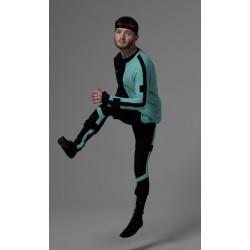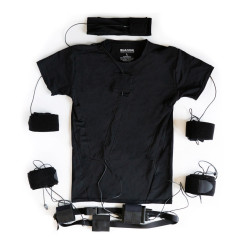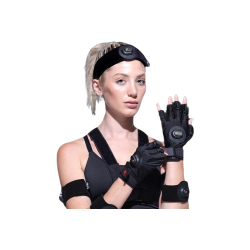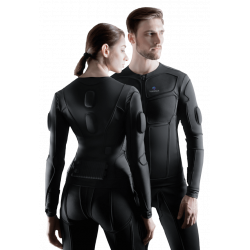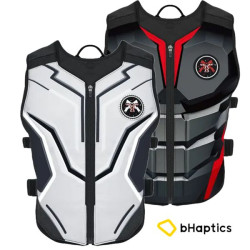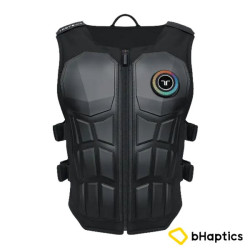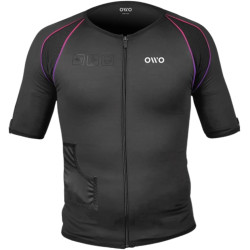
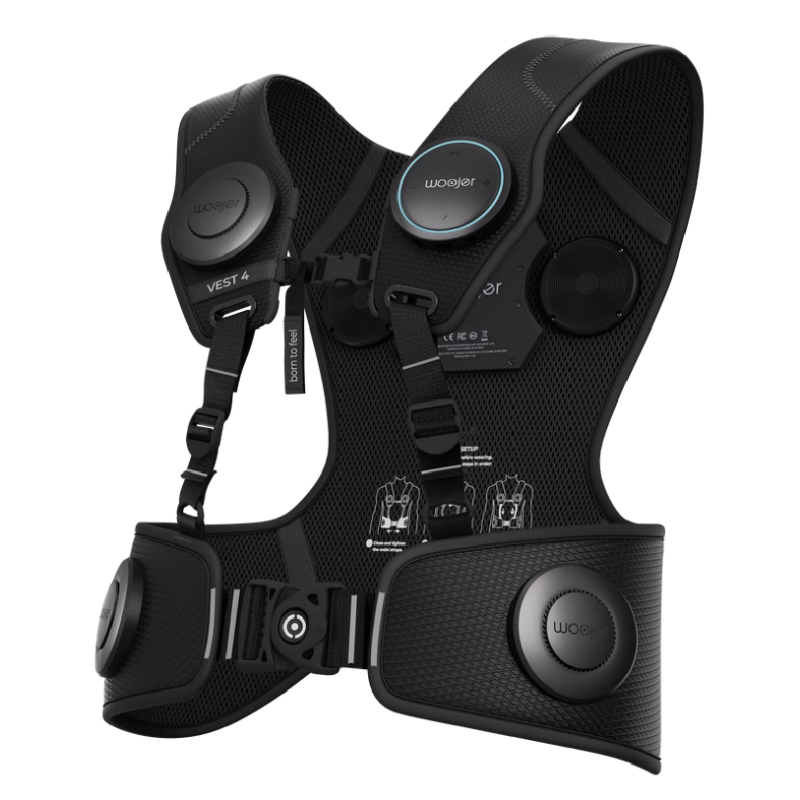
The Woojer Vest 4 is a wireless haptic vest that converts low-frequency sound into vibrations and impulses felt on the body. Six independent transducers located on the front and back of the vest allow you to physically feel explosions, impacts, engine sounds, music rhythms, and other sound effects.
The device requires no specially developed games or additional software – it analyzes audio signals transmitted via Bluetooth, USB-C, or a 3.5mm cable. It can be used with computers, consoles, smartphones, VR headsets, TVs, and both wired and wireless headphones.
Woojer Vest 4 – Haptic Vest for Gaming, VR, Movies, and Music
The Woojer Vest 4 is a wireless haptic vest that converts low-frequency sound into vibrations and impulses felt on the body. Six independent transducers located on the front and back of the vest allow you to physically feel explosions, impacts, engine sounds, music rhythms, and other sound effects.
The device requires no specially developed games or additional software – it analyzes audio signals transmitted via Bluetooth, USB-C, or a 3.5mm cable. It can be used with computers, consoles, smartphones, VR headsets, TVs, and both wired and wireless headphones.
Technical Specifications
Device Type: Audio-based haptic vest
Number of haptic zones: 6
Transducers: Six patented Woojer Osci™ TRX2 transducers
Haptic frequency range: 1–250 Hz
Operating modes: Multi-channel and stereo
Signal processing: Digital signal processing (DSP)
Haptic intensity adjustment: Directly on the vest
Volume control: Control panel integrated into the device
Wireless connectivity: Dual Bluetooth 5.0, transmitter and receiver
Bluetooth headphone support: Yes
Analog input: 3.5 mm
Digital audio input: USB-C
Headphone output: 3.5 mm
Built-in headphone amplifier: Yes
Operating time: Up to 10 hours on a single charge
Charging: USB-C with Power Delivery fast charging support
Size: Universal, declared range: S–XXL
Fit: Elastic adjustment straps
Material: Breathable material suitable for active use
Design: ergonomic, designed for use in both standing and sitting positions
Additional control: app for customizing profiles and activity intensity
Compatibility and Operation
The Woojer Vest 4 can receive audio from the source device via:
Bluetooth,
3.5mm audio cable,
USB-C digital connection.
The vest analyzes the audio signal and transmits selected, primarily low-frequency sounds to the haptic transducers. This means it doesn't reproduce specific, programmed in-game hit points, but rather reacts to sound. In practice, a loud explosion, gunshot, or powerful bass will cause correspondingly strong vibrations.
The manufacturer claims compatibility with most standard audio sources, including computers, mobile devices, and Meta Quest headsets. For the Meta Quest, you can connect the headset's headphone output to the vest's input and then connect your headphones to the Woojer output.
For applications requiring the lowest possible latency, such as online games, rhythm games, or simulations, the manufacturer recommends a wired connection over Bluetooth.
Who is the Woojer Vest 4 for?
PC and console gamers
The vest is primarily designed for those who want to enhance immersion in games. The most noticeable effect can be achieved in:
shooters,
action games,
horror games,
flight and driving simulators,
music games,
productions with intense soundtracks.
Players can experience explosions, gunfire, impacts, engine noise, or the bass accompanying music, among other things.
VR users
The Woojer Vest 4 can complement a virtual reality headset with a physical sound experience. This solution can be particularly useful in VR games, simulators, training applications, and immersive presentations.
However, it's important to remember that this is an audio-based haptic, not a full system that localizes hits to a specific body location.
Music lovers
The vest allows for the physical sensation of rhythm and low frequencies. The best results are typically achieved with music with pronounced bass, such as:
electronic music,
hip-hop,
rock and metal,
film music,
concerts and live recordings.
Movie viewers
The Woojer Vest 4 can amplify special effects, music, and action scenes. The solution works similarly to a personal bass system, eliminating the need for a large subwoofer in the room.
VR centers, arcades, and product presentations
The vest can be used as an additional element at demo stations, events, technology shows, and paid VR experiences. Its advantage is that it can operate without the need for special integration with a specific application.
Audio creators and producers
The manufacturer also recommends studio applications involving physical monitoring of low frequencies. The vest can be used as an auxiliary device, but should not replace professional monitors, a subwoofer, or acoustic measurements.
Advantages
1. Significantly Increased Immersion
The physical sensation of bass, explosions, and sound effects can significantly enhance games, movies, music, and VR experiences.
2. Six Independent Transducers
The vest covers a larger area of the body than small haptic devices mounted solely on the chest or waist. Six transducers positioned around the torso create a wider field of action.
3. No Game-Specific Control Required
The Woojer Vest 4 operates based on audio, so it doesn't require a built-in haptic system or special modifications.
4. Broad Compatibility
Bluetooth, USB-C, and 3.5mm cable support allow you to use the vest with multiple devices and headphones.
5. Bluetooth Headset Support
Dual Bluetooth allows you to simultaneously receive and transmit audio signals to compatible wireless headphones.
6. Long battery life
The claimed battery life of up to 10 hours should be sufficient for a longer gaming, movie-watching, or VR session. Actual battery life may depend on the haptic intensity, volume, and connection method.
7. Adjustable intensity
The user can reduce or increase the intensity of the impulses, adapting the device to the type of content and their own sensitivity.
8. Portability
The vest does not require speakers or a subwoofer and can be used in a variety of locations, including where loud bass would disturb others.
Disadvantages and limitations
1. Haptics are dependent on sound
The most important limitation is the lack of direct feedback from the game engine. The vest responds to audio signals, meaning it can interpret various events generating similar frequencies similarly.
It should not be confused with advanced haptic systems that can precisely pinpoint impact location, projectile direction, temperature, or pressure.
2. Possibility of perceiving unwanted elements of the audio track
High-pitched background music can cause intense vibrations even when the user primarily wants to experience action-related effects. In some games, lowering the music volume in the settings may help.
3. Bluetooth connection delays
Wireless connectivity can introduce a delay between image, sound, and the vest's response. Therefore, a wired connection is better for rhythm games, online competitions, and simulations.
4. One size doesn't guarantee a perfect fit
The manufacturer claims a range of sizes from S to XXL, but one design doesn't necessarily fit every body shape perfectly. A proper fit is important because the transducers should remain close to the body.
5. Possible discomfort during long sessions
Despite the use of breathable materials, the vest remains an additional layer worn on the torso. During intense VR gaming, it may increase the feeling of heat, pressure, or fatigue.
6. Limited value in quiet content
In strategy games, office applications, quiet movies, or music with little low-frequency content, the effect may be less noticeable.
The Woojer Vest 4 is a wireless haptic vest that converts low-frequency sound into vibrations and impulses felt on the body. Six independent transducers located on the front and back of the vest allow you to physically feel explosions, impacts, engine sounds, music rhythms, and other sound effects.
The device requires no specially developed games or additional software – it analyzes audio signals transmitted via Bluetooth, USB-C, or a 3.5mm cable. It can be used with computers, consoles, smartphones, VR headsets, TVs, and both wired and wireless headphones.