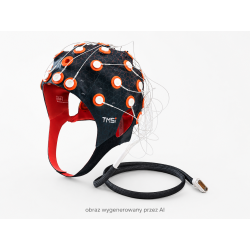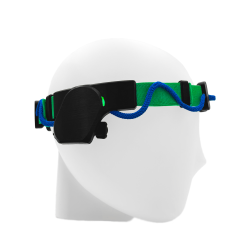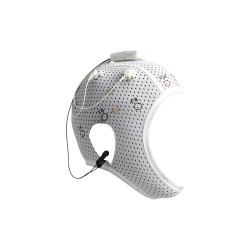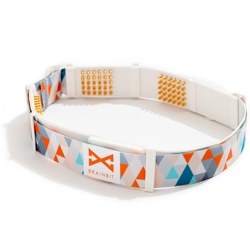
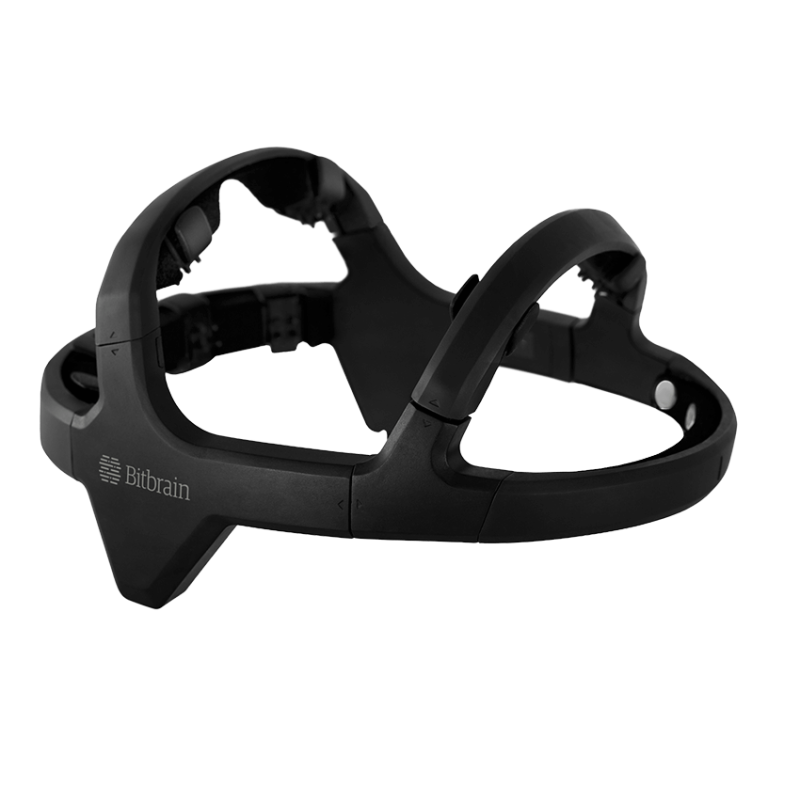
The Bitbrain Diadem 12ch EEG is a lightweight, mobile EEG system designed for conducting brain activity studies, with a particular emphasis on cognitive and emotional states. The device's design allows for measurements to be conducted both in the laboratory and in more natural research settings.
Electrode technology: Dry EEG electrodes, requiring no electrolyte gel, conductive pastes, or saline solutions.
Number of EEG channels: 12 EEG measurement channels plus a REF reference electrode and a GND ground electrode.
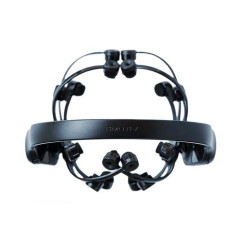
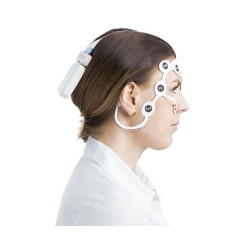
Bitbrain Diadem 12ch EEG.
Device type: Portable, wireless EEG system using dry electrodes to record electrical brain activity.
The Bitbrain Diadem 12ch EEG is a lightweight, mobile EEG system designed for conducting brain activity studies, with a particular emphasis on cognitive and emotional states. The device's design allows for measurements to be conducted both in the laboratory and in more natural research settings.
Electrode technology: Dry EEG electrodes, requiring no electrolyte gel, conductive pastes, or saline solutions.
Number of EEG channels: 12 EEG measurement channels plus a REF reference electrode and a GND ground electrode.
Electrode placement: AF7, Fp1, Fp2, AF8, F3, F4, P3, P4, PO7, O1, O2, and PO8, according to the international 10-10 EEG electrode placement system.
Measurement areas: prefrontal, frontal, parietal, and occipital regions of the brain.
Design: Adjustable headset for custom fit to the subject's head shape and hair volume.
Head circumference range: 530–610 mm, according to the manufacturer's current technical data sheet.
Signal quality enhancement technology: Active electrode shielding and an optimized DRL [Driven Right Leg] circuit, designed to increase the SNR [Signal-to-Noise Ratio] and reduce interference.
Sampling rate: 256 SPS [samples per second].
Transducer resolution: 24 bits.
Signal bandwidth: DC–40 Hz, third-order low-pass filter.
Electrode contact quality control: Real-time control of the relative electrode contact impedance.
Input range: ±100 mV.
Noise level: Less than 1 µVRMS from 0.5–30 Hz at 256 Hz sampling.
CMRR [Common-Mode Rejection Ratio]: Greater than 100 dB at 50 Hz.
Input impedance: Greater than 50 GΩ.
Built-in motion sensor: 9-axis IMU [Inertial Measurement Unit], including an accelerometer, gyroscope, and magnetometer.
Additional inputs: 1 1-bit digital input and an optical tag/photodiode input.
Wireless communication: Bluetooth 2.1 + EDR.
Declared Bluetooth transmission range: up to 10 m with direct line of sight between devices.
Data logging: Ability to wirelessly transfer data to a computer and save a copy of the data locally to a microSD card.
Local storage: Removable microSD card, up to 8 GB, Class 10 or higher.
Data export formats: CSV and EDF [European Data Format].
Synchronization with other devices: The system can work with other Bitbrain devices and external solutions via LSL [Lab Streaming Layer].
Power supply: Built-in rechargeable lithium-polymer battery.
Charging time: Less than 3 hours according to the current technical data sheet.
Operating time: The manufacturer states over 6 hours of operation in the current technical parameters table. Due to varying operating time values in the manufacturer's documentation, this parameter should be confirmed when submitting a formal offer or responding to a request for quotation.
EEG amplifier weight: approximately 120 g, according to the current product brochure.
Certification: CE marked; the manufacturer indicates compliance with the requirements of the 2014/53/EU Radio Equipment Directive.
Basic software: Bitbrain SennsLite – supplied with the device and intended for configuration, visualization, and recording of raw EEG data.
SennsLite features: real-time EEG signal preview, electrode contact quality control, recording configuration, data logging, user-defined marker support, Bitbrain device synchronization, and interoperability with external systems via LSL.
Required software for standard device operation: Bitbrain SennsLite. The software is provided by the manufacturer with the hardware and does not require the purchase of an additional license for basic data acquisition.
Current SennsLite system requirements: Windows 10 64-bit or later or Linux Ubuntu 22.04; 6th generation Intel Core i5 processor or later; minimum 8 GB of RAM; minimum 1 GB of free disk space, and a suitable Bluetooth adapter.
Bitbrain SDK: A software development kit provided as part of the Bitbrain core environment, enabling direct device configuration and data acquisition control from custom applications. The SDK can be used with Python, among other programs, and is available for Windows and Linux.
Integration with external software: LSL supports integration with BCI2000, OpenViBE, NeuroPype, and Medusa, among others.
Data analysis: Data exported from the device can be analyzed using Python/MNE and MATLAB environments, including tools such as EEGLAB, FieldTrip, or BCILAB.
Bitbrain SennsLab – optional: licensed software that expands the system's capabilities with experimental design, synchronized data acquisition, and integration of over 35 sensor types and measurement modalities, including EEG, eye tracking, and biosignals.
Bitbrain SennsMetrics – optional: licensed software for processing, analyzing, and visualizing results, as well as determining selected cognitive, emotional, and behavioral parameters.
Primary purpose: conducting scientific and experimental research related to the analysis of brain activity and the assessment of cognitive and emotional states.
Cognitive research: the system can be used to study attention, cognitive load, response to stimuli, and other cognitive processes, among other things.
Emotional research: the design and electrode placement are optimized for studies utilizing alpha asymmetry in frontal regions, among other things.
EEG/ERP research: the manufacturer indicates that the electrode placement can be used for studies of occipital alpha ERD/ERS, as well as potentials and components such as P300, N400, and CVN.
Behavioral research in natural settings: the device's portable design allows for the study of user responses outside of a traditional laboratory setting, for example, during specific activities or interactions with the environment.
Workplace research: the device can be used to study cognitive load, attention, and stress during task performance in a real or near-real work environment.
Marketing research and consumer neuroscience: Ability to analyze user responses to marketing materials, communications, products, interfaces, and new experiences.
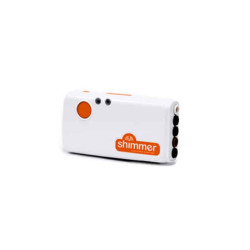
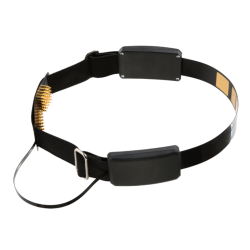
Multimodal research: The diadem can be synchronized with eye trackers, GSR (Galvanic Skin Response), BVP (Blood Volume Pulse), ECG/EKG, EMG, and other biosensors.
BCI research: The device can be used in Brain-Computer Interface projects, including research on neurorehabilitation and human-computer interaction.
Device nature: Research device, not medical. The manufacturer expressly states that Bitbrain hardware is not intended to diagnose, treat, mitigate, or prevent disease.
The Bitbrain Diadem 12ch EEG is a lightweight, mobile EEG system designed for conducting brain activity studies, with a particular emphasis on cognitive and emotional states. The device's design allows for measurements to be conducted both in the laboratory and in more natural research settings.
Electrode technology: Dry EEG electrodes, requiring no electrolyte gel, conductive pastes, or saline solutions.
Number of EEG channels: 12 EEG measurement channels plus a REF reference electrode and a GND ground electrode.