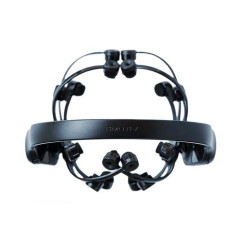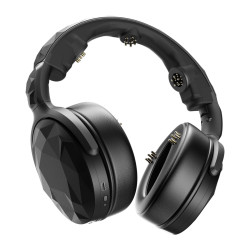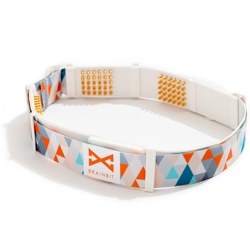
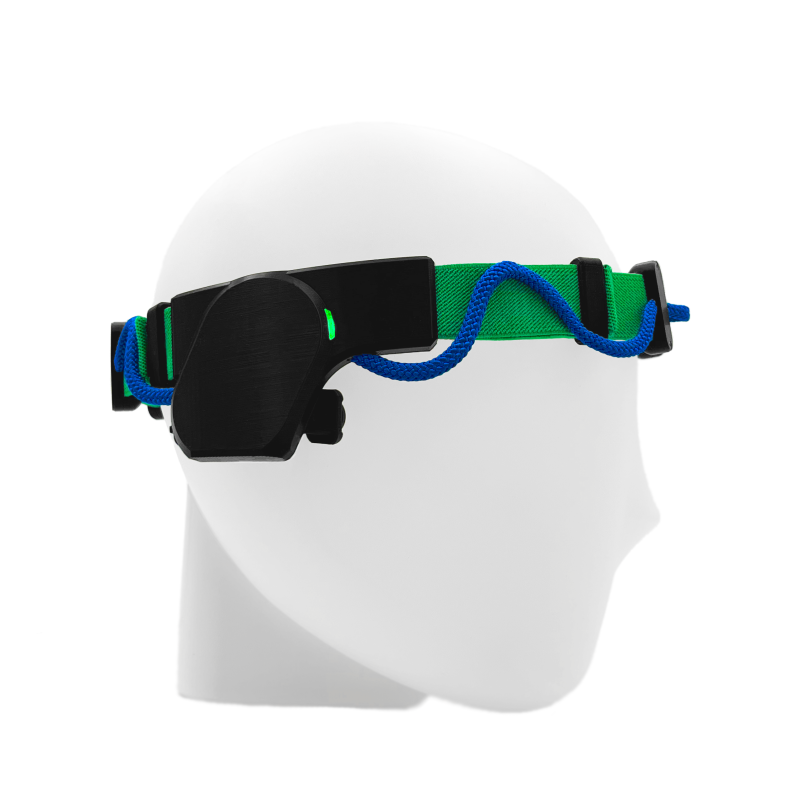
The MindRove Bright is a compact, wireless EEG system designed for recording electrical brain activity for research, neurofeedback, and neuromarketing applications.
The device provides the user with raw EEG data, allowing it to be analyzed using both the manufacturer's software and proprietary research applications.
Bright utilizes four EEG measurement channels distributed across the frontal and occipital regions: Fp1, Fp2, O1, and O2.
The MindRove Bright is a compact, wireless EEG system designed for recording electrical brain activity for research, neurofeedback, and neuromarketing applications.
The device provides the user with raw EEG data, allowing it to be analyzed using both the manufacturer's software and proprietary research applications.
Bright utilizes four EEG measurement channels distributed across the frontal and occipital regions: Fp1, Fp2, O1, and O2.
In addition to the four measurement electrodes, the device utilizes a TP10 reference electrode and a TP9 DRL/bias electrode—hence the manufacturer's 4+2 configuration designation.
The electrodes are replaceable, flexible, and do not require the use of traditional EEG gel.
The manufacturer's current product data sheet describes them as dry polymer electrodes with an Ag/AgCl coating; on the Bright homepage, the manufacturer also uses the term "semi-dry." In both cases, the manufacturer clearly states that no gel is required for their use. A built-in electrode contact quality control system allows you to assess the correct connection of the electrodes to the skin before and during the measurement.
Data is transmitted wirelessly to a computer via Wi-Fi Direct.
The device also features a 6-axis IMU module that records head movements.
The set comes with an adjustable, elastic strap that allows the device to fit the user's head.
Bright is a research device and is not intended by the manufacturer to diagnose, treat, prevent, or cure any disease.
Technical Specifications
Number of EEG measurement channels: 4.
Electrode configuration: 4+2.
EEG measurement electrodes: Fp1, Fp2, O1, O2.
Reference electrode: TP10 – behind the right ear.
DRL/bias electrode: TP9 – behind the left ear.
Electrode type: dry/semi-dry, flexible polymer electrodes with Ag/AgCl coating.
Electrodes: replaceable.
EEG gel: not required.
Electrode contact quality monitoring: yes.
EEG sampling rate: 500 SPS / 500 Hz.
Transducer resolution: 24 bit.
EEG signal bandwidth: 0–250 Hz.
Signal amplification: 12×.
Access to raw EEG data: yes.
Trigger/event marker support: yes.
Motion Sensors
Built-in IMU: 6-axis.
Gyroscope: 3-axis.
Accelerometer: 3-axis.
Gyroscope Range: ±500°/s.
Accelerometer Range: ±2 g.
IMU Sampling Rate: 50 Hz.
Access to Raw IMU Data: Yes.
The IMU can be used, among other things, to identify head movements and facilitate the detection of motion artifacts in recorded footage.
Connectivity and Power
Data Transmission: Wireless.
Communication Interface: Wi-Fi Direct.
Battery: Built-in, rechargeable Li-Po.
Stated Operating Time: Up to approximately 6 hours; the manufacturer states a range of 4–6 hours on the detailed technical page.
Charging Port: MicroUSB.
Adjustable Elastic Strap.
Software Required for Operation
No specific programming environment is required to use MindRove Bright – the method of operation depends on the device's intended use.
For standard visualization and data recording on a computer, the manufacturer provides the MindRove Connect application.
MindRove Connect allows for real-time display and recording of EEG signals.
MindRove Connect is currently available for Windows and macOS.
The manufacturer also provides an Android application that allows for viewing EEG/EMG data in real time, recording data on a mobile device, and adding event markers.
The older Visualizer on Desktop software is currently marked as deprecated by the manufacturer. The manufacturer also indicates that it is not compatible with devices received after May 5, 2025. Therefore, for new devices, MindRove Connect should be used as the primary desktop application.
MindRove SDK
For research, integration, and custom software development, the manufacturer provides the MindRove SDK – Software Development Kit, a set of libraries and programming tools that allow direct communication with the device and processing its data.
The SDK provides access to data from MindRove devices and functions for processing and analyzing them.
Supported systems: Windows, macOS, and Linux.
Supported programming languages and environments:
C++,
C#,
Python,
MATLAB.
The SDK allows, among other things, starting and stopping data streams, reading EEG data, processing signals, and controlling device modes.
The manufacturer provides ready-made integration examples and APIs.
Integration with Unity, Unreal Engine, and CryEngine is also available, enabling the creation of experimental BCI interfaces, interactive applications, and research environments.
For Python, the MindRove library can be installed as the mindrove package.
The SDK also supports signal processing functions independent of the device itself.
Integration with Other Software
MindRove Bright supports Lab Streaming Layer (LSL).
LSL is a software standard for transmitting and synchronizing real-time measurement data streams.
Using LSL, EEG data from MindRove can be transferred to other research applications that support this standard.
This allows for combining EEG data, for example, with other biosensors, stimulus presentation systems, or software designed for psychophysiological experiments.
For more complex research setups, the manufacturer offers the optional MindRove SyncBox, which allows synchronization of up to four MindRove EEG/EMG devices and integration with external devices.
The SyncBox also allows for the transmission and reception of physical +3.3V trigger signals.
Purpose
EEG research.
Brain activity studies in frontal and occipital regions.
Neurofeedback.
Neuromarketing.
Psychophysiological experiments.
Research on user response to visual stimuli and other experimental events.
Creation of prototype BCIs (Brain-Computer Interfaces).
Scientific and educational projects related to EEG signal analysis.
Development of proprietary algorithms for EEG signal analysis and classification.
Projects utilizing EEG and head movement data simultaneously.
Integration of EEG with other sensors and research systems via LSL or the optional SyncBox.
Creation of experimental and interactive applications using live EEG data.
Extended version available.
The manufacturer also offers the MindRove Bright-H variant.
Bright-H retains the EEG functionality of the Bright model but also features a frontal PPG sensor (photoplethysmography). The user gains access to the raw PPG signal.
Based on this, it is possible to calculate parameters such as heart rate, HRV (Heart Rate Variability), and SpO₂.
The standard Bright focuses on EEG recording and does not have this additional optical function.
Limitations
The MindRove Bright only has four actual EEG channels, so it does not replace multi-channel EEG systems used for detailed mapping of activity across the entire head.
Electrode placement is focused on the frontal and occipital regions.
The Bright version does not have central channels; the manufacturer offers the Lucid and Vision models for such applications, which have a correspondingly higher number of electrodes.
The manufacturer does not classify the device as a system intended for the diagnosis or treatment of diseases.
For applications requiring tight synchronization of multiple devices or external hardware triggers, the optional SyncBox may be required.
The MindRove Bright is a compact, wireless EEG system designed for recording electrical brain activity for research, neurofeedback, and neuromarketing applications.
The device provides the user with raw EEG data, allowing it to be analyzed using both the manufacturer's software and proprietary research applications.
Bright utilizes four EEG measurement channels distributed across the frontal and occipital regions: Fp1, Fp2, O1, and O2.