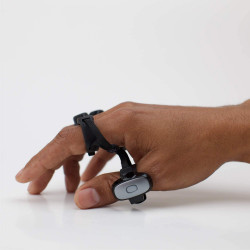
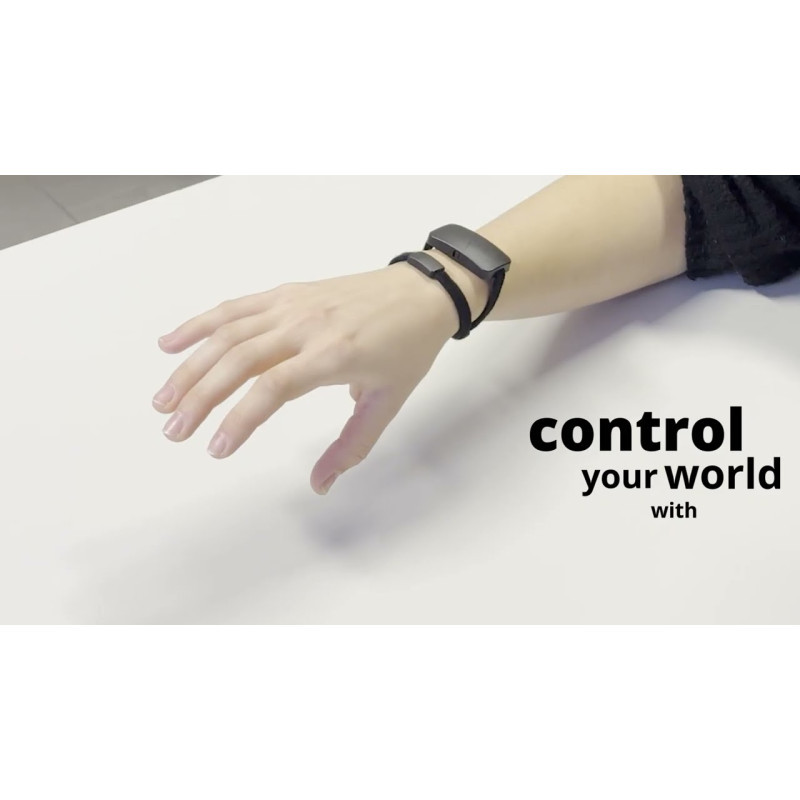
The MindRove Snaptic Beta Kit is a compact wrist-worn wearable device designed primarily for gesture recognition and creating new ways to control electronic devices.
The system is based on motion sensor technology and utilizes two independent IMU (Inertial Measurement Unit) modules to analyze hand and wrist movements.
The two motion sensors are arranged so that the system can recognize both larger hand movements and more subtle movements made with the wrist itself.
The MindRove Snaptic Beta Kit is a compact wrist-worn wearable device designed primarily for gesture recognition and creating new ways to control electronic devices.
The system is based on motion sensor technology and utilizes two independent IMU (Inertial Measurement Unit) modules to analyze hand and wrist movements.
The two motion sensors are arranged so that the system can recognize both larger hand movements and more subtle movements made with the wrist itself.
Snaptic enables the creation of natural HCI (Human-Computer Interaction) gesture interfaces without the need for a traditional mouse, controller, or touchscreen.
The device also includes a PPG (Photoplethysmography) sensor, enabling the acquisition of data related to heart rate (HR) and SpO₂ saturation.
Data transmission between the device and the computer is achieved via Bluetooth Low Energy (BLE). The manufacturer targets Snaptic primarily at developers, designers, research and development teams, and creators of prototypes for new user interfaces.
The product is currently offered as a Beta Kit, an early access kit also intended for testing and co-creating further development of the solution.
The manufacturer describes Snaptic as a solution particularly interesting for new AR, XR, and AI-powered glasses interfaces, where traditional controllers can be replaced with hand and wrist gestures.
The Snaptic is a patent-pending device.
Specifications
Device type: Wearable gesture controller.
Use location: Wrist and hand.
Basic technology: Motion detection.
Number of motion sensors: 2.
Sensor configuration: Dual IMU system.
Motion data provided via SDK: Data from the accelerometers and gyroscopes of both IMU modules.
Accelerometer: Measurement in the X, Y, and Z axes for both modules.
Gyroscope: Measurement in the X, Y, and Z axes for both modules.
Additional sensor: PPG – photoplethysmographic optical sensor.
Monitored PPG parameters: HR – heart rate and SpO₂ – blood oxygen saturation.
PPG data access: The SDK also allows for receiving raw SpO₂ data.
Connectivity: Bluetooth Low Energy – BLE.
Control: Hand gestures, wrist gestures, and combinations of hand and wrist movements. User interface: Gesture Mapper and mouse cursor control.
Ability to define custom gestures: yes, via SDK.
Create your own applications: yes.
Product status: Beta / Early Access.
Solution type: Development and prototyping platform.
Software Required/Available for Operation
Snaptic SDK – the manufacturer's software development kit provides direct access to the device and sensor data streams.
The SDK enables device discovery, establishing a BLE connection, and receiving IMU and PPG/SpO₂ data.
The official SDK is available through the MindRove SnapticSDK repository.
The manufacturer's current SDK documentation indicates support for Windows 10 or later.
The Windows SDK can be used in applications using .NET 8 MAUI or the Windows App SDK (WinAppSDK).
The manufacturer provides the SnapticSDK.dll library for integrating the device with custom Windows applications.
The manufacturer's repository also includes a directory with Python examples, allowing you to use Snaptic in prototypes and applications using this programming language.
Gesture Mapper – software for assigning detected gestures to specific functions or actions.
Mouse Control – the ability to use gestures to control the cursor and mouse functions. The SDK allows developers to create their own applications and custom gestures, so Snaptic is not limited to pre-built features.
Purpose
Controlling computers and electronic devices using gestures;
Creating touchless user interfaces;
Designing new HCI (Human-Computer Interaction) methods;
Developing applications using hand and wrist movement recognition;
Controlling AR (Augmented Reality) applications;
Controlling XR (Extended Reality) environments (augmented reality encompassing AR/VR/MR technologies);
Creating interfaces for smart glasses and AI glasses;
Prototyping gesture controllers;
Controlling presentations, multimedia, and interactive applications;
Developing interfaces for Smart Home systems and other smart devices;
R&D experiments on motion analysis;
Creating custom applications using IMU data;
Creating solutions requiring the simultaneous use of wrist and hand movement information;
Projects utilizing motion data and PPG sensor data simultaneously;
research and prototyping of new wearable devices.
Advantages
Two independent motion sensors, providing more information about movement than a single sensor placed solely on the wrist;
Ability to also detect movements performed primarily or exclusively with the wrist;
Simultaneous analysis of hand and wrist motion, enabling the development of more complex and natural gestures;
Built-in accelerometers and gyroscopes enabling detailed multi-axis movement analysis;
An additional PPG sensor extends the device to acquire HR and SpO₂ data;
Bluetooth Low Energy wireless communication, facilitating the use of the device in mobile applications and prototypes;
Pre-built Gesture Mapper simplifies the creation of gesture controls;
The device can be used as a mouse controller;
Access to the SDK, allowing developers to not be limited to pre-defined functions;
Ability to create custom gestures and applications;
Access to raw sensor data, enabling the development of custom motion recognition algorithms;
Compact, wearable design;
A particularly interesting solution for rapid prototyping of AR/XR interfaces, device control, and touchless interaction;
The ability to test alternative control methods without the need for optical hand tracking cameras;
This product is aimed directly at developers, allowing for further integration and expansion.
Important Information
Snaptic is currently a Beta product, so it should be considered primarily a development, test, and prototype platform, not a mature consumer controller with closed and unchangeable specifications.
The manufacturer does not currently publish a full table of technical parameters on the Snaptic website, including IMU sampling rate, accelerometer and gyroscope ranges, battery capacity, operating time, exact dimensions, and device weight. Therefore, these parameters should not be declared without additional manufacturer confirmation.
Snaptic utilizes motion and PPG sensors; it is not an EMG or EEG system.
The manufacturer stipulates that MindRove devices are not intended to diagnose, treat, or prevent disease.
The MindRove Snaptic Beta Kit is a compact wrist-worn wearable device designed primarily for gesture recognition and creating new ways to control electronic devices.
The system is based on motion sensor technology and utilizes two independent IMU (Inertial Measurement Unit) modules to analyze hand and wrist movements.
The two motion sensors are arranged so that the system can recognize both larger hand movements and more subtle movements made with the wrist itself.