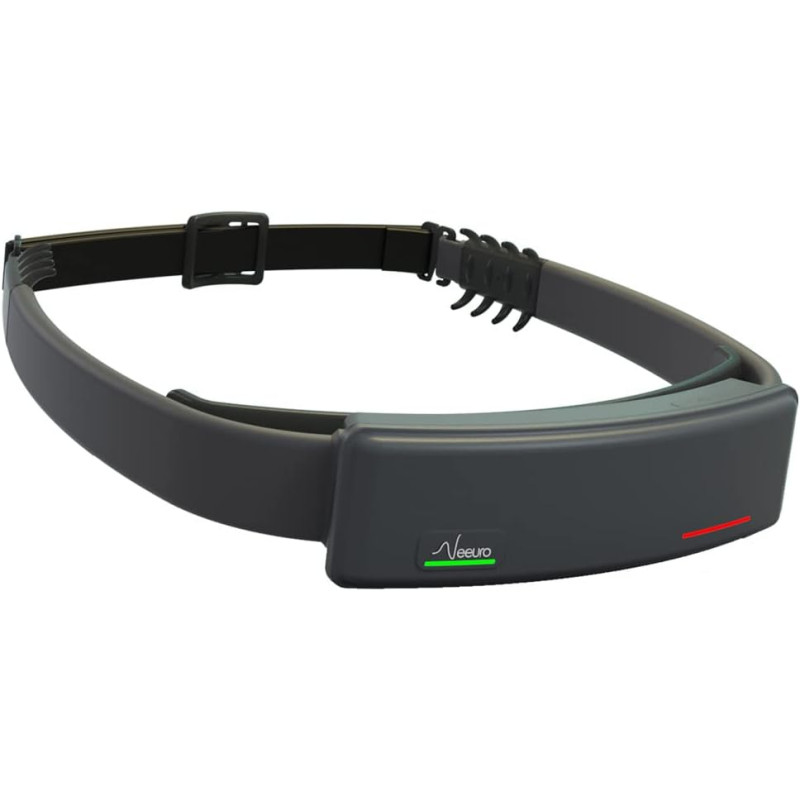
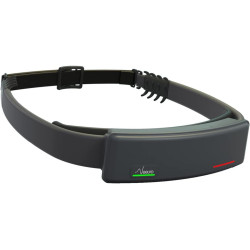
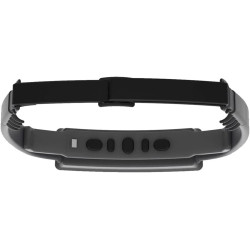
The Neeuro SenzeBand 2 is a portable, wireless EEG (Electroencephalography) headband designed to record electrical brain activity and convert it into information about the user's cognitive state. The device is compatible with the NeeuroOS platform and the manufacturer's applications using neurofeedback and BCI (Brain-Computer Interface).
The SenzeBand 2 uses seven dry EEG electrodes, five of which are located in the frontal region and two in the temporal region.
Neeuro SenzeBand 2 EEG Headset
The Neeuro SenzeBand 2 is a portable, wireless EEG (Electroencephalography) headband designed to record electrical brain activity and convert it into information about the user's cognitive state. The device is compatible with the NeeuroOS platform and the manufacturer's applications using neurofeedback and BCI (Brain-Computer Interface).
The SenzeBand 2 uses seven dry EEG electrodes, five of which are located in the frontal region and two in the temporal region.
The system measures EEG in four channels: Fp1, Fp2, T3, and T4.
The reference electrode is located at Fpz.
The temporal sensors are designed to more effectively contact the skin through the hair.
The device can analyze, among other things, levels of attention, relaxation, and mental workload. Neeuro's algorithms use machine learning to interpret EEG signals and transform them into specific mental states.
The SenzeBand 2 also features a PPG (Photoplethysmography) sensor, which allows for heart rate and blood oxygenation levels to be measured.
The integrated 9-axis motion system includes an accelerometer, gyroscope, and magnetometer.
Data is transmitted wirelessly via Bluetooth 5.0.
The band can be used with Neeuro apps and solutions created by third-party developers using the NeeuroOS SDK (Software Development Kit).
The device can be used for concentration training, cognitive training, mental state monitoring, relaxation, mindfulness, neurofeedback, education, and BCI projects, among other things.
The design is adjustable, and the manufacturer has also planned for the SenzeBand 2 to be used with other headgear, depending on its design. SenzeBand 2 is not a medical device and the manufacturer states that it should not be used to diagnose or treat any disease.
Technical Specifications
Product: SenzeBand 2.
Model Number: SB-02.
Type: Wireless EEG/BCI Headband.
Number of EEG Channels: 4.
Number of Electrodes: 7.
Forehead Electrodes: 5.
Temporal Electrodes: 2.
EEG Channels: Fp1, Fp2, T3, T4.
Reference Electrode: Fpz.
5-frontal electrode design: 2 EEG electrodes, 1 reference, and 2 bias.
Temporal Electrodes: 2 EEG electrodes.
Standard SenzeBand 2 Electrode Type: Dry, Proprietary Elastomeric Sensors.
Electrode Contact Control: Real-time impedance measurement/sensor contact control.
EEG Sampling Rate: 250 samples/s per channel.
EEG Resolution: 24-bit.
Declared voltage resolution: approximately 0.02235 µV.
Input range: ±187.5 mVpp.
PPG sensor
Technology: IR and red light.
Heart rate measurement: range 0–255 bpm.
SpO₂ measurement [Peripheral Oxygen Saturation]: 0–100%.
PPG sampling rate: 25 Hz.
Motion sensors
9-axis motion detection system.
Accelerometer: 3-axis.
Accelerometer range: ±2 g.
Gyroscope.
Magnetometer.
Head orientation information: Euler angles from -180° to +180°.
Recognized directions: N, S, E, W, NE, NW, SE, SW. Motion sampling rate: 100 Hz.
Connectivity
Bluetooth: Bluetooth 5.0.
Supported environments: iOS, Android, and Windows.
The manufacturer also claims integration via Unity and NeeuroOS.
Battery and power supply
Battery: Li-ion Polymer.
Battery voltage: 3.7 V.
Capacity: 320 mAh.
Maximum declared continuous operation time: up to 6 hours.
Charging time: approximately 2 hours.
Charging port: USB Type-C.
Power input: 5 V / 1 A.
Automatic shutdown after approximately 10 minutes of inactivity.
Dimensions and Design
Dimensions: approximately 17.9 x 15.1 x 3.1 cm.
Weight including battery: 88 g.
Adjustable elastic strap.
Strap adjustment range according to the catalog:
- Children: approximately 8.5–14.3 cm,
- Adults: approximately 14.0–25.3 cm.
Main module: polycarbonate + ABS.
Inner part of the wristband: silicone.
Sweat- and splash-resistant design.
The manufacturer does not provide a formal IP rating in the reviewed documentation, therefore the device should not be described as waterproof.
Indications:
Power and connection status LEDs,
Programmable LED Activity Indicator,
Option to visually display specific mental states using an LED.
Software Required for Operation
SenzeBand 2 is not tied to a single mandatory app. Depending on the application, it uses the Neeuro app or the NeeuroOS platform.
MindViewer
MindViewer is the most versatile tool for observing data generated by the SenzeBand.
View EEG activity,
Analysis of mental states,
Attention,
Relaxation,
Mental Workload,
Comparison of frequency bands:
Delta,
Theta,
Alpha,
Beta,
Gamma,
Track changes during various activities,
Save results for later analysis.
Memorie
a cognitive training app,
training attention,
memory,
decision-making,
spatial skills,
cognitive flexibility,
uses data from the SenzeBand to create an additional Brain Score.
The current Neeuro store states that the new SenzeBand 2 includes one year of access to the Memorie app and access to MindViewer.
Cogo
an attention training program,
using BCI and neurofeedback,
primarily aimed at children aged 6-12,
compatible with the SenzeBand 2.
Galini
a solution focused on stress management,
relaxation training,
mindfulness,
uses SenzeBand data to provide measurable biofeedback.
NeeuroOS
The NeeuroOS SDK platform is available for developers and integrators.
It provides access to, among other things, for:
raw EEG signals,
EEG frequency bands,
attention,
relaxation,
mental workload,
PPG data,
9-axis motion sensor data,
battery status,
device information,
Activity Indicator control.
Supported development environments:
Java – Android,
Objective-C – iOS,
C# – Windows,
C# / Unity – Android, iOS, and Windows.
Neeuro App System Requirements
For current Neeuro apps, the manufacturer specifies:
Bluetooth 5,
minimum 4 GB of RAM,
iOS 13.0 or later,
Android 8.0 or later,
for smartphones, a minimum 6-inch screen.
The manufacturer also notes that Android 11 and older versions of the system no longer receive official Google support and users may not receive all of the app's new features.
In the NeeuroOS developer documentation, requirements vary depending on the environment, for example:
Android: minimum Android 8,
iOS: minimum iOS 11,
Windows: Bluetooth-enabled computer,
Unity: Android, iOS, or Windows, as required by the SDK.
The Neeuro SenzeBand 2 is a portable, wireless EEG (Electroencephalography) headband designed to record electrical brain activity and convert it into information about the user's cognitive state. The device is compatible with the NeeuroOS platform and the manufacturer's applications using neurofeedback and BCI (Brain-Computer Interface).
The SenzeBand 2 uses seven dry EEG electrodes, five of which are located in the frontal region and two in the temporal region.