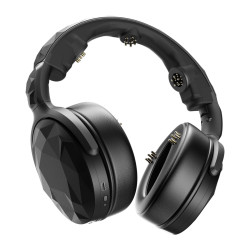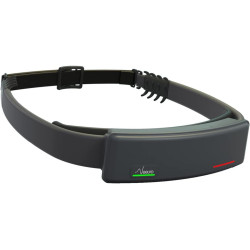
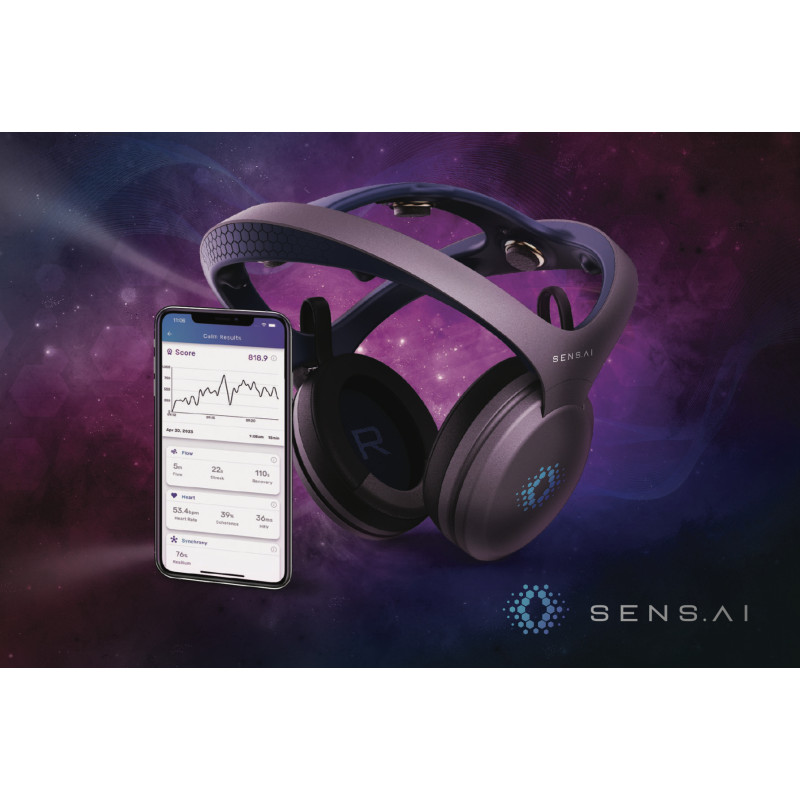
The Sens.ai Brain Training System is a personal cognitive training, neurofeedback, and physiological activity monitoring system developed by the Canadian company Sens.ai. The solution consists of a headset, a GeniusPulse controller, and the Sens.ai Brain Training mobile app. The system is designed for home use and—with the appropriate Professional subscription—for professional applications.
Sens.ai Brain Training System
The Sens.ai Brain Training System is a personal cognitive training, neurofeedback, and physiological activity monitoring system developed by the Canadian company Sens.ai. The solution consists of a headset, a GeniusPulse controller, and the Sens.ai Brain Training mobile app. The system is designed for home use and—with the appropriate Professional subscription—for professional applications.
Sens.ai combines several neurotechnologies in a single device: EEG (Electroencephalography), neurofeedback, HRV (Heart Rate Variability) and cardiac coherence training, tPBM (Transcranial Photobiomodulation) using near-infrared light, and ERP (Event-Related Potentials) testing.
Sensors located in the headset monitor brain activity and heart rate signals. The app analyzes this information and uses it to customize training sessions, light stimuli, and audio-visual feedback. Sens.ai offers three basic operating modes: Train, for training using neurofeedback; Boost, which utilizes photobiomodulation; and Assess, designed to assess selected functional parameters of brain information processing.
The manufacturer positions the solution as a wellness and personal development device, for training in concentration, calmness, stress resistance, sleep preparation, meditation, and cognitive performance, among other things. Sens.ai is not a medical device and is not intended to diagnose, treat, prevent, or cure diseases.
Technical Specifications
Device Type: Wireless neurofeedback and cognitive training system with a headset.
App Connectivity: Bluetooth, minimum BLE 4.2 [Bluetooth Low Energy 4.2] required.
Number of EEG Measurement Points: 3 patented electrodes positioned to measure the activity of specific neural network areas.
Analyzed EEG Frequency Range: 1–120 Hz, from delta waves to high gamma frequencies.
EEG Sampling: Up to 1000 samples/s.
Neurofeedback Latency: Manufacturer claims less than 200 ms.
Neurofeedback: Real-time feedback with adaptive adjustment of training thresholds to the user.
tPBM Photobiomodulation: 7 specialized LEDs.
tPBM Light Wavelength: 810 nm, i.e., near-infrared. Declared tPBM power density: 312 mW/cm².
Light modulation frequency range: 0.5–1024 Hz, depending on the selected Boost program.
Personalization of photobiomodulation: In Personal mode, the frequency can be selected based on the EEG signal.
Additional sound stimulation: The system uses, among other things, binaural beats.
Heart rate sensor: Integrated into the left side of the headset.
HRV sensor sampling rate: 800 samples/s.
Parameters monitored by the heart rate sensor: HR [Heart Rate], HRV [Heart Rate Variability], and heart rate coherence.
Respiratory training: Adaptive breathing rate adjusted during the session.
Brain function assessment mode: ERP-based tests [Event-Related Potentials].
Declared time precision of ERP measurements: 1 ms. Assessed areas include attention, information processing speed, and decision-making.
GeniusPulse Controller: Used in Assess mode to perform functional ERP tests.
Data Recording: The manufacturer claims over 1.4 million data points per session.
Headset Power: Built-in lithium battery.
GeniusPulse Power: Built-in lithium battery.
Charging: USB-C.
The first full charge can take up to approximately 3 hours.
The manufacturer does not provide a fixed battery life in hours; it states that multiple sessions can be completed on a single charge. For Boost sessions, it claims approximately 7–12 sessions on a single charge, depending on the type of training.
The device cannot be used while charging.
Minimum user age: 13; consent and supervision from a parent or guardian are required for minors, as per the manufacturer's terms and conditions.
The manufacturer's recommended training frequency for best results: at least 15 minutes, 5 times a week, for at least 8 weeks. This is a manufacturer's recommendation and not a guarantee of a specific effect.
The electrodes require direct contact with the scalp and are moistened with water before use. If you have thick hair, it may be necessary to part the hair so that the electrodes touch the skin.
Intensive head or body movements, jaw clenching, and frequent blinking can cause interference with the EEG signal.
Software required for operation
Required app: Sens.ai Brain Training.
The app is available for Apple iOS/iPadOS and Android devices.
Sens.ai recommends Apple iOS 16 or later.
The App Store formally indicates installation from iOS/iPadOS 15.6, however, Sens.ai's technical documentation recommends iOS 16 or later; when selecting a device, it's safer to use the manufacturer's iOS 16+ system.
Minimum Android system requirements according to Sens.ai: Android 10 or later.
Recommended mobile device RAM: minimum 4 GB.
Recommended mobile device processor: minimum 4 cores / 1.8 GHz.
Bluetooth required: BLE 4.2 or later.
The manufacturer lists iPhone 8 or later, Samsung Galaxy S21 or later, and Google Pixel 6 or later as compatible devices. This is not an exhaustive list of compatible devices. A Sens.ai account is required to use the system.
A network connection is required for normal app operation; the manufacturer advises that Sens.ai does not function properly in airplane mode.
Full access to Train, Boost, Missions, meditation, and other personalized features requires a paid Sens.ai membership/subscription.
Without an active paid subscription, access is very limited – a free account primarily provides access to Align Boost.
The current app available in the App Store supports English; the manufacturer also indicates that the app's content is in English.
The Sens.ai Brain Training System is a personal cognitive training, neurofeedback, and physiological activity monitoring system developed by the Canadian company Sens.ai. The solution consists of a headset, a GeniusPulse controller, and the Sens.ai Brain Training mobile app. The system is designed for home use and—with the appropriate Professional subscription—for professional applications.