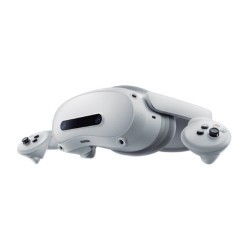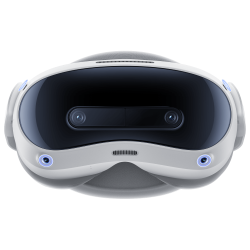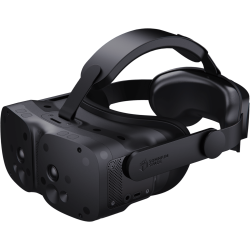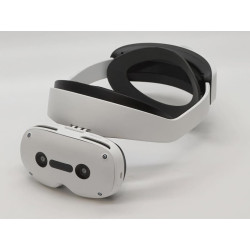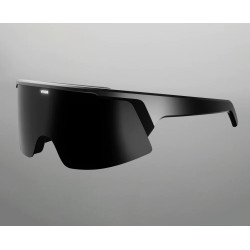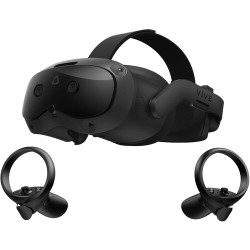
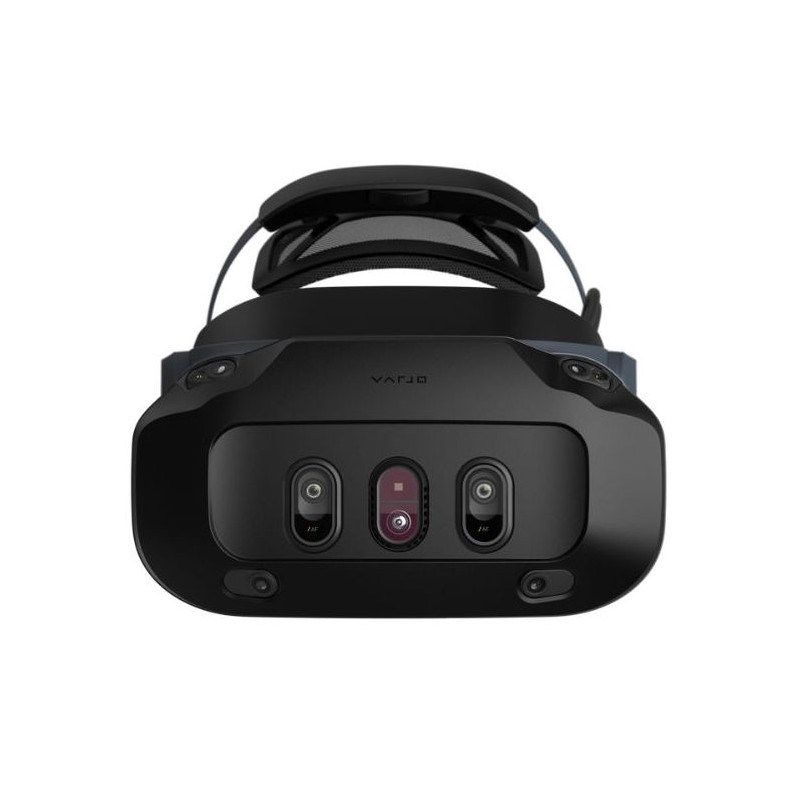
The Varjo XR-4 Series consists of professional-grade headsets designed for advanced simulation, training, research, engineering visualisation and work with digital 3D models. The solution combines high-resolution virtual reality with video passthrough technology, allowing users to see physical surroundings, equipment and elements of a training station within a computer-generated environment.
Varjo XR-4 Series – Professional VR and Mixed Reality Headsets for Simulation, Training and Research
The Varjo XR-4 Series consists of professional-grade headsets designed for advanced simulation, training, research, engineering visualisation and work with digital 3D models. The solution combines high-resolution virtual reality with video passthrough technology, allowing users to see physical surroundings, equipment and elements of a training station within a computer-generated environment.
A resolution of 3840 × 3744 pixels per eye, a wide 120° × 105° field of view, 200 Hz eye tracking and two 20 MP passthrough cameras make it possible to display small labels, instruments, screens and control elements with a high level of detail.
The series has been developed primarily for aviation, defence, vehicle operator training, industry, scientific research and specialist education.
Varjo XR-4 is not a standalone headset. It requires a permanent wired connection to a high-performance Windows workstation equipped with a supported NVIDIA graphics card.
Who Is the Varjo XR-4 Designed For?
Varjo XR-4 is intended for organisations that require a higher level of image quality, accuracy and integration capability than typical consumer headsets can provide.
The product is particularly suitable for:
simulation system manufacturers and integrators;
military, defence and public safety organisations;
pilot and vehicle operator training centres;
technical, medical and military universities;
research laboratories;
industrial and manufacturing companies;
automotive, aviation, maritime and energy sectors;
engineering offices, architectural studios and R&D teams;
organisations using digital twins;
developers of specialist VR, MR and XR applications.
It is not designed primarily for entertainment, basic presentations or occasional consumer VR use. In such applications, the capabilities of the device are unlikely to justify the cost of the headset, workstation and specialist software.
Available Models
Varjo XR-4
The standard model in the series is equipped with fixed-focus mixed reality cameras. It provides approximately 33 PPD in the passthrough image.
It is suitable when the virtual environment forms the main part of the experience, while the view of the physical surroundings is used primarily for orientation, observing larger objects or connecting a virtual scene with a relatively simple physical training station.
This model is suitable for applications including:
training conducted primarily in VR;
visualisation of large models;
design reviews;
product presentations;
research using eye tracking;
simulations in which users do not need to read small labels on physical equipment.
Varjo XR-4 Focal Edition
This version is equipped with an automatic focus system controlled by the user’s gaze. Eye tracking and the depth sensor determine which physical object the user is looking at, while the system adjusts the focus of the passthrough cameras.
The solution delivers up to 51 PPD in the view of the physical environment and is designed for situations in which users need to see real switches, labels, indicators, screens, instruments or components located within arm’s reach.
The Focal Edition is particularly recommended for:
cockpit simulators;
pilot training;
driver and vehicle operator stations;
service and maintenance training;
working with physical control panels;
research requiring natural gaze transitions between near and distant objects;
combining physical prototypes with digital overlays.
Varjo XR-4 Secure Edition
This model is intended for government, defence, military and classified environments. It is assembled in Finland, complies with the United States Trade Agreements Act requirements and can be configured without radio components.
The Secure Edition can operate offline and in air-gapped environments that are completely isolated from the Internet and other untrusted networks. It is available in both fixed-focus and autofocus configurations.
It is intended primarily for:
military training systems;
aviation and combat vehicle simulators;
critical infrastructure;
laboratories and facilities working with classified data;
closed government networks;
projects requiring devices without wireless connectivity.
Key Information Before Purchase
1. The Correct Version Must Be Selected
The main difference between the XR-4 and XR-4 Focal Edition concerns the quality of the physical environment displayed through the passthrough cameras.
When users need to read real labels, instruments, switches or screens located close to the headset, the Focal Edition is recommended. When the physical environment serves mainly as a background for a virtual scene, the standard XR-4 may be sufficient.
2. The Headset Requires a High-Performance Computer
Varjo XR-4 relies on an external computer to render the entire image. Requirements include an NVIDIA graphics card, at least 32 GB of RAM, a modern processor and a compatible USB controller.
For the most demanding simulators, large CAD models and advanced mixed reality applications, the manufacturer recommends 64 GB of RAM, a 16-core-class processor and an NVIDIA GeForce RTX 5090 or NVIDIA RTX PRO 6000 Blackwell graphics card.
3. AMD Graphics Cards Are Not Supported
The current Varjo XR-4 system requirements specify NVIDIA graphics cards. AMD graphics cards are not supported.
4. USB Port Compatibility Must Be Verified
XR-4 requires a USB-C port with a bandwidth of at least 10 Gb/s, connected directly to a compatible motherboard chipset.
The presence of a USB-C port alone does not guarantee compatibility. If the motherboard is not supported, an approved PCIe expansion card may be required.
5. It Is a Wired Solution
The headset must be connected to the computer using DisplayPort and USB-C data cables. The standard set includes 5-metre cables. Optional 15-metre cables are also available.
The wired connection provides high image quality and eliminates battery-related limitations, but it restricts mobility and requires proper workstation planning and cable management.
6. Controllers May Need to Be Purchased Separately
The current XR-4 Series supports Varjo controllers, SteamVR devices and optical hand tracking. However, Varjo controllers are optional accessories and are not included in the standard XR-4 Series 2026 package.
7. The Headset Does Not Include Ready-Made Training Scenarios
A compatible software application prepared for the specific process is required. This may be a complete simulator, an industrial application, an engineering platform or a custom solution developed in Unity or Unreal Engine.
Purchasing the headset does not automatically provide a complete training system. The overall project budget should also include the workstation, licences, 3D content, integration, physical workstation equipment, technical support, controllers and any external tracking or motion systems.
Advantages
Very high resolution of 3840 × 3744 pixels per eye.
Up to 51 PPD, meaning pixels per degree of the user’s field of view.
Wide field of view of 120° horizontally and 105° vertically.
Two 20 MP passthrough cameras.
200 Hz eye tracking.
Automatic IPD adjustment.
Dynamic foveated rendering, concentrating image quality in the area observed by the user.
Integrated LiDAR depth sensor.
Support for inside-out tracking and SteamVR Tracking.
Integration with ART and OptiTrack tracking systems.
Integrated optical hand tracking.
Mixed reality functions including masks, chroma key and hand occlusion.
Integrated DTS spatial audio speakers and noise-cancelling microphones.
Suitable for use by people wearing glasses.
Secure Edition available for closed, classified and restricted environments.
Support for professional engines and applications, including OpenXR, Unity, Unreal Engine, Autodesk VRED, Prepar3D and VBS Blue IG.
Disadvantages and Limitations
High total deployment cost compared with consumer headsets.
Requires a very high-performance workstation.
No standalone operation — the headset must be connected to a computer.
Wired connection limits freedom of movement.
No support for AMD graphics cards.
Support limited to Windows 10 and Windows 11.
Specific motherboard chipset and USB-C port requirements.
Controllers may require a separate purchase.
The standard XR-4 does not provide the same level of clarity for nearby physical objects as the Focal Edition.
Achieving full visual quality requires properly optimised software and foveated rendering support.
Specialist simulator deployments may require an integrator, custom 3D models, input devices, motion platforms and physical cockpit or workstation components.
The headset is generally not economically justified for simple presentations, basic school education or typical office work.
Software Required for Operation
Varjo Base
Varjo Base is the primary software required to start, configure and operate the headset.
The software is responsible for:
device configuration;
firmware updates;
image quality settings;
calibration;
selection of the tracking system;
mixed reality configuration;
eye-tracking configuration;
device diagnostics;
operation of OpenXR and OpenVR environments.
Varjo Base 4.13 or later is required for XR-4 Series 2026 devices. A Varjo account is required to download the software. The standard configuration also requires Internet access for authentication.
Varjo Base Pro
Varjo Base Pro is an optional paid licence intended for advanced mixed reality and research functionality.
The licence is assigned to a specific headset and cannot be transferred to another device after activation. This should be considered when planning laboratories and installations involving multiple workstations.
SteamVR
SteamVR is optional. It is required when:
using OpenVR applications;
using SteamVR base stations;
using compatible SteamVR controllers and accessories.
An Enterprise/Government version of SteamVR is available for offline installations and government environments.
Custom Application Development
Varjo XR-4 supports:
OpenXR 1.0;
Unity;
Unreal Engine;
Varjo Native SDK;
OpenVR;
applications using Varjo APIs.
The headset is also compatible with a range of professional platforms, including Autodesk VRED, Blender, Twinmotion, TechViz, Prepar3D and VBS Blue IG.
The available functionality may differ between applications. Support for the selected headset model, controllers, eye tracking and foveated rendering should therefore be confirmed before purchase.
Applications by Sector
Military and Defence – Very High Suitability
Varjo XR-4 can be used for training pilots, vehicle crews, weapons system operators, tactical teams and personnel responsible for equipment operation and emergency procedures.
The ability to combine a physical cockpit, real switches and physical equipment with a virtual environment makes it possible to build training stations with a high level of procedural realism.
The XR-4 Secure Edition is designed for classified installations and networks isolated from the Internet.
Recommended model: XR-4 Focal Edition or XR-4 Secure Edition Autofocus.
Aviation and Aerospace – Very High Suitability
The wide field of view, high resolution and ability to read physical instruments make the XR-4 suitable for:
aircraft and helicopter simulators;
normal and emergency procedure training;
multi-crew training;
analysis of pilot behaviour and visual attention;
cockpit design;
astronaut training;
workstation ergonomics evaluation.
In cockpits and stations containing large numbers of small labels and indicators, the autofocus function of the Focal Edition is particularly important.
Recommended model: XR-4 Focal Edition; XR-4 Secure Edition Autofocus for military installations.
Industry and Manufacturing – High Suitability
The solution can support:
machine operation training;
assembly instructions;
maintenance and service training;
simulation of hazardous procedures;
workstation ergonomics assessment;
engineering and design reviews;
digital twin presentation;
comparison of physical prototypes with digital models;
production line planning.
The Focal Edition is more suitable for maintenance training and work involving real components. The standard XR-4 may be sufficient for visualising large, primarily virtual models.
Automotive and Transport – Very High Suitability
Varjo can be used for vehicle design, virtual test drives, visibility and ergonomics evaluation, safety system testing and driver or operator training.
Integration with a physical seat, steering wheel, cockpit, motion platform and digital environment can reduce the need to build complete physical prototypes during early project stages.
Recommended model: XR-4 Focal Edition.
Laboratories and Scientific Research – Very High Suitability
The 200 Hz eye tracking, automatic IPD adjustment, high image quality and access to data through development tools support research in areas including:
human–computer interaction;
ergonomics;
psychology;
perception;
visual attention;
operator behaviour;
medicine;
automotive research;
user interfaces;
simulation and training.
Varjo also offers academic programmes and pricing for research and educational institutions.
Recommended model: XR-4 or XR-4 Focal Edition, depending on the experiment, together with Varjo Base Pro where required.
Higher Education and Specialist Training – High Suitability
The solution is suitable for technical, medical, aviation, military and creative universities, as well as programmes related to engineering design, simulation and XR application development.
It can be used for teaching anatomy, 3D design, equipment operation, research methods and the development of professional immersive systems.
For general primary or secondary education, however, it is usually too costly and complex. Its potential is best used in specialist laboratories and structured training programmes.
Medicine and Emergency Response – High Suitability for Training and Research
Varjo XR-4 can support:
procedural training;
medical simulation;
anatomy education;
emergency team training;
visualisation of anatomical data;
preparation for rare or hazardous scenarios;
research into medical interfaces and imaging.
Mixed reality makes it possible to retain visibility of physical mannequins, instruments, the user’s hands and other team members while displaying virtual information.
Clinical applications require a separate assessment of the complete system, software and procedure. The headset itself is not a substitute for a certified diagnostic or medical device.
Public Administration and Emergency Services – Conditional Suitability
Varjo can be valuable for specialist government units and services responsible for:
crisis management;
public safety;
operator and driver training;
disaster response;
critical infrastructure protection;
uniformed service training;
spatial analysis and planning.
It is not intended for standard office work, video conferencing or document processing.
The XR-4 Secure Edition should be considered for environments processing classified or restricted information.
Energy and Critical Infrastructure – High Suitability
The headset can be used for operator training, emergency simulations, engineering reviews and preparing personnel to work in hazardous or difficult-to-access environments.
Applications may include power plant operation, nuclear facility design and training, industrial process simulation and infrastructure maintenance.
Maritime Sector – High Suitability
Varjo can support the training of ship crews, bridge operators, port personnel and technical service teams.
Combining physical bridge components with a virtual environment allows different weather conditions, emergency situations and port operations to be reproduced without requiring a complete full-scale simulator.
Architecture, Construction and Engineering Design – High Suitability
The high resolution makes it possible to evaluate interiors, materials, proportions, visibility and ergonomics using BIM, CAD and 3D visualisation models.
Varjo can be used for:
presenting projects at a 1:1 scale;
design reviews;
collaboration between distributed teams;
prototype evaluation;
architectural visualisation;
comparison of digital models with physical objects.
Varjo XR-4 Series Technical Specifications
Display
Display type: two mini-LED displays.
Resolution: 3840 × 3744 pixels per eye.
Image density: up to 51 PPD.
Field of view: 120° horizontal × 105° vertical.
Refresh rate: 75 Hz or 90 Hz.
Colour coverage: 98% sRGB and 96% DCI-P3.
Contrast ratio: 1:10,000.
Brightness: 200 nits.
Local dimming.
Mixed Reality and Passthrough
Two 20 MP video passthrough cameras.
Approximately 33 PPD for the standard fixed-focus model.
Up to 51 PPD for the autofocus version.
Gaze-controlled automatic focus in the Focal Edition.
Night mode.
Dynamic and custom mixed reality masks.
Chroma key support.
Hand occlusion.
RGB ambient light sensor.
300 kpixel LiDAR depth sensor.
Depth measurement range of up to 7 metres.
Eye Tracking
Tracking frequency: 200 Hz.
Automatic one-point calibration.
Support for dynamic foveated rendering.
Automatic interpupillary distance adjustment.
IPD range: 56–72 mm.
Position and Motion Tracking
6DoF — six degrees of freedom.
Integrated inside-out tracking.
SteamVR Tracking support.
ART and OptiTrack external tracking support through APIs.
Integrated optical hand tracking.
Support for optional Varjo controllers.
Support for SteamVR-compatible devices.
Audio
Integrated DTS spatial audio speakers.
Integrated microphones with noise reduction.
Connectivity
DisplayPort 1.4 or later.
USB-C 10 Gb/s or faster.
Separate power supply through the headset power adapter.
DisplayPort image cable: 5 m.
USB-C data cable: 5 m.
Optional 15 m cable set.
Minimum Desktop Computer Requirements
Processor: modern 8-core processor, such as Intel Core i7-13700K, Intel Xeon w7-2475X or AMD Ryzen 7 7700X.
Memory: 32 GB RAM.
Graphics card: NVIDIA RTX PRO 4500 Blackwell, NVIDIA RTX 5000 Ada, GeForce RTX 5070 Ti, RTX 4080 or RTX 3090.
Storage: at least 3 GB for the Varjo Base installation.
Video output: DisplayPort 1.4 or later.
USB: USB-C 10 Gb/s connected directly to the motherboard chipset.
Operating system: 64-bit Windows 10 or Windows 11.
Recommended Configuration for the Most Demanding Applications
16-core-class processor, such as Intel Core Ultra 9 285K, Intel Xeon w9-3495X or AMD Ryzen 9 9950X3D.
64 GB RAM.
NVIDIA GeForce RTX 5090 or NVIDIA RTX PRO 6000 Blackwell graphics card.
A desktop workstation is recommended for advanced simulators, large datasets, engineering design, ray tracing and full-resolution mixed reality.
Software and Operating Environment
Varjo Base — required.
Varjo Base 4.13 or later for the 2026 series.
Varjo Base Pro — optional.
NVIDIA graphics drivers.
SteamVR — optional, depending on the application and tracking system.
OpenXR and OpenVR support.
Varjo account required for standard installation.
Offline deployment possible in an appropriately prepared configuration.
The Varjo XR-4 Series consists of professional-grade headsets designed for advanced simulation, training, research, engineering visualisation and work with digital 3D models. The solution combines high-resolution virtual reality with video passthrough technology, allowing users to see physical surroundings, equipment and elements of a training station within a computer-generated environment.