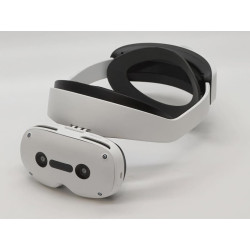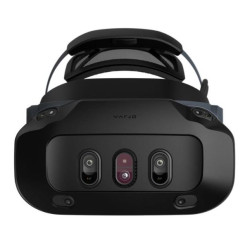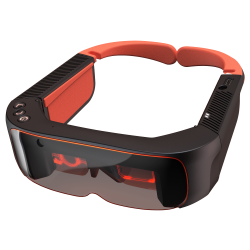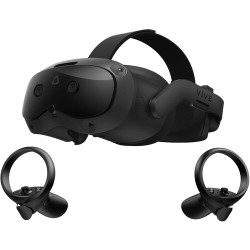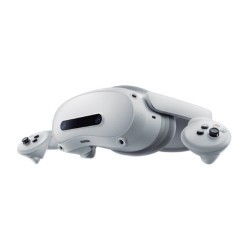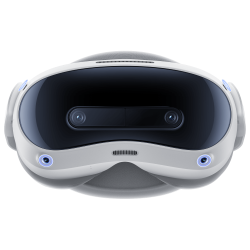
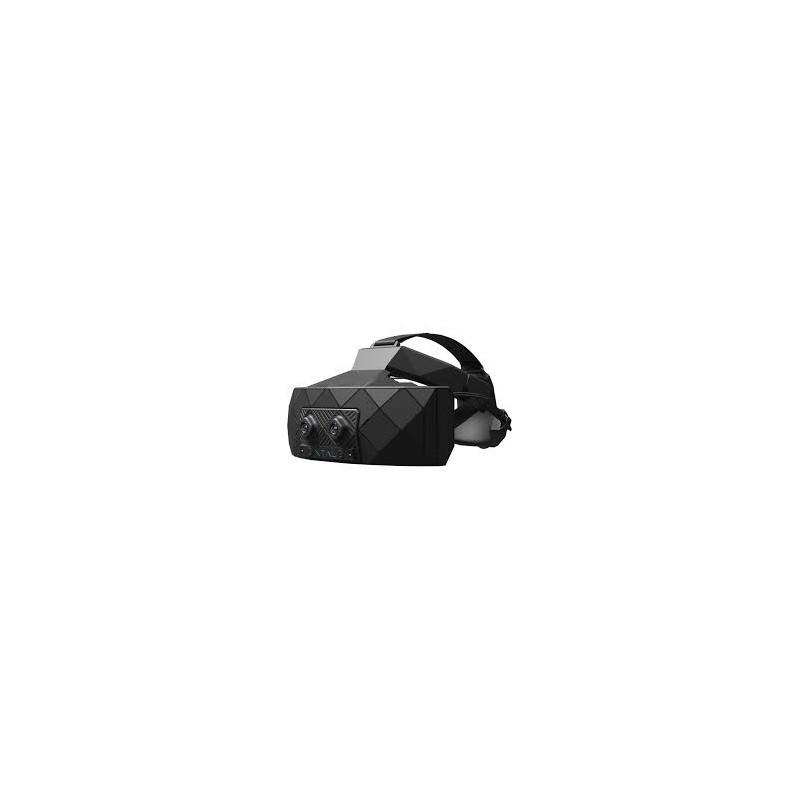
A professional MR (Mixed Reality) headset designed primarily for pilot training, flight simulators, and military and industrial applications.
It combines computer-generated imagery with a real cockpit thanks to two front-facing video passthrough cameras. The user can see physical instruments, controls, and their own hands, while the surroundings and parts of the scene are virtually generated.
XTAL 3 NEO Mixed Reality Pilot Dedicated Headset
A professional MR (Mixed Reality) headset designed primarily for pilot training, flight simulators, and military and industrial applications.
It combines computer-generated imagery with a real cockpit thanks to two front-facing video passthrough cameras. The user can see physical instruments, controls, and their own hands, while the surroundings and parts of the scene are virtually generated.
The design is designed to work with a full-scale replica of the cockpit, controls, and professional simulation software.
The system allows the passthrough cameras to read physical instrument panels and MFD (Multi-Function Display) screens.
Advanced masking allows for combining a green screen with 3D object mapping, allowing the real cockpit to be embedded in the virtual environment.
Integrated Ultraleap hand tracking allows for the observation and recording of hand movements without the need for hand controllers. Head Tracking Compensation technology reduces shifts between the real camera image and virtual elements when the head moves.
Integrated eye tracking can record the pilot's gaze direction and generate heat maps used for analysis and debriefing of the training session.
The manufacturer allows for customization of the hardware, firmware, and software to a specific training program, including the integration of additional sensors, tracking systems, and special MR lenses.
Technical Specifications
VR Image
Display Resolution: 3840 × 2160 pixels per eye.
The manufacturer's term "8K" refers to two 4K displays; it does not imply 8K resolution per eye.
Display Type: Two fast-switching 4K LCD panels.
Refresh Rate:
-75 Hz at 4K resolution per eye,
-120 Hz at QHD resolution per eye.
Optics: Proprietary non-Fresnel lenses with software correction for chromatic aberration and barrel distortion.
VR Field of View
Standard Configuration:
-140° horizontal,
-90° vertical.
Maximum Experimental Values:
-up to 180° horizontal,
-up to 120° vertical.
FOV may vary depending on hardware configuration, software, and measurement method.
Mixed Reality Cameras and Image
Number of pass-through cameras: Two front-facing cameras.
Foveated image profiles:
-up to 3072 × 3040 at 75 Hz.
Uncompressed image profiles:
-4056 × 3040 at 30 Hz,
-3040 × 3040 at 40 Hz,
-2028 × 1512 at 120, 90, or 75 Hz,
-1536 × 1520 at 120, 90, or 75 Hz.
Various MR lens configurations are available, varying the relationship between central image detail and field-of-view width.
Mixed Reality Field of View
High Fidelity Lens:
-60° horizontal,
-40° vertical.
Balanced Lens:
-80° horizontal,
-60° vertical.
Immersive Lens:
-125° horizontal,
-85° vertical.
Infinite Lens:
-170° horizontal,
-120° vertical.
The manufacturer notes that actual values may vary depending on the hardware version, software settings, and measurement method.
User Tracking
Eye tracking:
- gaze direction analysis,
- heat map visualization,
- native frequency 120 Hz,
- maximum 210 Hz.
Hand tracking:
- built-in Ultraleap sensor.
Default positional tracking:
- SteamVR Lighthouse.
Supported alternative systems:
- ART,
- OptiTrack,
- Polhemus,
- Vicon,
- custom solutions.
Automatic IPD adjustment (Interpupillary Distance): 56 to 74 mm.
Customized correction inserts can be ordered according to the user's vision defect.
Connections and Power
Connection via a 5 m VirtualLink cable.
Alternative connection configurations:
- DisplayPort 1.4,
- USB 3.2 Gen 2,
- 12 V / 3 A power supply.
The MR version uses additional USB connections for passthrough cameras.
The device is wired and requires external power—it is not a standalone system.
Dimensions and Weight
Weight of the headset without the head-mount system: 700 g.
Dimensions of the headset itself: 293 × 123 × 113 mm.
Software Required
Basic Software
Operating System:
Microsoft Windows 11,
Microsoft Windows 10.
Appropriate NVIDIA graphics card driver.
VRG Tool – a manufacturer-provided application for headset installation, configuration, diagnostics, and management.
VRG Runtime – a required component between the XTAL device and the VR or MR application.
One of the runtime environments:
VRG OpenXR Runtime,
SteamVR with the VRG SteamVR driver.
Ultraleap driver – required when using the built-in hand tracking system.
Appropriate tracking system software if ART, OptiTrack, Vicon, or another external system is used.
Computer Hardware and Software Requirements
Compatible NVIDIA graphics card.
Manufacturer-recommended cards include:
GeForce RTX 4060 / 4060 Ti and higher models of the RTX 40 series,
GeForce RTX 5070 and higher models of the RTX 50 series,
NVIDIA RTX A4000, A4500, A5000, and A6000,
professional RTX Ada Generation and RTX PRO cards.
The manufacturer does not provide a single, universal minimum for processor, RAM, and disk space. These requirements should be determined based on the simulator used, resolution, refresh rate, and scene complexity.
Simulation Software
The manufacturer claims support for, among others:
Prepar3D,
X-Plane 11 and X-Plane 12,
Microsoft Flight Simulator,
Aerofly FS,
FlyInside.
VBS3 and VBS4 from Bohemia Interactive Simulations.
Blue IG.
MAK.
multiSim.
Metrea.
Aechelon Technology solutions.
Creating your own applications
SteamVR and OpenXR drivers.
Plugins for Unity and Unreal Engine.
C++ libraries.
Support for graphical environments:
DirectX,
OpenGL,
Vulkan.
A professional MR (Mixed Reality) headset designed primarily for pilot training, flight simulators, and military and industrial applications.
It combines computer-generated imagery with a real cockpit thanks to two front-facing video passthrough cameras. The user can see physical instruments, controls, and their own hands, while the surroundings and parts of the scene are virtually generated.