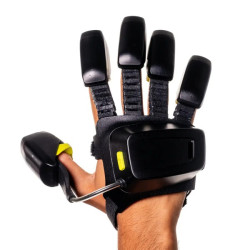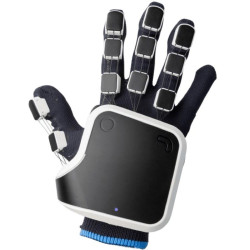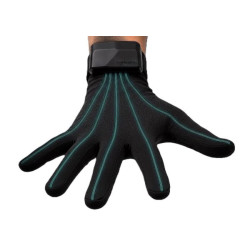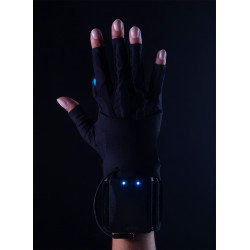
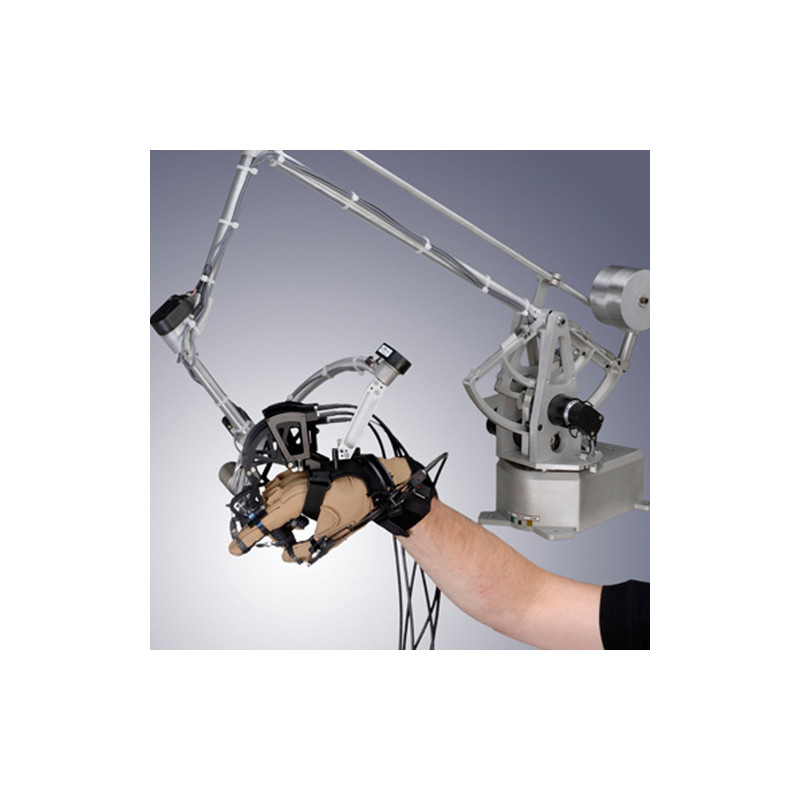
CyberForce is a professional, stationary haptic system that allows not only tracking hand movements but also sensing physical resistance when in contact with virtual objects. The CyberForce mechanical arm is connected to the CyberGrasp finger exoskeleton and the CyberGlove measuring glove. This allows the user to rest their hand on a virtual steering wheel, feel the inertia of a moving object, or encounter the resistance of a simulated wall.
CyberGlove Systems CyberForce
CyberForce is a professional, stationary haptic system that allows not only tracking hand movements but also sensing physical resistance when in contact with virtual objects. The CyberForce mechanical arm is connected to the CyberGrasp finger exoskeleton and the CyberGlove measuring glove. This allows the user to rest their hand on a virtual steering wheel, feel the inertia of a moving object, or encounter the resistance of a simulated wall.
This is no ordinary "VR glove." CyberForce is a mechanically anchored force feedback system: a stationary base and arm can act on the entire hand, while CyberGrasp controls the resistance of individual fingers, and CyberGlove measures their position. The system also provides six degrees of freedom hand tracking, meaning positioning along three axes and rotation around three axes.
Key distinction: CyberGlove – measures finger flexion and hand position. CyberGrasp – applies programmable resistance to individual fingers. CyberForce – adds force applied to a stationary base, allowing you to simulate resistance acting on the entire hand and part of the arm. CyberTouch II – provides vibrations on the fingers and palm, i.e., vibrotactile feedback, but does not replace the mechanical resistance of CyberGrasp or CyberForce.
Technical Specifications
Solution Type: Mechanical haptic system with force feedback.
Hand Tracking: 6 degrees of freedom – 3 axes of position and 3 axes of orientation.
Maximum CyberForce force: Up to 8.8 N.
Force Range: Dependent on hand position within the workspace.
Workspace covered by the full specification: approximately 30.5 x 30.5 cm, traversable in a 133° arc within a radius of approximately 51 cm.
Total workspace specified in the manual: approximately 0.328 m³, although force and accuracy parameters may be lower outside the nominal workspace.
Nominal position resolution: approximately 0.06–0.073 mm.
Orientation resolution: 0.09°.
Communication Interface: Ethernet 10/100 Mb/s.
Control Unit: Force Control Unit, or FCU. Power supply: separate Power Supply Unit (PSU).
FCU and PSU power supply: 100–240 VAC, 47–63 Hz.
Required protective grounding: Class I device.
Mechanical arm weight: approximately 8.6 kg.
FCU weight according to the manual: approximately 20 kg.
PSU weight according to the manual: approximately 9.1 kg.
Total weight of three main components: approximately 37.7 kg, excluding CyberGrasp, CyberGlove, cables, and additional equipment.
Operating environment: Indoor use only, laboratory or office environment.
Operating temperature: +5°C to +40°C.
Maximum operating altitude: 2000 m above sea level.
Variants: Right or left arm; a two-handed station can be configured.
Important documentation discrepancy
The product page and brochure list 8.8 N as the maximum value and 6.6 N as the minimum value within the described working envelope. The Rev. E manual, however, lists 8.8 N at a 14-inch radius and 7.2 N at a 26-inch radius.
Components Required for Operation
The full configuration described by the manufacturer includes:
CyberForce mechanical arm,
CyberGrasp with exoskeleton and actuator module,
22-sensor CyberGlove,
FCU control unit,
PSU power supply unit,
safety pedal,
data, control, and power cables,
control computer,
software and drivers,
stable mounting stand,
Ethernet network or direct connection to a computer.
The CyberForce public website also presents the system as an option for compatibility with CyberGrasp.
Software
The manufacturer's primary development environment is the VirtualHand SDK, or Software Development Kit – a set of tools for creating custom applications. It includes:
Device Manager for hardware communication,
Device Configuration Utility for configuration and calibration,
C++ programming library,
3D object collision handling,
virtual hand interaction management,
CyberGrasp and CyberForce feedback control,
network communication,
sample applications and demo code,
model import mechanisms and interoperability with external visualization software.
The manufacturer also provides examples of integration with MATLAB, MotionBuilder, Jack software, and Unity. However, the public materials do not provide the current supported versions of Unity, Unreal Engine, OpenXR, SteamVR, or modern Windows systems.
CyberForce is a professional, stationary haptic system that allows not only tracking hand movements but also sensing physical resistance when in contact with virtual objects. The CyberForce mechanical arm is connected to the CyberGrasp finger exoskeleton and the CyberGlove measuring glove. This allows the user to rest their hand on a virtual steering wheel, feel the inertia of a moving object, or encounter the resistance of a simulated wall.