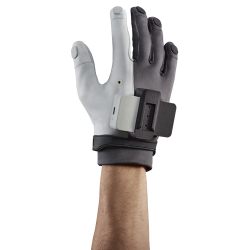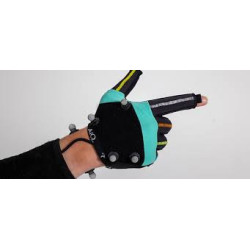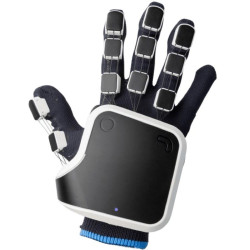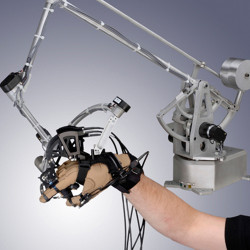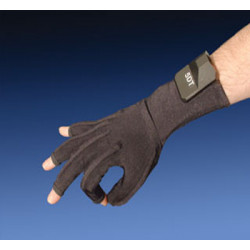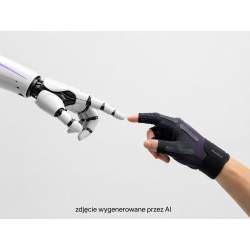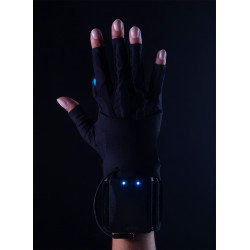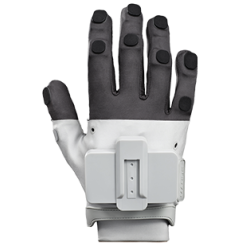
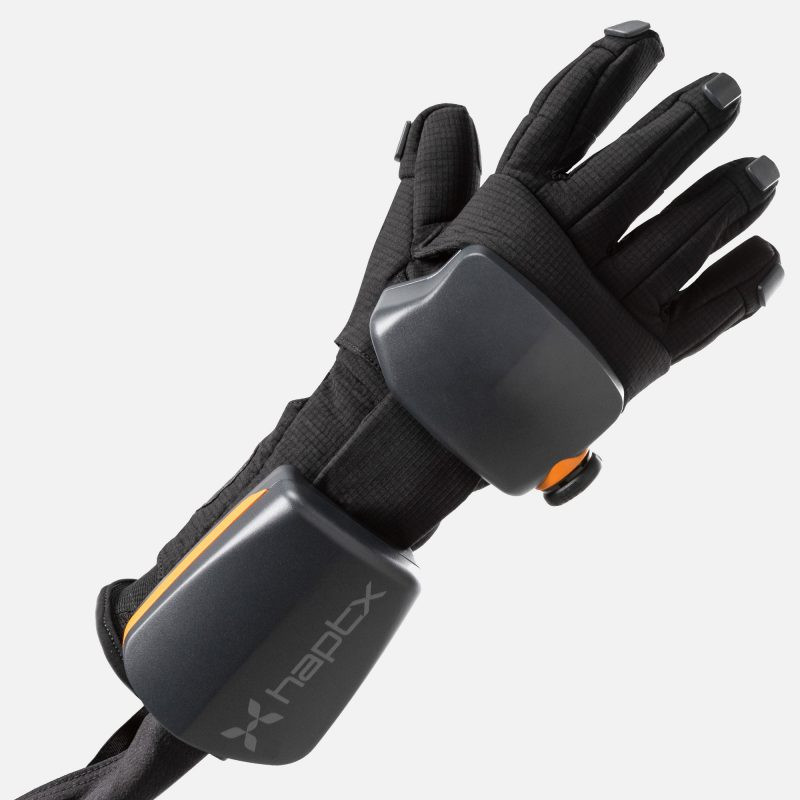
The HaptX Gloves G1 is a professional haptic glove system designed for virtual reality, training simulations, and robot control. The solution combines precise hand tracking with two types of feedback: haptic, delivered by microfluidic elements pressing against the skin, and force, which provides resistance to the fingers when grasping virtual objects. This allows the user to experience, among other things, the contact surface, shape, stiffness, texture, and resistance of the virtual object.
HaptX Gloves G1
The HaptX Gloves G1 is a professional haptic glove system designed for virtual reality, training simulations, and robot control. The solution combines precise hand tracking with two types of feedback: haptic, delivered by microfluidic elements pressing against the skin, and force, which provides resistance to the fingers when grasping virtual objects. This allows the user to experience, among other things, the contact surface, shape, stiffness, texture, and resistance of the virtual object.
Key Features:
Realistic pressure on the skin surface of the hand and fingers,
Physical resistance when squeezing a virtual object,
135 touch elements in each glove,
Five force mechanisms in each glove—one for each finger,
36 degrees of freedom tracking,
Mobile operation possible with the Airpack worn on the back,
Stationary operation possible with the Airpack positioned next to the user,
Support for multi-player environments,
Integration with Unreal Engine, Unity, C++, ROS, and robotics,
Four glove sizes: S, M, L, and XL.
DoF — Degrees of Freedom (DoF) refers to the number of independently tracked movements and rotations. In the case of the G1, the manufacturer claims 36 degrees of freedom for each hand.
Technical Specifications
Gloves
Weight per glove: 0.57 kg
Available sizes: S, M, L, XL
Supported hand length range: 16.5–21.4 cm
Supported hand width range: 7.3–10 cm
Connection length in mobile configuration: 0.8 m
Connection length in stationary configuration: 1.25 m
Wrist mobility: almost full range of motion
Declared glove lifespan: 18 months or 540 hours of use
Motion tracking
Number of sensors: 6 per glove
Positional resolution: 0.3 mm
Rotational precision: 0.3°
Number of tracked degrees of freedom: 36 per glove
Update rate: 120 Hz
Latency: 16 ms
Tactile feedback
Number of touch elements: 135 per glove Glove
Maximum pressure felt on the skin: 62 kPa
Maximum operating frequency: 125 Hz
Communication frequency: 250 Hz
Pneumatic filling time: 35 ms in the best-case scenario
Maximum displacement on the palm: 1.5 mm
Maximum displacement on the fingers: 0.9 mm
Force feedback
Number of force mechanisms: 5 per glove
Maximum holding force: 35.6 N per finger
Typical operating force: 22.24 N per finger
Minimum retraction force: 1.33 N
Resistance engagement time: 62 ms
Resistance release time: 30 ms
The manufacturer describes the maximum combined resistance as approximately 40 lbf, or approximately 178 N per hand. This value is due to the maximum force per finger, not the action of the full arm exoskeleton.
Airpack
The Airpack is a pneumatic unit that generates and controls the compressed air needed to operate the gloves.
The Airpack itself weighs; 8.8 kg
Weight with backpack mount and battery: 10.1 kg
Dimensions without backpack mount: 52.5 x 26.5 x 12.3 cm
Maximum noise level: 55 dB
Typical battery life: 2 hours
Battery charging time: 3 hours
Battery capacity: 84.42 Wh
Maximum power consumption: 120 W
Power supply: 36 V, maximum 2.5 A
Connectivity: Wi-Fi 802.11ac
Maximum declared Wi-Fi range: 30.5 m
Maximum pressure: 250 kPa
Declared Airpack life: 5 years or 10,000 hours
Important clarification regarding "wireless"
The mobile configuration communicates wirelessly with the computer, but the gloves themselves are still connected to Airpack with short cables and pneumatic tubes. Therefore, it's not a completely independent pair of wireless gloves like typical VR controllers.
Hardware Requirements
The manufacturer provides the following basic requirements:
a PC that meets at least the recommended, not minimum, requirements of the VR headset used,
a Windows system according to the public documentation, Revision 1.4,
at least one USB 2.0 port for the HaptX system; the VR headset may require additional ports,
a compatible VR headset using SteamVR Tracking,
a hardware tracker or controller that tracks hand position,
SteamVR base stations,
a Wi-Fi network for a mobile setup,
adequate operating space and secure cable management,
an application developed using the HaptX SDK.
The manufacturer recommends the following configurations as the most reliable:
HTC Vive trackers,
SteamVR base stations,
HTC Vive or HTC Vive Pro,
Valve Index,
Varjo headsets
The HaptX Gloves G1 is a professional haptic glove system designed for virtual reality, training simulations, and robot control. The solution combines precise hand tracking with two types of feedback: haptic, delivered by microfluidic elements pressing against the skin, and force, which provides resistance to the fingers when grasping virtual objects. This allows the user to experience, among other things, the contact surface, shape, stiffness, texture, and resistance of the virtual object.