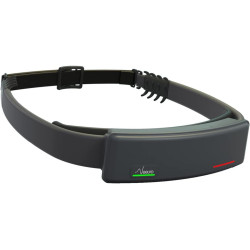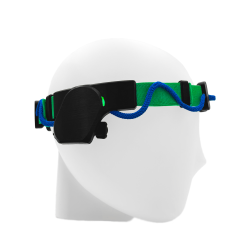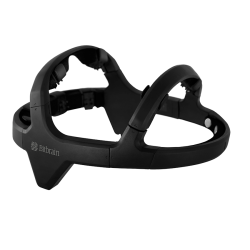
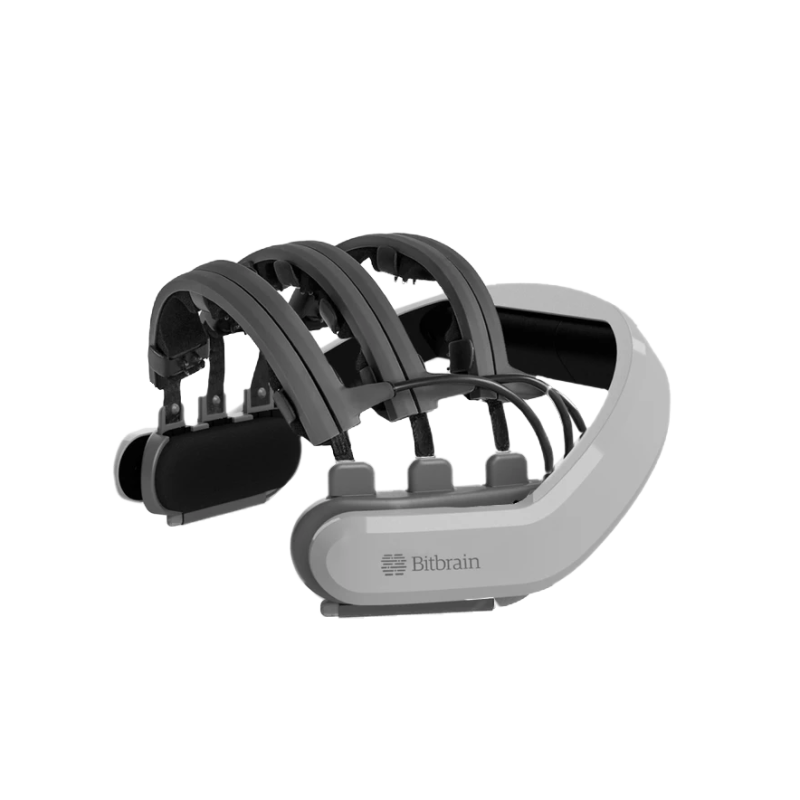
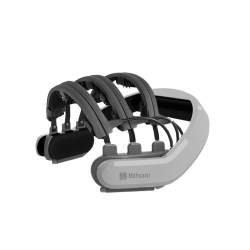
The Bitbrain Hero 9ch EEG is a lightweight, wireless electroencephalography (EEG) system designed for the study of cognitive processes and sensorimotor activity.
The system uses dry EEG electrodes, eliminating the need for conductive gel, saline solution, or other electrolyte substances.
The wearable design allows for measurements to be taken during more natural behavior and movement than with traditional stationary EEG systems.
The device includes nine EEG measurement channels, primarily located over frontocentral, central, and centroparietal regions, plus an additional A2 reference channel.
The electrode placement corresponds to the international 10-10 EEG system.
Bitbrain Hero 9ch EEG
The Bitbrain Hero 9ch EEG is a lightweight, wireless electroencephalography (EEG) system designed for the study of cognitive processes and sensorimotor activity.
The system uses dry EEG electrodes, eliminating the need for conductive gel, saline solution, or other electrolyte substances.
The wearable design allows for measurements to be taken during more natural behavior and movement than with traditional stationary EEG systems.
The device includes nine EEG measurement channels, primarily located over frontocentral, central, and centroparietal regions, plus an additional A2 reference channel.
The electrode placement corresponds to the international 10-10 EEG system.
The measurement electrodes are located at positions FC3, FCz, FC4, C3, Cz, C4, CP3, CPz, and CP4.
The system also has a reference connected to the A2 ear, REF, and GND. The electrode array has been optimized for recording phenomena related to motor and cognitive activity, such as mu/alpha ERD/ERS, ERPs, including P300 and N400, and MRCP (Movement-Related Cortical Potentials).
The EEG signal amplifier is integrated directly into the device.
The system can transmit data wirelessly to a computer via Bluetooth.
Data can be simultaneously or independently saved locally to a microSD card, reducing the risk of data loss in the event of a momentary interruption in wireless transmission.
The device features an integrated nine-axis IMU (Inertial Measurement Unit) module, which includes an accelerometer, gyroscope, and magnetometer.
The design of the headbands and the ability to adjust the sensor position allow the system to be adapted to the user's head shape and hair volume.
The entire system weighs approximately 250 g, facilitating longer sessions and studies requiring participant mobility. The system configuration was designed so that preparing the participant for measurement takes just a few minutes and does not require preparing the electrodes with gel.
Technical Specifications
Device type: Wireless, portable dry-EEG system.
Number of EEG measurement channels: 9.
EEG electrode positions: FC3, FCz, FC4, C3, Cz, C4, CP3, CPz, CP4.
Additional reference channel: A2 – linked-ear reference.
Reference/ground electrodes: REF + GND.
Electrode placement standard: International 10-10 EEG system.
Sensor type: Dry EEG electrodes.
Noise reduction technology: Active shielding and optimized DRL (Driven Right Leg) circuit.
Sampling rate: 256 SPS (samples per second).
Transducer resolution: 24 bits.
Bandwidth: DC–40 Hz, third-order low-pass filter.
Input range: ±100 mV.
Noise level: <1 µV RMS, for the 0.5–30 Hz range at 256 Hz.
CMRR: >100 dB at 50 Hz.
Input impedance: >50 GΩ.
Electrode contact monitoring: Available in real time as a relative impedance/contact measurement.
Integrated motion sensors: 9-axis IMU – accelerometer, gyroscope, and magnetometer.
Device connectivity: Bluetooth 2.1 + EDR.
Declared transmission range: Up to approximately 10 m in direct line of sight.
Local data storage: MicroSD card.
Supported card: Up to 8 GB, Class 10 or higher.
Data export formats via Bitbrain software: CSV and EDF.
Battery: Replaceable Li-ion/LiPo battery.
Operating time: Over 3 hours on a single battery.
Charging time: Less than 3 hours.
Weight: approximately 250 g.
Manufacturer certification: CE, compliance with Directive 2014/53/EU on radio equipment.
Required Software
The primary software for recording data from Hero is currently Bitbrain SennsLite.
SennsLite is software provided by Bitbrain as part of the core Research Software suite.
The program enables:
- real-time EEG signal visualization,
- starting and stopping acquisition,
- electrode contact quality control,
- data recording,
- synchronization of Bitbrain devices,
- data export to CSV and EDF formats,
- integration with external software via LSL – Lab Streaming Layer.
SennsLite can be used with solutions used for EEG and BCI research, including BCI2000, OpenViBE, NeuroPype, and Medusa.
Data recorded from Hero can then be analyzed using:
- Python / MNE,
- MATLAB / EEGLAB,
- MATLAB / FieldTrip,
- BCILAB.
Minimum requirements for the current version of SennsLite
Operating system: Windows 10 64-bit or later or Linux Ubuntu 22.04.
Processor: Intel Core i5 6th generation or later.
RAM: Minimum 8 GB.
Free disk space: Minimum 1 GB.
Bluetooth adapter: According to current SennsLite requirements, Bluetooth 5.0 or later is required.
Bluetooth Low Energy support required.
Additional software
Bitbrain SDK – an optional solution for users creating their own research applications or BCI systems.
The SDK allows direct control of Bitbrain devices, as well as configuration and data acquisition.
The current version of the SDK is designed for Windows 11 and Ubuntu 22.04.
The SDK uses the C language and enables integration with Python, among other platforms.
Bitbrain SennsLab – an optional, licensed environment for designing experiments and synchronizing multiple data sources. SennsLab enables the integration of over 35 sensor types/modalities, including EEG, eye tracking, and other biosignals. It is primarily intended for more extensive multimodal studies in which EEG recordings must be synchronized with additional devices or experimental stimuli.
Purpose
EEG studies on motor and sensorimotor cortex activity.
Cognitive processes research.
BCI (Brain-Computer Interface) research.
BCI-based motor rehabilitation research.
Cognitive rehabilitation research.
Analysis of brain activity during movement and motor tasks.
Movement preparation and planning research.
Research on human reactions during interactions with devices, interfaces, and products.
UX (User Experience) research conducted in more natural settings.
Research on human behavior during real-world activities.
Educational research on cognitive and sensorimotor states.
Individual and group research.
EEG signal recording combined with eye-tracking, biosignals, or other measurement systems.
Research using ERP – Event-Related Potentials, including P300 and N400. ERD/ERS – Event-Related Desynchronization/Synchronization studies, particularly those involving mu and alpha rhythms. MRCP – Movement-Related Cortical Potentials studies.
Advantages
Dry electrodes – no EEG gel or saline required.
Short participant preparation time compared to traditional wet EEG systems.
No consumables associated with electrode preparation, such as conductive gel.
Mobile design allows for conducting studies outside of a typical laboratory setting.
Lightweight – approximately 250 g.
Wireless data transmission via Bluetooth.
Local storage on a microSD card, providing data security in the event of wireless transmission issues.
Over 3 hours of operation on a replaceable battery.
24-bit EEG recording at 256 SPS.
Active shielding and DRL improve signal-to-noise ratio and reduce interference.
Real-time electrode contact quality control facilitates proper study preparation.
Built-in IMU module enables simultaneous recording of head movement information.
Electrode placement is particularly well suited for studies of central brain areas and sensorimotor functions. Integration with popular research environments via Lab Streaming Layer (LSL) is possible.
Data export in standard CSV and EDF formats facilitates further analysis in MATLAB or Python.
Expandable with the SDK and SennsLab platform for more complex experiments and multimodal studies.
The Bitbrain Hero 9ch EEG is a lightweight, wireless electroencephalography (EEG) system designed for the study of cognitive processes and sensorimotor activity.
The system uses dry EEG electrodes, eliminating the need for conductive gel, saline solution, or other electrolyte substances.
The wearable design allows for measurements to be taken during more natural behavior and movement than with traditional stationary EEG systems.
The device includes nine EEG measurement channels, primarily located over frontocentral, central, and centroparietal regions, plus an additional A2 reference channel.
The electrode placement corresponds to the international 10-10 EEG system.