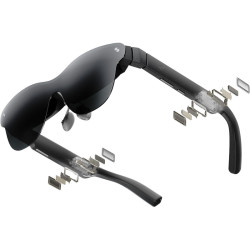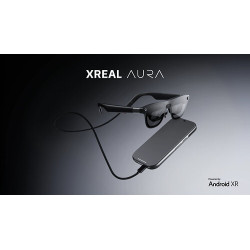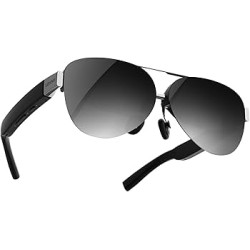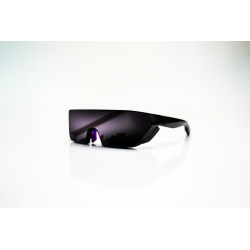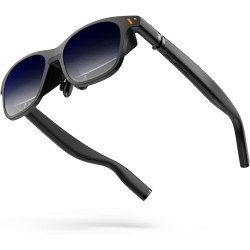
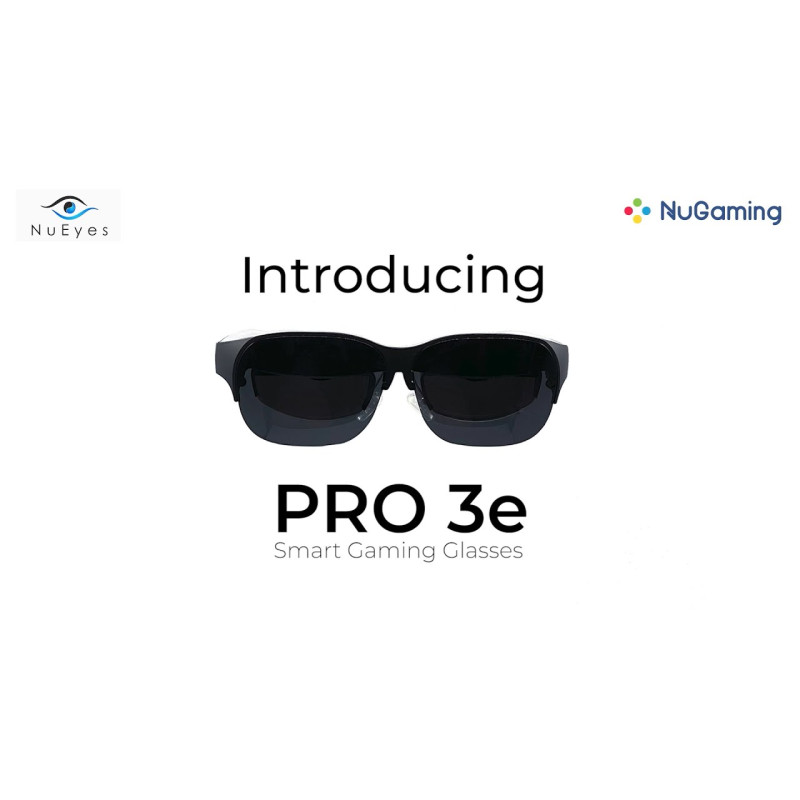
The NuEyes PRO 3e are lightweight screen glasses designed primarily for displaying images from a compatible smartphone, tablet, or computer.
The device functions as a personal, head-mounted monitor—the image is transmitted wired via USB-C with DisplayPort Alt Mode support.
NuEyes PRO 3e Gaming Smart Glasses
The NuEyes PRO 3e are lightweight screen glasses designed primarily for displaying images from a compatible smartphone, tablet, or computer.
The device functions as a personal, head-mounted monitor—the image is transmitted wired via USB-C with DisplayPort Alt Mode support.
The manufacturer positions the PRO 3e as AR/MR [Augmented Reality/Mixed Reality] glasses, but in terms of functionality, they are closer to multimedia glasses than a full VR headset or an extended AR system.
The glasses can be used for gaming, watching movies, using streaming services, and displaying the screen of a phone or computer.
The PRO 3e are not a standalone console or computer—the game or app runs on the source device, and the glasses display the provided image.
The term "5G Ready" means that you can access content transmitted by a compatible phone equipped with 5G connectivity. The glasses themselves do not have their own 5G modem.
Technical Specifications
Weight: 68 g.
Dimensions when folded: 2 x 6 x 2 inches.
Dimensions when unfolded: 7 x 6 x 2 inches.
Optical Technology: Birdbath – an optical system that uses semi-transparent elements to direct the image from the displays to the user's eyes.
Resolution: 1920 x 1080 pixels.
Refresh Rate: 75 Hz.
Manufacturer-Declared Brightness: 2000 nits.
Field of View: 46° according to NuEyes' official announcement from 2022; however, this value is not repeated in the current specification table and should be confirmed with the manufacturer.
Head Tracking: 3DoF [Three Degrees of Freedom], which records head rotation but does not fully track the user's movement through space. Display modes: Standard 2D and stereoscopic 3D.
Screen positioning: Fixed or head-tracking.
Connectivity: USB Type-C.
Video standard: DisplayPort 1.4 over USB-C.
Required mode: DisplayPort Alt Mode.
EDID support: Yes - glasses can be identified by the source device as a display.
Audio: Built-in stereo speakers.
Audio format: LPCM [Linear Pulse Code Modulation] from 32 kHz to 192 kHz.
Sensors: IMU [Inertial Measurement Unit], accelerometer, gyroscope, magnetometer, and proximity sensor. Diopter adjustment: 0 D to -5 D.
Power supply and power consumption: 5 V, 0.5 A.
Buttons: Brightness adjustment, volume control, 2D/3D image selection, and fixed or tracking screen position selection.
Water resistance: The manufacturer generally states that NuEyes devices are not waterproof.
Image Size
The current product page lists a virtual screen size of over 104 inches.
Another official NuEyes website and the 2021 launch announcement list 148 inches.
The manufacturer does not currently explain this discrepancy or provide the reference distance for which the screen size is calculated.
The virtual screen size should therefore be treated as a marketing value depending on the measurement method used, and not as a clear technical parameter.
Compatible Smartphones
The manufacturer lists, among others:
Huawei Mate 10, 20, 30, and 40.
Huawei P10, P20, P30, and P40.
Samsung Galaxy S10 and newer models.
Smartisan R2.
Lenovo Legion Phone.
Oppo Find X2.
OnePlus 7 Pro and newer.
Xiaomi Black Shark 2 and newer.
ZTE Axon 10 Pro.
The mere presence of a USB-C port does not guarantee compatibility.
The phone must support USB-C DisplayPort Alt Mode.
The manufacturer's list also includes older devices and should not be construed as a complete list of all currently compatible phones.
Compatible Computers and Tablets
The manufacturer lists:
iPad Pro 4th generation and newer models.
MacBook Air and MacBook Pro with USB-C/Thunderbolt 3 or newer.
Lenovo Legion Y7000p 2019.
Selected generations of Lenovo ThinkPad S2.
LG G8 ThinQ.
Asus MiniPC PN61-b.
Asus Chromebook CT100p.
Asus ZenBook UX410UQK.
HP Gaming Pavilion 15-cv0100x.
HP Envy 13-ad124tx.
Dell XPS 15 9550.
Huawei MateBook 13 WRT-W19.
Intel NUC with USB-C display output.
Other computers supporting DisplayPort 1.4 and DisplayPort Alt Mode over USB-C.
Available Models and Kits
Pro 3e USB Type-C Standalone – a basic kit containing the PRO 3e glasses and a wired USB-C connection to a compatible device.
Pro 3e Ultrasound Bundle – a medical kit containing the glasses, a portable wireless ultrasound probe, and software.
NuCaption Bundle – an accessibility kit containing the PRO 3e glasses, a Samsung Galaxy phone, an external microphone, and a license for the NuCaption software for displaying speech-generated captions.
Software Required for Operation
The manufacturer does not specify the mandatory dedicated NuEyes software for basic image display.
The glasses are described as a plug-and-play solution – when connected to a compatible device, they receive the image signal via USB-C. A source device that supports DisplayPort Alt Mode is required for operation.
Playing requires a game or gaming service running on a phone, tablet, or computer.
The game controller should be connected to the source device, not directly to the glasses.
The manufacturer does not claim that the PRO 3e has its own operating system, application processor, storage, or app store.
Additional software is only required for specialized applications, such as NuCaption, NuAssist, RemoteAssist, or the ultrasound kit.
Advantages
Very lightweight: At 68g, it's significantly lighter than typical VR headsets.
Compact design: Foldable arms make it easy to transport.
Full HD resolution: Suitable for movies, text editing, and many games.
75Hz refresh rate: Smoother than a standard 60Hz screen.
High brightness: 2000 nits can improve image readability in bright environments.
Built-in stereo speakers: No need for separate headphones for basic applications.
Diopter adjustment up to -5D: Some nearsighted users can use it without additional prescription glasses.
Stereoscopic 3D mode.
Screen positioning support: Can be locked onto the image or moved with your head.
No need for a separate headset: The device draws power from the connected hardware.
Compatible with various platforms: Android, iPadOS, macOS, and PCs, provided the appropriate image output is supported.
Disadvantages and Limitations
Wired-only connection: the USB-C cable remains connected during use.
No standalone operation: the glasses require a phone, tablet, or computer.
No full 6DoF tracking: the device records head rotation, but not full movement in space.
Not a full VR headset: no confirmed motion controllers, room tracking system, or a complete VR gaming ecosystem.
75Hz may be a limitation for fast-paced games, especially compared to devices offering 90, 120, or higher hertz.
No camera in the current PRO 3e specification: this limits the ability to perform advanced environmental recognition and overlay AR objects in real-world space.
Limited vision correction: the 0 to -5D adjustment does not correct for hyperopia or astigmatism.
Potential drain on phone or laptop battery: the glasses draw approximately 2.5W from the source device, based on the stated power specifications.
Not every USB-C port transmits images: it is often necessary to check the phone or computer's documentation beforehand.
Lack of water resistance.
Documentation ambiguities: inconsistent information about the virtual screen size and missing some important parameters from the current table.
The manufacturer currently does not provide detailed information on the product page regarding image lag, color reproduction, interpupillary distance, IPD adjustment, sensor response time, or the full sales package contents.
The official FAQ warns against driving while using Pro line products.
The NuEyes PRO 3e are lightweight screen glasses designed primarily for displaying images from a compatible smartphone, tablet, or computer.
The device functions as a personal, head-mounted monitor—the image is transmitted wired via USB-C with DisplayPort Alt Mode support.