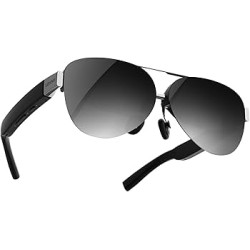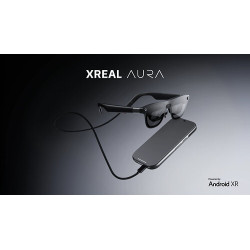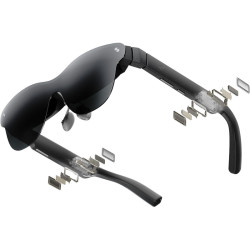
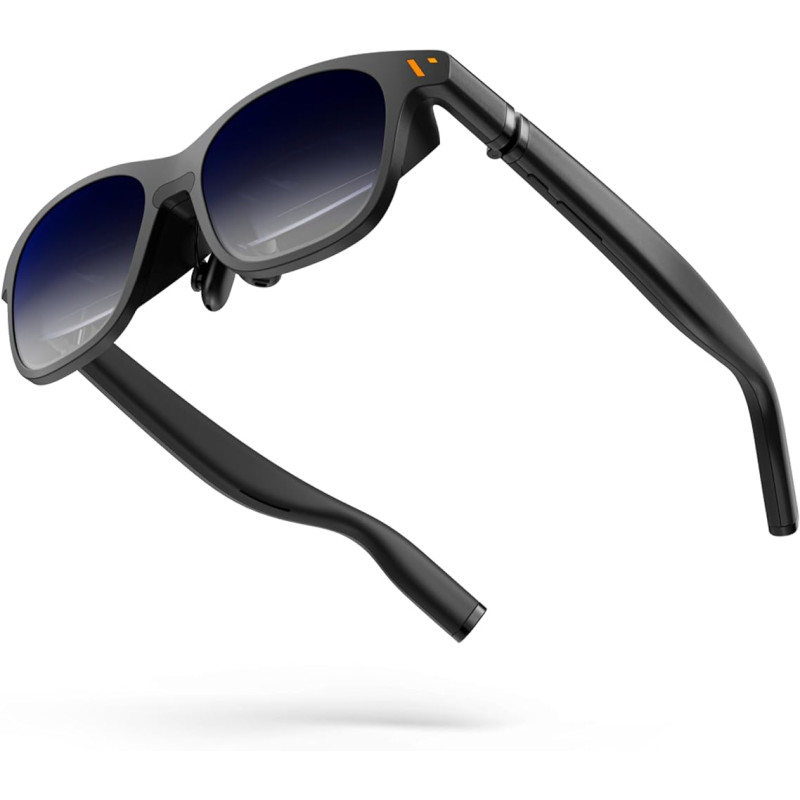
VITURE is a family of wired XR [Extended Reality] glasses that function as a personal, head-mounted display.
VITURE — XR Glasses
VITURE is a family of wired XR [Extended Reality] glasses that function as a personal, head-mounted display.
The glasses project a large virtual screen in front of the user, which can be used for:
- watching movies and TV shows,
- gaming on a computer, portable console, or via cloud services,
- working on one or more virtual screens,
- browsing the internet,
- displaying 2D, 3D, SBS [Side-by-Side] content, and spatial content.
Basic consumer models are not standalone computers. They require connection to a phone, tablet, computer, portable console, the VITURE Pro Neckband module, or a suitable adapter.
The image is generated by Sony Micro-OLED displays.
The glasses do not have their own battery and are powered by the connected device.
The manufacturer uses the term "4K-like," but the actual resolution is a maximum of 1920 × 1200 pixels per eye. This is not native 4K resolution per eye.
Current Models
VITURE Luma
The entry-level model and the most affordable in the current family.
Virtual screen: approximately 146 inches, at a claimed viewing distance of 4 meters.
Field of view: 50°.
Resolution: 1920 × 1200 pixels per eye.
Refresh rate: up to 120 Hz.
Perceived brightness: up to 1000 nits.
VITURE Luma Pro
An intermediate model, designed for users who want a larger image, better fit, and higher sound quality.
Virtual screen: approximately 152 inches.
Field of view: 52°.
Resolution: 1920 × 1200 pixels per eye.
Refresh rate: up to 120 Hz.
Perceived brightness: up to 1000 nits.
VITURE Luma Ultra
The most advanced model in the Luma family.
Virtual screen: approximately 152 inches.
Field of view: 52°.
Resolution: 1920 × 1200 pixels per eye.
Refresh rate: up to 120 Hz.
Perceived brightness: up to 1500 nits.
VITURE Beast
The flagship model designed for entertainment, gaming, and working on a large virtual screen.
Virtual screen: approximately 174 inches at a distance of 4 meters.
Field of view: 58°.
Resolution: 1920 × 1200 pixels per eye.
Refresh rate: up to 120 Hz.
Perceived brightness: up to 1250 nits.
VITURE Helix – A Separate Category
VITURE Helix is not just another variant of consumer display glasses.
It is an announced industrial AI Safety Glasses solution, developed using the NVIDIA XR AI platform.
The device will include:
a 12MP camera,
four microphones,
stereo speakers,
Wi-Fi,
Bluetooth 5.3,
support for multimodal AI models,
instructional features, compliance checks, and workflow documentation.
The product is intended for use in laboratories, manufacturing, and regulated environments, among other applications.
ANSI Z87.1-2025 certification is pending.
Software Required for Operation
Basic Display
For basic screen mirroring, the VITURE app is not required.
The source device must support USB-C display:
- DisplayPort over USB-C,
- DP Alt Mode,
- Thunderbolt 3,
- Thunderbolt 4,
- USB4 with display support.
Just having a USB-C port does not guarantee compatibility.
For devices with HDMI, Nintendo Switch, PlayStation, Xbox, or incompatible phones, the following may be required:
- VITURE Pro Mobile Dock,
- HDMI XR Adapter,
- USB-C XR Charging Adapter,
- other compatible display converter.
SpaceWalker
SpaceWalker is the official companion app for VITURE glasses.
Available platforms:
- Windows,
- macOS,
- Android,
- iOS and iPadOS.
Key Features:
3DoF head tracking,
screen pinning in space,
support for multiple virtual monitors,
ultrawide screen,
playback of 2D, 3D, SBS, 180°, and 360° content,
Ambient Mode,
media player,
real-time 2D-to-3D conversion,
firmware updates for select models.
Availability of specific features varies depending on the system, glasses model, phone, and adapter used.
Requirements for Selected Platforms
iPhone and iPad:
SpaceWalker requires at least iOS 17 or iPadOS 17.
A compatible iPhone model with USB-C can be used for basic viewing.
Some tracking, multi-screen, and VR features require the VITURE adapter.
Android:
The phone must support DP Alt Mode.
Some 3D content requires 4K or higher output.
Not every USB-C phone is compatible.
Windows:
Windows 10 x64 version 1903 or later or Windows 11,
16 GB RAM recommended,
NVIDIA GeForce GTX 1060 or AMD Radeon RX 580 or later recommended,
USB-C port with DP Alt Mode.
macOS:
Current versions of SpaceWalker require macOS Ventura 13 or later,
a Thunderbolt 3, Thunderbolt 4, or USB4 port that supports video is required.
Additional Software and Hardware
Immersive 3D:
A feature that converts 2D videos and photos to 3D,
available on supported Windows, macOS, Android, and iOS devices.
Pro Neckband:
An optional neck-worn computing module
Enables the use of apps, streaming, cloud gaming, remote gaming, AI assistant, and gesture control without directly connecting your phone.
Pro Mobile Dock:
Expands compatibility with HDMI devices and Nintendo Switch,
Includes a rechargeable battery,
Allows you to connect two pairs of glasses for shared gameplay or viewing.
Polish Language Support
The official language list for the SpaceWalker app for iOS includes:
English,
Japanese,
Simplified Chinese,
Traditional Chinese,
Thai.
Polish is not included in the official language list for the iOS version.
I couldn't find any official confirmation of a fully Polish interface in the public documentation for SpaceWalker for Windows, macOS, and Android. Therefore, you should not declare that the app or glasses menu supports Polish.
Polish characters may be displayed correctly as part of an image transmitted from your phone or computer—for example, in a Polish website, a video with subtitles, or a document. This does not mean that the SpaceWalker app is localized to Polish.
Disadvantages and Limitations
Consumer glasses are not standalone computers.
They require a constant wired connection to the source device.
The lack of a dedicated battery means they draw power from a phone, laptop, or console.
Compatibility depends on DP Alt Mode support, not solely on the presence of USB-C.
For HDMI consoles, the Nintendo Switch, and some iPhones, additional adapters or a Mobile Dock may be required.
Expanding the set with adapters, a neckband, and prescription lenses increases the overall cost.
SpaceWalker features are not identical across all platforms.
3DoF tracking in the Luma and Luma Pro models depends on the app and the source device.
The Luma Ultra offers 6DoF, but the number of practical applications that utilize the full AR capabilities is limited by the availability of compatible software.
The term "4K-like" can be misleading—the glasses do not offer native 4K viewing in each eye.
A sharp image depends on:
correct IPD,
nose pad fit,
display distance from the eyes,
user's vision.
If improperly fitted, blurring may occur at the edges of the image.
Beast does not have built-in diopter adjustment.
Weighing 77-88 g, the glasses are heavier than regular prescription glasses.
The manufacturer recommends sessions lasting around 3-4 hours for some models, not continuous all-day use.
The current consumer family lacks native speech recognition and translation functionality similar to that offered by some AI glasses.
VITURE is a family of wired XR [Extended Reality] glasses that function as a personal, head-mounted display.