
Pupil Labs Neon
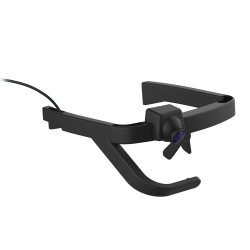
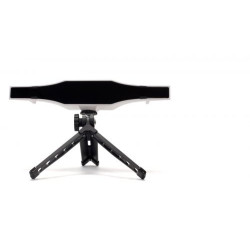
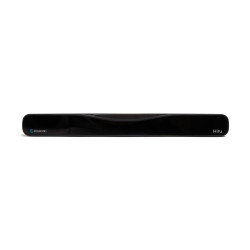
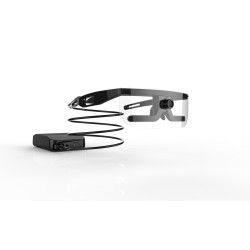
Pupil Labs Neon is a research-grade mobile eye tracking system designed for conducting research in the laboratory and in the user's natural environment.
The system records gaze direction, fixations, saccades, blinks, pupil diameter, eye position and orientation, eyelid opening, ambient image, sound, and head movement data.
NeonNet technology uses deep learning models to determine gaze direction without the need for standard calibration before recording.
Neon begins tracking immediately after the device is placed on the device. It does not require manual positioning of the eye cameras, adjustments to their position, or recalibration of the device during the study.
The system is designed to operate while the participant is freely moving, making it suitable for research in consumer behavior, ergonomics, human-computer interaction, psychology, education, sports, medicine, occupational safety, and processes performed in real-world environments, among other areas.
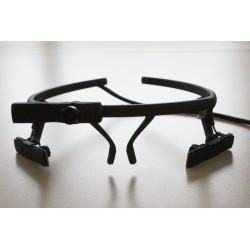
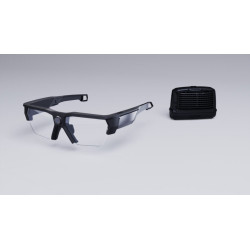
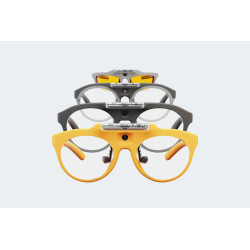
The system's modular design allows for use in research on consumer behavior, ergonomics, human-computer interaction, psychology, education, sports, medicine, occupational safety, and processes performed in real-world environments. The main measurement module can be mounted in a variety of frames, including frames resembling regular glasses, sports frames, safety frames, children's frames, lensless frames, and frames adapted for prescription lenses.
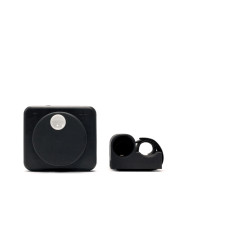
The Neon module contains two infrared eye cameras, a wide-angle ambient camera, microphones, infrared LEDs, and an IMU (Inertial Measurement Unit).
The device connects via USB-C to a supported smartphone acting as the Neon Companion Device. The phone powers the module, performs eye-tracking calculations, and stores the collected data.
Technical Specifications
Eye Tracking Technology: Pupil Labs NeonNet, powered by deep learning.
Tracking Mode: Binocular or Monocular – Separately for the Left or Right Eye.
Calibration: System Requires No Standard Calibration.
Frame Offset Compensation: Automatic, Based on Deep Learning Models.
Claimed Accuracy Without Calibration: Approximately 1.8°.
Claimed Accuracy After Applying Offset Correction: Approximately 1.3°.
Eye Tracking Field: 100° × 80°.
Eyesight Data Rate: Up to 200 Hz.
Eyesight Data: 2D Coordinates in an Ambient Camera Image.
Pupil and Eye Status Data: Up to 200 Hz.
Eye parameters recorded: eye position, eye orientation, pupil diameter, eyelid opening, blinks, fixations, and saccades.
Processing latency: less than 10 ms, measured from image capture to output.
Eye cameras: two infrared cameras.
Eye camera resolution: 192 × 192 pixels.
Eye camera frame rate: up to 200 Hz.
Ambient camera: 1600 × 1200 pixels at 30 frames per second.
Ambient camera field of view: 103° horizontal, 77° vertical, and 128° diagonal.
IMU: accelerometer, gyroscope, and magnetometer.
Head movement, accelerometer, and gyroscope data frame rate: up to 110 Hz.
Audio recording: two integrated microphones; Audio recording can be disabled in the app settings.
Module interface: USB 2.0.
Connection to the Companion Device: USB-C cable.
Neon module dimensions: 35 × 40 × 10 mm.
Neon module weight: 7.3 g.
Complete system weight: Depends on the selected frame; a sample "Just act natural" frame with the module weighs approximately 50 g.
Recording time according to the current manufacturer's specifications: up to approximately 4 hours when recording at 200 Hz or up to approximately 8 hours in 30 Hz mode.
Companion Device memory capacity: over 25 hours of recording.
Computing device: Supported Android smartphone. Current documentation lists the Samsung Galaxy S25 and Motorola Edge 40 Pro, among others; supported configurations may vary depending on the version of the supplied kit.
Available frame types: standard, minimalist, prescription, sports, children's, safety, motion capture, and designs that enable integration with the user's own device.
Software Required for Operation
Neon Companion App – Required for data recording.
The Neon Companion App runs on a compatible Android device and is a fundamental element of every data collection process.
The app is responsible for starting and stopping recordings, previewing images, generating real-time eye tracking data, saving data, and optionally uploading recordings toPupil Cloud.
Initial setup of the app requires creating a Pupil Cloud account. Automatic uploading of recordings to the cloud can be disabled.
The manufacturer officially supports a limited list of smartphones and Android versions. Using any Android phone does not guarantee proper system operation.
Pupil Cloud – Recommended for analysis and study management.
Pupil Cloud is a browser-based platform for storing, processing, visualizing, sharing, and exporting recordings.
The platform enables, among other things, the analysis of fixations, blinks, and pupil diameter, the definition of AOIs (Areas of Interest), the creation of heat maps, and automatic gaze mapping to reference images. Uploading recordings to Pupil Cloud is optional, but some advanced data and analytical processes may not be available without processing the recordings in the cloud.
The free Pupil Cloud plan currently includes two hours of active recording analysis. A paid Unlimited Analysis plan is available for larger projects.
Neon Player – optional software for local work.
Neon Player is a free desktop application that runs on Windows, macOS, and Linux.
The program allows you to play, analyze, and export recordings locally, including to CSV files, without uploading the data to Pupil Cloud.
Neon Player works completely offline and supports extensions for adding custom visualizations, data streams, and analytical processes.
Neon Monitor – optional study preview.
Neon Monitor is a web application that allows remote viewing of images, viewpoints, and recording control from a computer, tablet, or phone connected to the same network.
Real-Time API – optional integration tool.
The API allows for real-time data stream downloads, recording control, event additions, and synchronization of Neon with external research systems.
The system can be integrated with Python, PsychoPy, MATLAB, and LSL [Lab Streaming Layer], among others.