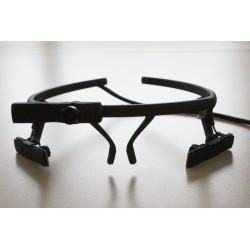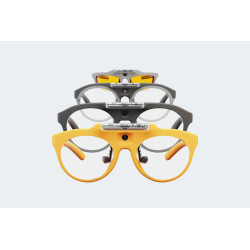

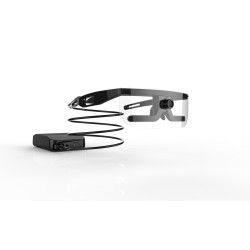
The Argus Science ETVision is a mobile, head-mounted binocular eye tracking system designed for conducting research both in the laboratory and in the user's real-world work environment. The system captures gaze direction at a rate of 180 Hz, or 180 samples per second, and images from an ambient camera in HD resolution.
Argus Science ETVision System
The Argus Science ETVision is a mobile, head-mounted binocular eye tracking system designed for conducting research both in the laboratory and in the user's real-world work environment. The system captures gaze direction at a rate of 180 Hz, or 180 samples per second, and images from an ambient camera in HD resolution.
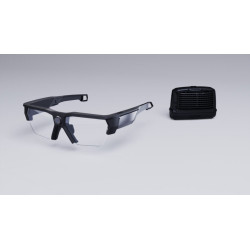
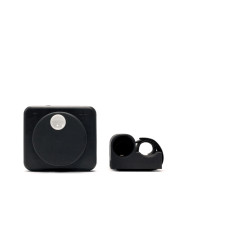
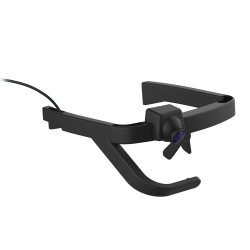
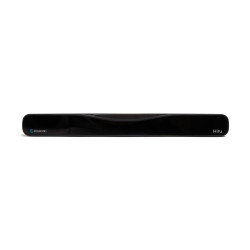
The head-mounted component is a lightweight spectacle frame. It contains two eye cameras, near-infrared light sources, a wide-angle ambient camera, and a microphone. The frame can also be worn over prescription glasses. It is connected via HDMI to a portable controller that can be worn on a belt or in a pocket.
Data can be:
transferred in real time to a computer via Wi-Fi or wired LAN,
saved directly to a microSD card,
analyzed live,
and then processed based on the recorded images from the eye cameras and ambient camera.
The system measures, among other things, gaze point, pupil size, eyelid position, blinks, and fixations (periods of relatively stable visual attention). It can also recognize objects in the surrounding camera image and determine which ones the subject is looking at.
Technical Specifications
System type: Mobile, head-worn eye tracker.
Measurement method: Dark Pupil – Corneal Reflection, which analyzes the dark pupil and light reflection from the cornea.
Binocular measurement: yes.
Gaze measurement frequency: 180 Hz.
Declared accuracy: 0.5° of viewing angle.
Calibration: Automatic, single-point or multi-point.
Automatic parallax compensation: yes.
Automatic vergence correction for various viewing distances: yes.
Pupil size measurement: in millimeters or pixels.
Upper and lower eyelid position recording: yes.
Real-time blink detection: yes.
Real-time fixation detection: yes.
Area of interest tracking: LAOI [Live Area of Interest], which dynamically tracks defined areas in the image.
AI object recognition: available.
Standard AI model: Recognizes 80 common object classes.
Creating custom object recognition models: Available via the optional AI Object Training module.
Eye camera registration: Both cameras, 320 × 240 pixels, 180 fps.
Ambient camera registration: 1280 × 720 pixels, 30 fps.
Standard ambient camera viewing angle: Approximately 96° horizontally, 16:9 aspect ratio.
Ambient camera lens: Interchangeable.
Microphone: Built-in.
Controller headphone jack: 3.5 mm.
Two-way audio capability: Yes.
Compatibility with user prescription glasses: Yes.
Outdoor compatibility: Yes.
Sunshield: Removable, polarized.
Headpiece weight: 56 g.
Number of interchangeable nose pads: Three.
Controller processor: ARM Cortex-A9. Controller operating system: Linux.
Storage medium: microSD card.
Typical card capacity: 128 GB.
Typical recording time on a 128 GB card: over 5 hours.
Battery: lithium polymer, rechargeable.
Battery operating time: over 5 hours.
Charging time for a depleted battery: approximately 4.5 hours when not in use.
Controller dimensions: 150 × 80 × 36 mm.
Controller weight with battery: 345 g.
Wireless connectivity: 802.11ac Wi-Fi.
Wired connectivity: Gigabit Ethernet.
Connection between the eyepiece frame and the controller: HDMI cable.
Measurement data streaming: via LAN or Wi-Fi.
Local recording without a computer in range: via microSD card. Synchronization with external devices: available via network, time stamps, and optional TTL signals.
Integration with motion capture systems, including Vicon, Qualisys, and Advanced Realtime Tracking, using the optional ET3Space solution.
SDK [Software Development Kit] examples available: Python, MATLAB, LSL [Lab Streaming Layer], and more.
Software Required for Operation
ETVision Application — Required
A basic application used to:
connect the computer to the controller,
view images from both eyes and the surrounding camera,
calibrate the user being tested,
calculate the gaze point,
record data at 180 Hz,
save videos from cameras,
support fixation, blink, LAOI, and AI object detection,
read footage recorded on a microSD card.
A computer, typically a laptop, with the ETVision application installed is required for full system operation. The computer can be supplied by the manufacturer with a ready-made configuration or provided by the user.
Minimum computer configuration as listed in the ETVision manual:
Intel Core i7-8750H processor or higher,
Windows 10 Pro 64-bit or Windows 11,
8 GB DDR4 RAM,
Graphics card with at least an NVIDIA GeForce RTX 2060 with at least 6 GB of memory,
802.11ac Wi-Fi,
Gigabit Ethernet network adapter,
Two USB 3.0 ports,
SD card reader,
Microphone and speaker support.
ETAnalysis — for analyzing results
ETAnalysis software is included with the system as standard and is used to analyze recorded data. It enables, among other things:
analysis of raw data,
detection of fixations and saccades,
calculation of gaze time and dwell time in regions of interest,
analysis of pupil size and blink rate,
creation of heat maps,
creation of gaze paths,
analysis of moving regions of interest,
combination of results from multiple participants,
creation of group statistics,
export of results to Excel and text files.
The current ETAnalysis manual specifies a computer with:
Windows 11,
minimum 16 GB RAM,
NVIDIA RTX 3060 or higher,
a CUDA-enabled driver.
The lack of a compatible NVIDIA card or CUDA driver will disable the AI object detection feature.
ETRemote - for remote control
ETRemote is an included application for an additional computer running Windows 10 or Windows 11. It allows you to:
remotely observe data and images from ETVision,
start and stop recording,
synchronize multiple ETVision systems,
add event markers to data,
present images and videos to the user according to a pre-defined script,
record the screen of the computer presenting the stimuli.
ETPhone – Optional Application
ETPhone allows you to control some system functions via your smartphone:
viewing camera images,
checking eye recognition,
automatic calibration,
starting and stopping recording to a microSD card,
changing basic image and sound settings.
Direct data recording on the phone is limited to 30 Hz. To obtain full 180 Hz data, the manufacturer recommends saving to a computer or microSD card and then processing it in the ETVision application.
Software and Optional Modules
ET3Space – analysis of gaze direction and point of view in a three-dimensional coordinate system using an external head tracking system.
StimTrac – analysis of gaze at a screen or presented stimulus, similar to a stationary eye tracker.
AI Object Training – creation of custom AI models that recognize objects specific to a given study.
SDK and Network Protocol – integration of ETVision with your own software, experimental systems, LSL, Python, or MATLAB.
The Argus Science ETVision is a mobile, head-mounted binocular eye tracking system designed for conducting research both in the laboratory and in the user's real-world work environment. The system captures gaze direction at a rate of 180 Hz, or 180 samples per second, and images from an ambient camera in HD resolution.