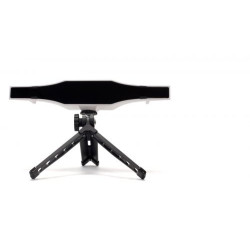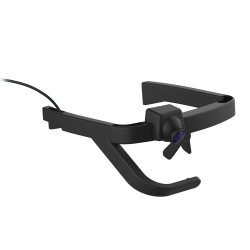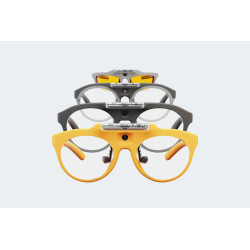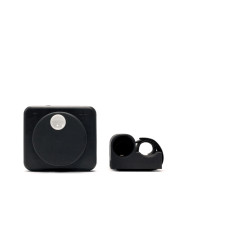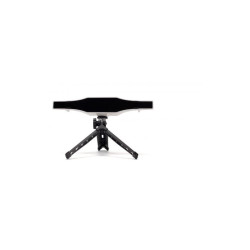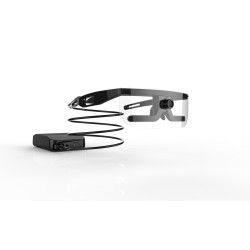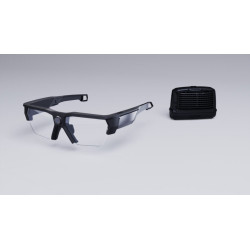
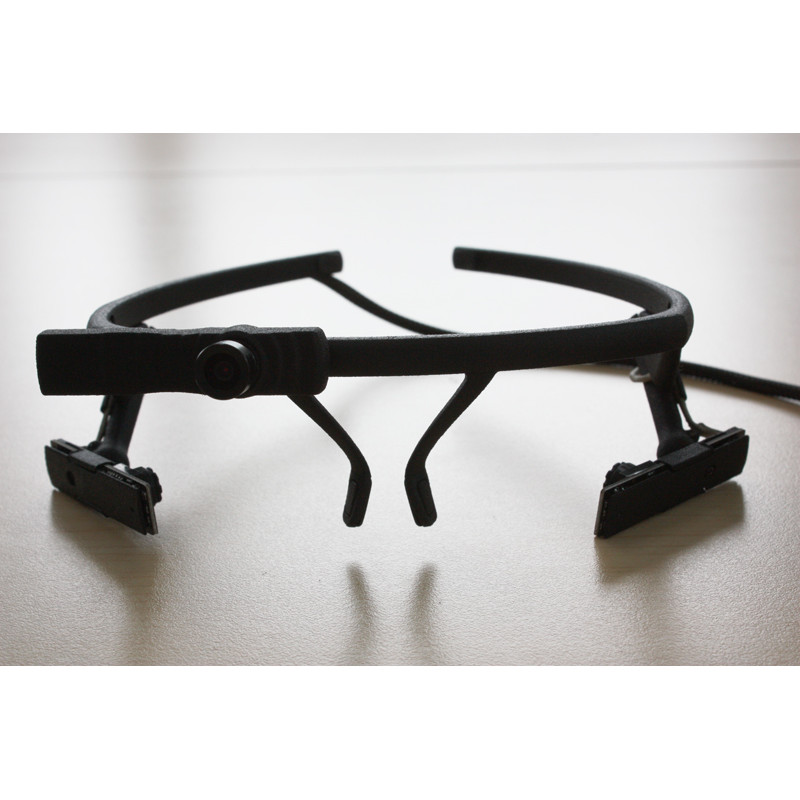
Pupil Labs Core is a modular, head-mounted eye tracking platform designed primarily for scientific research, experimental projects, user behavior analysis, and the development of custom solutions utilizing gaze direction and pupil diameter data. The system consists of a lightweight frame, two infrared cameras that monitor the eyes, a scene camera that captures the user's field of view, and the open-source Pupil Core software.
Pupil Labs Core
Pupil Labs Core is a modular, head-mounted eye tracking platform designed primarily for scientific research, experimental projects, user behavior analysis, and the development of custom solutions utilizing gaze direction and pupil diameter data. The system consists of a lightweight frame, two infrared cameras that monitor the eyes, a scene camera that captures the user's field of view, and the open-source Pupil Core software.
The device can operate in either a binocular or monocular configuration. Data can be recorded locally on a computer, analyzed after the study is completed, or transmitted in real time via a web-based API (Application Programming Interface). The platform is open to integration, custom Python plugins, and connections to other research devices.
Specifications
Device type: Head-mounted eye tracker.
Tracking configuration: Binocular or monocular.
Tracking technology: Dark pupil technique and 3D eye model.
Eye cameras: 2 IR [Infrared] cameras.
Eye camera resolution and frequency: 192 x 192 pixels at a maximum of 200 Hz.
Scene camera mode 1: 1920 x 1080 pixels at 30 Hz.
Scene camera mode 2: 1280 x 720 pixels at 60 Hz.
Scene camera mode 3: 640 x 480 pixels at 120 Hz.
Manufacturer-declared accuracy: 0.60° after calibration.
Manufacturer-declared precision: 0.02°.
Calibration: Five-point calibration is standard; other calibration methods are also available.
Face frame offset compensation: Implemented using a three-dimensional eye model.
2D gaze data: Gaze position in a two-dimensional coordinate system.
3D gaze data: Three-dimensional gaze direction rays and gaze point determined based on binocular vergence.
2D pupil data: Pupil position and diameter provided in pixels of the eye camera image.
3D pupil data: Eye model parameters and pupil diameter provided in millimeters.
Real-time data transmission: Gaze data, pupilometric data, and video streams via local network.
PC connection: Wired; the headset uses a USB-C connector, and a USB-C to USB-A cable is included.
Frame material: Nylon PA12.
Frame weight: 22.75 g; The manufacturer does not provide specifications on the website for the total weight of the setup, including cameras and cables.
Eye camera adjustment: Camera arms can be moved and positioned using six-degree-of-freedom joints.
Scene camera adjustment: Vertical angle adjustment and manual focus adjustment are possible.
Scene camera lenses: Wide-angle and narrow-angle lenses are available depending on the configuration.
Minimum manufacturer requirements: Desktop or laptop computer, Intel Core i7 processor or higher, and at least 8 GB of RAM.
Software Required for Operation
Pupil Capture
A basic application for device configuration and recording. It receives images from the eye cameras and scene camera, detects pupils, determines gaze direction, handles calibration, records video and events, and provides real-time data.
Pupil Player
A program for playing and analyzing recordings made with Pupil Capture. It allows for visualizing gaze in the scene camera image, analyzing data, running plugins, and exporting recordings and results for further processing.
Pupil Service
A lightweight application designed primarily for VR [Virtual Reality] and AR [Augmented Reality] integration. It does not display the scene camera image, uses fewer resources, and may offer lower gaze mapping latency than Pupil Capture.
Pupil Core Software Package
The software is released as an open source project. The official release page still lists version 3.5 as the latest ready-made package for Pupil Capture, Pupil Player, and Pupil Service. This release package lists support for Windows 10, Ubuntu 16.04 or later, and macOS from Mojave 10.14 to Monterey 12. In macOS 12, Pupil Capture and Pupil Service must be run with administrator privileges to access cameras.
For newer systems, particularly Windows 11 and later versions of macOS, compatibility should be confirmed with Pupil Labs before purchase or deployment, as they are not listed on the official list of systems supported by the current binary package.
Pupil Labs Core is a modular, head-mounted eye tracking platform designed primarily for scientific research, experimental projects, user behavior analysis, and the development of custom solutions utilizing gaze direction and pupil diameter data. The system consists of a lightweight frame, two infrared cameras that monitor the eyes, a scene camera that captures the user's field of view, and the open-source Pupil Core software.