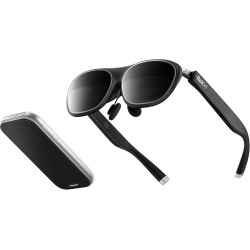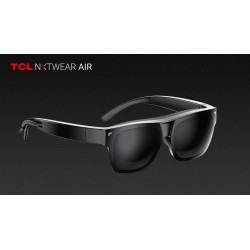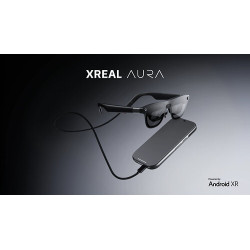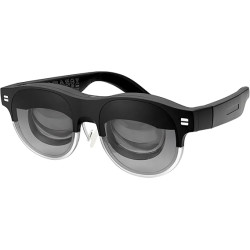
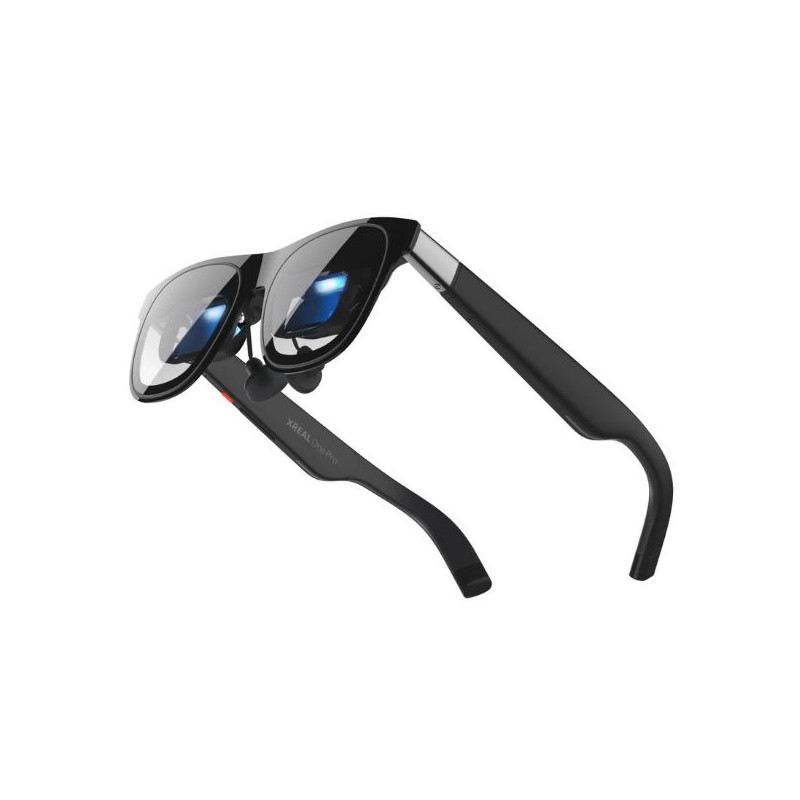
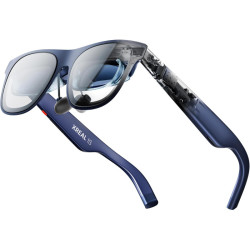
XREAL is a family of lightweight augmented reality (AR) glasses that project a large, virtual screen in front of the user. They can be used with smartphones, computers, consoles, and portable gaming devices.
XREAL is a family of lightweight augmented reality (AR) glasses that project a large, virtual screen in front of the user. They can be used with smartphones, computers, consoles, and portable gaming devices.
In practice, most XREAL models should be considered primarily portable 3D displays, not completely standalone AR headsets similar to the Microsoft HoloLens. The glasses typically require a USB-C cable connection to the source device or the XREAL Beam Pro. However, the XREAL One series has its own X1 processor, which supports 3DoF stabilization and tracking without an additional device.
3DoF [Three Degrees of Freedom] – tracking head rotation: tilt, roll, and roll.
6DoF [Six Degrees of Freedom] – additionally tracking the user's movement forward, backward, sideways, up, and down.
The glasses can be used for watching movies, working on a large virtual screen, gaming, presentations, remote desktop, and running selected 3D applications.
Available Models
XREAL 1S
The current all-in-one model designed for movies, games, and working on a virtual screen.
Spatial processor: XREAL X1.
Tracking: Native 3DoF directly through the glasses.
Display: 0.68-inch Sony Micro-OLED.
Combined resolution for both eyes: 3840 × 1200 pixels.
Field of view: 52°.
Refresh rate: 90 Hz standard, 120 Hz maximum.
Peak brightness: 700 nits.
Contrast: 100,000:1.
Color gamut: 108% sRGB.
Color accuracy: ΔE < 3.
Virtual screen size: 31 to 500 inches.
Adjustable viewing distance: 1 to 10 meters.
IPD (Interpupillary Distance) Adjustment: Software, range approximately 59.5–70.5 mm.
Electrochromic Dimming: Three levels and Auto mode.
Audio: Sound by Bose.
Microphones: Four-microphone array.
Functions: Anchor, Follow, UltraWide, Side View, and 2D to 3D conversion – REAL 3D.
XREAL One
Model with an integrated X1 processor, offering native 3D modes without the need for Beam Pro.
Processor: XREAL X1.
Tracking: Native 3DoF.
Display: 0.68-inch Sony Micro-OLED.
Resolution: 1920 × 1080 pixels.
Field of View: 50°.
Maximum Refresh Rate: 120 Hz.
Motion-to-Photon Latency (M2P): 3 ms.
Perceived Brightness: Up to 600 nits.
Default Virtual Screen: Approximately 147 inches.
Electrochromic Dimming: Three levels.
IPD Adjustment: Software.
Audio: Sound by Bose.
Weight: 84 g.
Can be upgraded with the XREAL Eye module, including for 6DoF functionality.
XREAL One Pro
Premium model with a wider field of view and the new X Prism optics.
Processor: XREAL X1.
Optics: X Prism.
Tracking: Native 3DoF.
Display: 0.55-inch Sony Micro-OLED.
Resolution: 1920 × 1080 pixels.
Field of view: 57°.
Maximum refresh rate: 120 Hz.
M2P latency: 3 ms.
Brightness: Up to 700 nits.
Virtual screen: Approximately 171 inches at standard setting.
Electrochromic dimming: Three levels.
Audio: Sound by Bose.
Weight: 87 g.
Two interpupillary distance options available:
M: IPD 57–66 mm,
L: IPD 66–75 mm. Additional software IPD correction.
Optical design reduces externally visible reflections.
Upgradeable with the XREAL Eye camera and 6DoF capabilities.
XREAL Air 2
Lighter version of the previous generation, designed primarily for displaying images from a smartphone, computer, or console.
Display: 0.55-inch Sony Micro-OLED.
Resolution: 1920 × 1080 pixels per eye.
Field of view: 46°.
Refresh rate:
up to 120 Hz in 2D mode,
up to 90 Hz in 3D mode.
Brightness: up to 500 nits.
Weight: 72 g.
Built-in speakers and microphones.
Adjustable earpieces and interchangeable nose pads.
No built-in X1 processor.
3DoF spatial features require Beam, Beam Pro, or compatible software.
XREAL Air 2 Pro
An evolved version of the Air 2 with electrochromic lens dimming.
Display: 0.55-inch Sony Micro-OLED.
Resolution: 1920 × 1080 pixels per eye.
Field of view: 46°.
Refresh rate:
up to 120 Hz in 2D mode,
up to 90 Hz in 3D mode.
Brightness: up to 500 nits.
Weight: 75 g.
Three levels of electrochromic dimming: 0%, 35%, and 100%.
Two speakers and two microphones.
Directional audio reduces audibility for those around you.
Body Anchor and Smooth Follow modes require XREAL Beam Pro.
No native X1 spatial processor.
XREAL Air 2 Ultra
This model is designed primarily for developers and applications requiring spatial awareness.
Construction: Titanium.
Weight: 83 g.
Display: Sony Micro-OLED.
Resolution: 1920 × 1080 pixels per eye.
Field of view: 52°.
Refresh rate:
up to 120 Hz in 2D mode,
up to 90 Hz in stereoscopic 3D mode.
Brightness: up to 500 nits in 2D mode.
Electrochromic dimming: three levels.
Sensors: Two environmental cameras.
Tracking: 6DoF.
Supported features:
hand tracking,
head tracking,
plane detection,
depth meshing,
spatial anchors,
image tracking.
The environmental cameras are not intended for regular video recording or still photography. Full functionality requires the XREAL SDK and a compatible computing device, such as the Beam Pro or a compatible phone.
XREAL xbx a01+
Lightweight model focused on gaming and display.
Display: SeeYa Micro-OLED 0.6-inch.
Resolution:
1920 x 1080 in 2D mode,
3840 x 1080 in 3D mode.
Field of view: 50°.
Maximum refresh rate: 120 Hz.
HDR10 and AI-HDR support.
Contrast: 2,000,000:1.
Color gamut: 145% sRGB.
Color accuracy: ΔE < 2.
IPD range: 54.5–74.5 mm.
Weight: 62 g with removable front panel, 56 g without front panel. No built-in battery. Power and display via USB-C with DisplayPort Alt Mode.
Software Required for Operation
Basic Display
No additional software is required for basic screen mirroring.
The source device must support USB-C DisplayPort Alt Mode.
The XREAL One Series can natively implement Anchor, Follow, and UltraWide modes thanks to the X1 processor.
The One Series glasses do not have their own battery; they are powered by the connected device.
XREAL Beam Pro
The Beam Pro is a separate smartphone-like device designed to act as a processing unit and controller for the glasses.
Operating System: NebulaOS based on Android 14.
Access to Google Play.
Support for Android apps displayed as 3D windows.
Built-in My Glasses app for configuring the glasses.
3DoF support with Air and One models.
Full 6DoF support with Air 2 Ultra and appropriately configured One models with XREAL Eye.
Glasses software updates can be installed automatically upon connection. XREAL SDK
The XREAL SDK development environment is required for applications created specifically for AR.
Current version described by the developer: XREAL SDK 3.1.0.
Integration with Unity.
Support for the Unity XR Interaction Toolkit.
Integration with AR Foundation.
Features include:
6DoF,
hand tracking,
spatial anchors,
image detection,
plane detection,
access to cameras and sensors.
The developer is testing the SDK only with select devices, including the Beam Pro and Samsung Galaxy S25.
Control Glasses
The Control Glasses app is required to run AR apps on select Android phones when not using the Beam Pro.
It is also used to update firmware and run apps developed with the XREAL SDK.
The manufacturer limits compatibility testing primarily to flagship Samsung phones.
The developer portal states that the previous Nebula software will no longer be developed or maintained.
Firmware Update
Updates can be performed via the XREAL OTA website in the Chrome browser on a Windows or macOS computer.
Alternatively, the firmware can be updated automatically after connecting the glasses to the Beam Pro.
Advantages
Lightweight and significantly less bulky than typical VR [Virtual Reality] headsets.
High-quality Micro-OLED displays with Full HD or 1200p resolution.
Refresh rate up to 120 Hz, and in the ROG XREAL R1 gaming headset, even up to 240 Hz.
The One series provides a stable 3DoF screen without an additional app or Beam Pro.
Get a very large virtual screen without a physical monitor or TV.
Extensive compatibility with computers, select smartphones, and portable consoles.
Electrochromatic dimming in the 1S, One, One Pro, Air 2 Pro, and Air 2 Ultra models.
Adaptation of corrective lenses for those with visual impairments is supported.
The One and 1S models offer Side View, UltraWide, and REAL 3D modes.
The Air 2 Ultra offers 6DoF spatial capabilities, hand tracking, and ambient recognition.
The lack of cameras in the base models mitigates some of the risks associated with inadvertent recording of surroundings.
Disadvantages and Limitations
Most models are not standalone devices – they require a phone, computer, console, or Beam Pro.
A USB-C cable is required during use.
The glasses draw power from the source device, which can accelerate phone, laptop, or console battery drain.
Not every USB-C port supports DisplayPort Alt Mode; the shape of the USB-C connector itself does not guarantee compatibility.
Consoles and devices with HDMI output require additional adapters or a docking station.
The Air 2 and Air 2 Pro models do not have a native spatial processor – stable 3DoF modes require an additional device.
Full 6DoF is only available with specific configurations, such as the Air 2 Ultra or One Series with XREAL Eye and compatible software.
The 46-57° field of view is significantly smaller than that of typical VR headsets; the image resembles a large screen in front of the user, rather than completely filling the field of view. Image quality at the edges may depend on pupillary distance, face shape, nose pad position, and the correct selection of the M or L version.
People with visual impairments may require additional corrective inserts.
The software is in a transitional period: Nebula is no longer maintained, and the manufacturer is shifting development to Beam Pro, Control Glasses, and the XREAL SDK.
Not all Android features and apps are optimized for the spatial interface.
Powerful 6DoF capabilities, spatial processing, and additional cameras increase the cost of the entire system.
XREAL is a family of lightweight augmented reality (AR) glasses that project a large, virtual screen in front of the user. They can be used with smartphones, computers, consoles, and portable gaming devices.