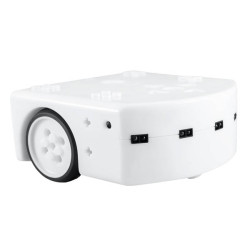
Mobsya Thymio is a small, interactive educational robot designed for learning programming, robotics, logical thinking, and STEAM topics.
STEAM stands for Science, Technology, Engineering, Arts, and Mathematics.
The robot was developed by researchers from the Swiss polytechnic university EPFL in collaboration with the ECAL design school and is manufactured by the non-profit organization Mobsya.
Mobsya Thymio – an educational robot for learning programming and robotics
Mobsya Thymio is a small, interactive educational robot designed for learning programming, robotics, logical thinking, and STEAM topics.
STEAM stands for Science, Technology, Engineering, Arts, and Mathematics.
The robot was developed by researchers from the Swiss polytechnic university EPFL in collaboration with the ECAL design school and is manufactured by the non-profit organization Mobsya.
Thymio's design is based on open-source hardware and software, making it suitable for use in both beginner programming classes and more advanced school, academic, and research projects.
The robot is delivered as a complete, pre-assembled device and can be started without prior programming.
The user has six pre-programmed behaviors, including line tracking, obstacle avoidance, hand movement, and robot control. The colored backlight on the housing indicates the currently selected operating mode and sensor responses.
After connecting to a computer or mobile device, users can create their own programs using graphical interfaces, programming blocks, or text code.
Thymio can be used in primary and secondary schools, universities, during extracurricular activities, robotics workshops, and for home learning.
Available Models and Variants
Thymio – Wired Version
The basic version of the robot communicates with a computer via a USB cable.
The cable is used for both programming and charging the device.
The kit includes the robot, a USB-Micro-USB cable, and an instruction manual.
This solution is suitable for a single user, home learning, or workspaces where a wired connection is not a limitation.
Wireless Thymio – Wireless Version
This version is equipped with a wireless communication module.
The robot communicates with the computer via the included USB receiver operating in the 2.4 GHz band.
The wireless connection allows programming the robot and monitoring its parameters without the need for a cable.
The kit includes the Wireless Thymio robot, a USB cable, a USB receiver, and an instruction manual.
This variant is particularly useful for group classes, floor work, and experiments requiring free movement of the robot.
Thymio AI
A special educational kit that combines the Wireless Thymio robot with the AlphaAI software. It enables classes on artificial intelligence, neural networks, and machine learning.
A graphical interface allows you to connect the robot's sensor readings with its actions, such as forward, backward, turning, or rotating.
The robot can be trained using supervised learning or reinforcement learning.
The kit includes the Wireless Thymio robot, an AlphaAI activation key, a USB cable, a wireless receiver, a getting started guide, a sticker, and five sets of educational materials.
Thymio AI is a software-education variant. The robot itself uses the Wireless Thymio design.
Thymio 3
The next generation of the Thymio robot, announced by the manufacturer for release in September 2026.
The robot has built-in Bluetooth communication, eliminating the need for a proprietary USB receiver.
It can connect directly to computers, Chromebooks, tablets, and smartphones.
It is equipped with an improved three-axis gyroscope and accelerometer, allowing for more accurate rotations, routes, and geometric drawings. It features a downward-facing RGB color sensor.
It offers an improved sound system, the ability to play MP3 files, and save recorded sounds to the robot's memory.
It contains 51 programmable LEDs.
It is charged via USB-C.
It offers ten preset operating modes: six classic behaviors known from Thymio 2 and four new modes related to movement sequences, music, geometry, and machine learning.
It is available as a single robot or in classroom kits with six robots, USB-C cables, mats, a multi-port charger, and a carrying case.
Thymio 2+
The Thymio 2+ is not a robot.
It is a special educational router used to connect Wireless Thymio robots to tablets.
One receiver connected to the router can support up to 12 robots.
The device creates a local Wi-Fi network to which student tablets connect.
It works with the Thymio Suite Mobile app and the VPL3 and Scratch environments.
It supports tablets running Android 12 or later and iPadOS/iOS 13 or later.
It only operates on the 2.4 GHz Wi-Fi band.
It does not support 5 GHz networks, login portal networks, or direct connection to Windows, macOS, or Linux systems.
Thymio and Wireless Thymio Technical Specifications
Robot dimensions: 11 x 11.2 x 5.3 cm.
Packaging dimensions: 13.5 x 15 x 7.5 cm.
Wireless Thymio weight: approximately 270 g.
Wired version weight: approximately 265–270 g, depending on the revision.
Battery: Li-Po lithium polymer.
Battery voltage: 3.7 V.
Battery capacity: 1500 mAh.
Charging: via Micro-USB port.
Declared operating time: over two hours; previous technical documentation states approximately three to five hours, depending on use.
Maximum speed: 14 cm/s.
Wired version connectivity: USB.
Wireless version connectivity: 2.4 GHz, IEEE 802.15.4 protocol. Card reader: MicroSD.
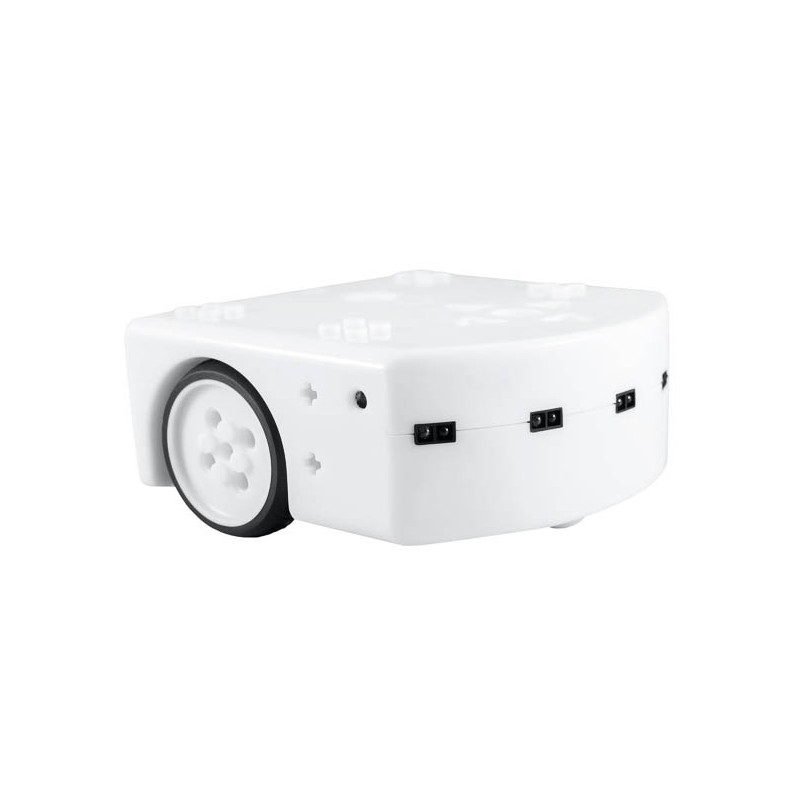
A hole in the center of the housing allows you to attach a pencil or marker.
A rear hook allows you to pull lightweight items or structures.
The housing is designed for educational use and is resistant to typical impacts encountered during classes.
Sensors
Nine infrared sensors.
Approximate infrared sensor range: approximately 10 cm.
Seven horizontal proximity sensors located on the front and rear of the robot.
Two downward-facing ground sensors detect lines, edges, and brightness differences.
Five capacitive touch buttons.
Three-axis accelerometer.
Temperature sensor.
Microphone.
Infrared receiver compliant with the RC-5 standard, enabling remote control.
The Wireless version also includes a wireless communication module.
Actuators
Two independently controlled DC motors connected to the wheels.
39 programmable LEDs.
Built-in speaker.
Multicolor housing illumination.
Ability to control the speed and direction of each wheel individually.
Ability to generate simple sounds, melodies, and warning signals.
Software required for operation
Programming-free operation
Software installation is not required to use the six pre-installed robot behaviors. The robot can be started and operated using the buttons located on the housing.
Thymio Suite
The primary development environment for Thymio and Wireless Thymio is the free Thymio Suite.
The software is available for Windows, macOS, and Linux.
Client applications for Android devices and iPads are also available.
Thymio Suite includes tools for users of varying skill levels.
Supported Development Environments
VPL – Visual Programming Language, a visual programming language based on combining events with actions.
VPL3 – a newer version of the visual programming environment.
Scratch – a popular block-based programming environment.
Blockly – an environment using programming blocks.
Aseba Studio – a text-based and event-driven environment for more advanced programming.
Python – a text-based language enabling the implementation of more complex projects.
ROS – Robot Operating System, used in advanced robotics and academic projects.
Thymio AI Software
AlphAI software is required for artificial intelligence classes. The AlphaI license is included with the Thymio AI kit.
The environment allows you to graphically build and train neural networks without the need for hand-coding.
Thymio 3 Software
Thymio 3 uses the new, browser-based thymio.Lab environment.
The software does not require traditional installation.
It supports Chrome, Safari, and Edge browsers.
The platform includes the visual vpl.Lab environment, the block-based scratch.Lab environment, and the text-based py.Lab using MicroPython.
The platform is also designed to work with existing Thymio 2 robots.
Accessories
Wireless Kit – a kit that allows you to transform a compatible wired robot into a Wireless Thymio.
The Wireless Kit includes an electronic module that requires soldering, a USB receiver, installation instructions, and device labeling.
Thymio 2+ – a router that allows you to connect Wireless Thymio robots to tablets.
Thymio Challenge Activities – a set of 30 cards with activities of increasing difficulty.
The Challenge Activities kit also includes sheets for building obstacles, a racetrack, and a guide to the robot and the VPL environment. Thymio Discovery Kit – a foldable A1 mat with a route and a double-sided card containing games and programming tasks.
Experiment kit for ground sensors.
Experiment kit for proximity sensors.
Infrared remote control compatible with the RC-5 standard.
The remote control requires two AAA batteries, which are not included.
Multi-port USB charger designed to charge multiple robots simultaneously.
Carrying case for six robots.
Carrying case can hold six robots, a six-port charger, a remote control, Challenge Activities materials, and contoured safety features.
Mats and tracks for tracing lines.
A standard pencil or marker that fits in the robot's center hole.
Thymio 3 classroom case with six robots, mats, USB-C cables, a charger, and a remote control.
Mobsya Thymio is a small, interactive educational robot designed for learning programming, robotics, logical thinking, and STEAM topics.
STEAM stands for Science, Technology, Engineering, Arts, and Mathematics.
The robot was developed by researchers from the Swiss polytechnic university EPFL in collaboration with the ECAL design school and is manufactured by the non-profit organization Mobsya.