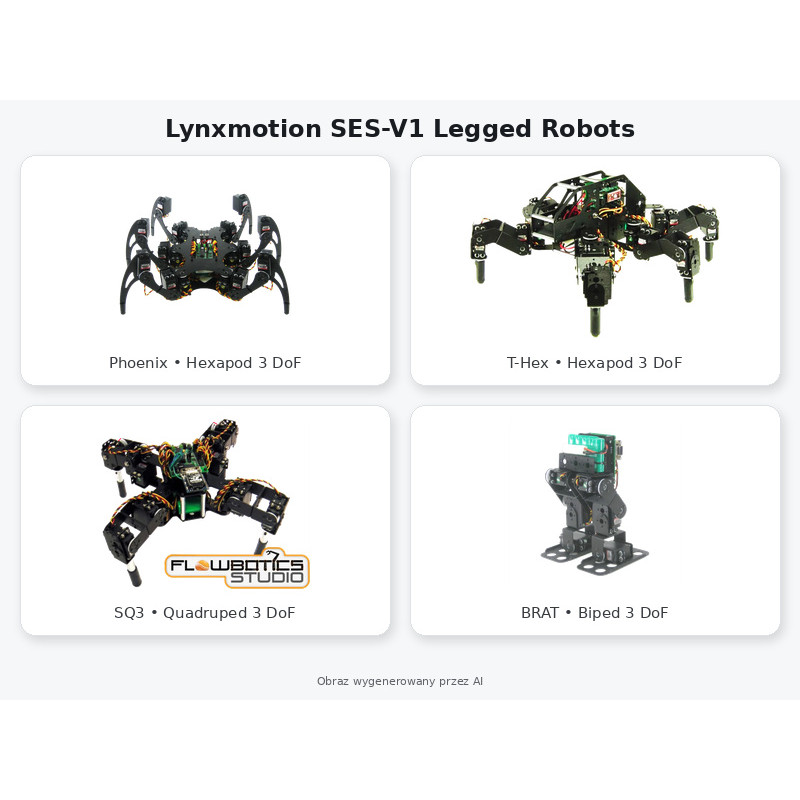
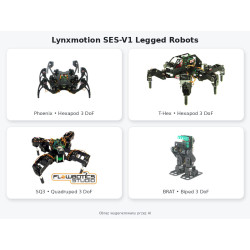
Lynxmotion SES-V1 Legged Robots is a series of modular walking robots designed for education, programming, kinematics research, prototyping, and hobby applications.
The series primarily includes six-legged robots – hexapods, as well as quadrupedal, bipedal, and humanoid designs.
Most designs are based on the SES-V1 – Servo Erector Set V1 system [a modular robot construction system using classic RC servos].
The modular design allows for the combination of various bodies, legs, handles, servos, controllers, and additional sensors.
Lynxmotion SES-V1 Legged Robots – Series Description
Lynxmotion SES-V1 Legged Robots is a series of modular walking robots designed for education, programming, kinematics research, prototyping, and hobby applications.
The series primarily includes six-legged robots – hexapods, as well as quadrupedal, bipedal, and humanoid designs.
Most designs are based on the SES-V1 – Servo Erector Set V1 system [a modular robot construction system using classic RC servos].
The modular design allows for the combination of various bodies, legs, handles, servos, controllers, and additional sensors.
Individual legs can have from two to four degrees of freedom.
DoF stands for Degrees of Freedom, which is the number of independently controlled axes of motion.
Designs with three or four degrees of freedom per leg can move in multiple directions, rotate in place, and vary the body height and gait. Motion control uses inverse kinematics, which allows the required joint positions to be calculated based on the expected leg and body positions.
The mechanical design is primarily based on anodized or brushed aluminum components and black polycarbonate components.
The drive is provided by classic Hitec RC servos.
Depending on the version, the kit may include just the mechanical structure, a servos-enabled structure, or a complete kit with an SSC-32U controller and a BotBoarduino microcontroller.
Not all variants include a battery, charger, wireless controller, or control electronics. Contents should be verified by the kit's catalog number.
Models
The manufacturer's current catalog lists three main families of SES-V1 Legged robots:
Phoenix 3 DoF
T-Hex 3 DoF
T-Hex 4 DoF
Each family is available in several configurations.
Phoenix 3 DoF Hexapod
The Phoenix is a six-legged robot with a design inspired by the natural leg arrangement of insects.
Each of the six legs has three degrees of freedom.
The robot has a total of 18 active axes of motion.
The legs are powered by 18 Hitec HS-645MG servos.
The design allows for movement in any direction, rotation in place, and a combination of translation and rotation.
The body height, leg lift height, and gait speed and type can be adjusted via software.
The Phoenix provides a more natural and extended leg movement than classic symmetrical hexapods. The manufacturer notes, however, that the Phoenix design has a lower load-bearing capacity than some other Lynxmotion hexapods.
Available catalog configurations:
PHOE-NE – kit with mechanics and servos, without a servo controller and microcontroller;
PHOEU – kit with the BotBoarduino control system;
PHOE-BLK – black mechanical design without servos and electronics.
Phoenix 3 DoF Specifications
Number of legs: 6.
Degrees of freedom per leg: 3.
Total degrees of freedom: 18.
Servos: 18 × Hitec HS-645MG.
Steering: Omnidirectional.
Declared movement speed: approximately 10 inches per second, or approximately 254 mm/s.
Total length: approximately 368 mm.
Total width: approximately 432 mm.
Maximum overall height: approximately 133 mm.
Body length: approximately 191 mm.
Body width: approximately 149 mm.
Body height: approximately 51 mm.
Maximum ground clearance: approximately 140 mm.
Weight without battery: approximately 1.64 kg.
Servo control: Local closed-loop position control inside each servo.
Recommended power supply: 6 V NiMH battery.
The manufacturer indicates compatibility with 1600 mAh or 2800 mAh batteries.
The battery and charger are not included with all configurations.
T-Hex 3 DoF Hexapod
The T-Hex 3 DoF is a six-legged robot with a design inspired by mech robots.
Each leg has three degrees of freedom.
The robot has a total of 18 active axes of motion.
It is powered by 18 Hitec HS-645MG servos.
Offset leg mounts increase the available range of motion.
The robot can walk in any direction, rotate in place, and perform both translational and rotational motion simultaneously.
The central body and legs are constructed from aluminum Servo Erector Set components.
Available catalog configurations:
THEX3-NE – kit with servos, without control electronics;
THEX3 – mechanical kit without servos and electronics;
THEX3U – kit with BotBoarduino electronics.
T-Hex 3 DoF Specifications
Number of legs: 6.
Degrees of freedom per leg: 3.
Total degrees of freedom: 18.
Servos: 18 × Hitec HS-645MG.
Steering: Omnidirectional.
Declared movement speed: approximately 10 inches per second, or approximately 254 mm/s.
Maximum overall height: approximately 175 mm.
Body height: approximately 51 mm.
Body width: approximately 216 mm.
Total width: approximately 457 mm.
Maximum ground clearance: approximately 118 mm.
Weight without battery: approximately 1.73 kg.
Recommended power supply: 6 V NiMH battery with a capacity of approximately 2800 mAh.
Battery and charger sold separately.
T-Hex 4 DoF Hexapod
The T-Hex 4 DoF is a more advanced version of the T-Hex robot.
Each of its six legs has four independently controlled axes of motion.
The robot has a total of 24 degrees of freedom.
It is powered by 24 Hitec HS-645MG servos.
An additional fourth axis increases the range of possible leg movements and allows for more complex poses, gaits, and body movements.
The robot can move in any direction, rotate in place, and combine translation with rotation.
The structure is made of aluminum components from the SES-V1 system.
Available catalog configurations:
THEX4-NE – a design with 24 servos, without a microcontroller and servo controller;
THEX4 – a mechanical kit without servos and electronics.
T-Hex 4 DoF Specifications
Number of legs: 6.
Degrees of freedom per leg: 4.
Total degrees of freedom: 24.
Servos: 24 × Hitec HS-645MG.
Construction: Aluminum handles and Servo Erector Set components.
Steering: Multi-directional.
Recommended power supply: 6V battery with a capacity of at least approximately 2500–2800 mAh.
For the THEX4-NE version, a microcontroller, servo controller, battery, charger, and an optional PS2 controller must be purchased separately.
Software Required for Operation
There is no single program required for all SES-V1 robots. The required software depends on the electronics used and the selected control method.
Arduino IDE
The Arduino IDE is required to edit, compile, and upload programs to the BotBoarduino microcontroller.
In older BotBoarduino documentation, select the "Arduino Duemilanove w/ ATmega328" board in the Arduino IDE.
After uploading the program, the Arduino IDE does not need to be running.
The robot can execute the program autonomously from the microcontroller's memory.
The Arduino IDE is required for versions using the BotBoarduino, but is not necessary for systems controlled exclusively from a computer via FlowBotics Studio.
Phoenix Code
The Phoenix Code is a sample program for controlling the Lynxmotion multi-legged robot.
The software was originally developed for the Phoenix robot, but has also been adapted for other hexapods and quadrupeds. The program supports inverse kinematics, various gait styles, body height, leg lift height, movement speed, and rotation.
The code primarily works with the BotBoarduino microcontroller and the SSC-32 or SSC-32U controller.
Supported control methods include PS2 and serial communication.
The code is a starting point for your own experiments and may require adaptation to your specific design, servo placement, and electronics configuration.
FlowBotics Studio
FlowBotics Studio is a graphical environment for creating and running robot control applications.
The program runs on a computer and communicates with the SSC-32 or SSC-32U controller in real time via COM port, USB, or Bluetooth.
It allows you to create motion sequences, control interfaces, and applications for robots such as BRAT and SQ3.
The FlowBotics code is not uploaded to the microcontroller – the computer must remain running and connected to the robot. The official documentation lists compatibility with Windows 7, Windows 8, and Windows 10.
The manufacturer does not officially confirm full compatibility with Windows 11, Linux, or macOS.
Visual Sequencer and SSC-32 Tools
Older versions of BRAT could use the Visual Sequencer to prepare and play back motion sequences.
Tools that communicate directly with the SSC-32 or SSC-32U controller can be used to set center positions, test channels, and calibrate servos.
These programs are part of the older Lynxmotion ecosystem and should be verified for compatibility with your current operating system before implementation.
Lynxmotion SES-V1 Legged Robots is a series of modular walking robots designed for education, programming, kinematics research, prototyping, and hobby applications.
The series primarily includes six-legged robots – hexapods, as well as quadrupedal, bipedal, and humanoid designs.
Most designs are based on the SES-V1 – Servo Erector Set V1 system [a modular robot construction system using classic RC servos].
The modular design allows for the combination of various bodies, legs, handles, servos, controllers, and additional sensors.