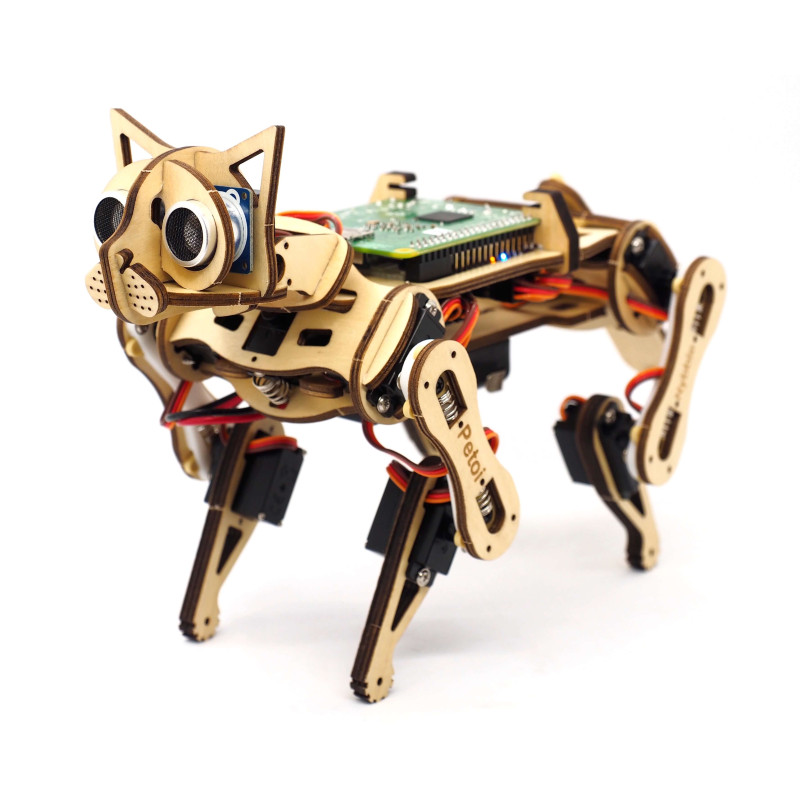
Petoi Nybble is a programmable, four-legged walking robot in the form of a cat, designed for learning robotics, programming, electronics, and mechanics. This is the first generation of the Petoi robotic cat, based on the OpenCat open-source environment and the Arduino Uno-compatible NyBoard controller.
Petoi Nybble is a programmable, four-legged walking robot in the form of a cat, designed for learning robotics, programming, electronics, and mechanics. This is the first generation of the Petoi robotic cat, based on the OpenCat open-source environment and the Arduino Uno-compatible NyBoard controller.
Nybble's distinctive feature is a wooden structure that assembles like a 3D puzzle. The robot is delivered as a DIY (Do It Yourself) kit, allowing users to learn not only programming but also the robot's mechanical structure, servos, wiring, and joint calibration. The manufacturer states that building the robot from scratch typically takes about 3-4 hours.
The robot has 11 movable joints driven by servo motors. Two servos control the movement of each leg, two control the head and neck, and one controls the tail. This allows Nybble to rotate and tilt its head, move its tail, walk, change body position, and perform more expressive movements than designs with a single head joint.
Nybble can be controlled via remote control, a mobile app, or commands sent from a computer. The robot supports graphical programming, Python, and C/C++. You can also connect a Raspberry Pi and utilize the additional processing power for projects related to image analysis, autonomy, and artificial intelligence, among other things.
The robot's head contains ultrasonic sensors for object detection and distance measurement. The robot also uses an IMU (Inertial Measurement Unit) to measure the orientation and acceleration of the structure.
Available Models in the Nybble Series
Petoi Nybble Q
The current generation of the Petoi robotic cat.
Designed using 3D-printed components.
BiBoard controller with an ESP32-WROOM-32D processor. Built-in Bluetooth and Wi-Fi support.
USB-C port.
11 movable joints.
Built-in ultrasonic sensor.
Supports over 35 movements and behaviors.
Voice command support.
Program up to 10 custom voice commands in C++.
Available with lightweight P1L servos and with metal P1S servos.
Designed for more advanced educational, research, IoT (Internet of Things), and AI (Artificial Intelligence) projects.
Nybble Q Lite Servos Variant
P1L servos.
Plastic gears.
Lower servos.
Standard torque.
This variant is primarily intended for beginners, intermediate users, and educational activities.
Nybble Q Alloy Servos
P1S servos.
Metal gears.
Higher torque.
Greater durability for heavy loads and more complex movements.
This variant is designed for advanced users, teachers, laboratories, and research projects.
Petoi Nybble Technical Specifications
Device Type: Programmable quadruped walking robot.
Appearance: Cat-shaped robot.
Construction: Self-assembly kit.
Dimensions: 250 × 107 × 140 mm.
Weight: approximately 320 g.
Frame Material: Wood.
Number of Movable Joints: 11.
Number of Servos: 11.
Leg Movement: Two Controlled Joints per Leg.
Head and Neck Movement: Two Controlled Joints.
Tail Movement: One Controlled Joint.
Servo Type: DS031.
Servo Gears: Metal.
Servo Housing Material: Plastic.
Servo Motor Type: Core. Maximum servo voltage: 8.4 V.
Control board: NyBoard V1.
Board compatibility: Arduino Uno.
Processor: ATmega328PA.
External EEPROM: 64 Kbit.
IMU: Six-axis MPU6050.
Number of PWM [Pulse Width Modulation] channels: 16.
Number of Grove connectors: 4.
NeoPixel RGB LEDs: 7.
Communication interfaces: UART and I²C.
Onboard components: IR receiver and buzzer.
Proximity sensor: Ultrasonic, located in the robot's head.
Wired connectivity: Micro-USB.
Bluetooth connectivity: via optional module.
Wi-Fi connectivity: via optional module.
Raspberry Pi support: Yes.
Battery type: Lithium-ion.
Battery included: yes.
Battery voltage: 7.4 V.
Battery capacity: 1000 mAh.
Typical current draw: 2 A.
Maximum current draw: 5 A.
Estimated operating time: approximately 1 hour.
Required charging source: USB 5 V / 1 A.
Estimated charging time: approximately 2 hours.
AC charger included: no.
Charging cable: Micro-USB–USB included.
Supported programming languages: C/C++ and Python.
Supported graphical programming: Petoi Coding Blocks.
Firmware environment: OpenCat.
Petoi Nybble is a programmable, four-legged walking robot in the form of a cat, designed for learning robotics, programming, electronics, and mechanics. This is the first generation of the Petoi robotic cat, based on the OpenCat open-source environment and the Arduino Uno-compatible NyBoard controller.