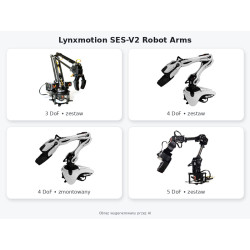
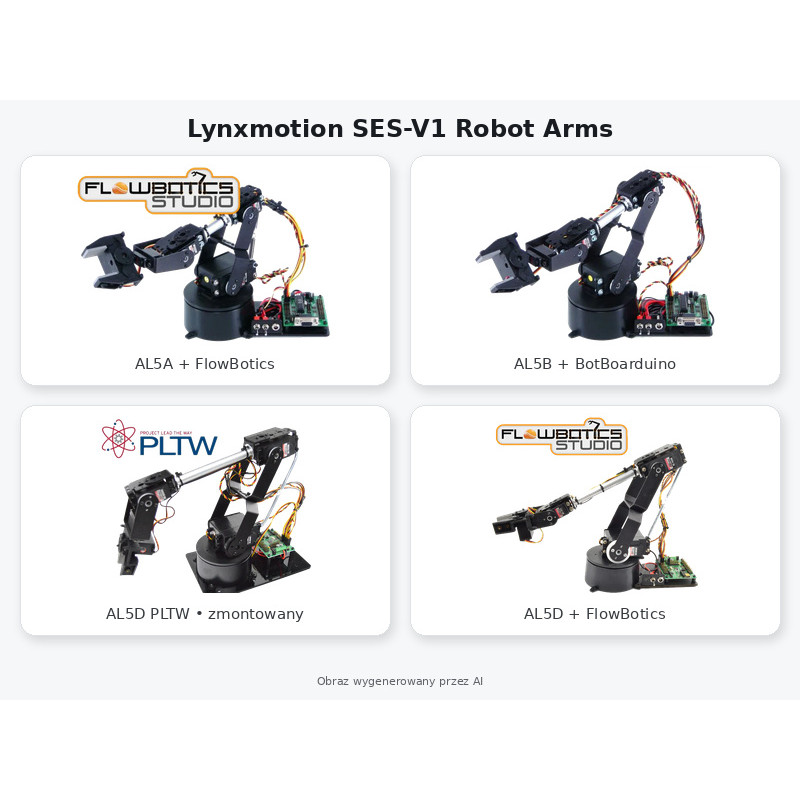
The Lynxmotion SES-V1 Robot Arms are a series of modular AL5 robotic arms designed for education, robotics training, programming, prototyping, and hobby applications.
SES stands for Servo Erector Set.
The AL5 series is the fifth generation of Lynxmotion's hobby robotic arms.
All basic models share a similar design but differ in arm length, reach, servos, and maximum payload.
The Lynxmotion SES-V1 Robot Arms are a series of modular AL5 robotic arms designed for education, robotics training, programming, prototyping, and hobby applications.
SES stands for Servo Erector Set.
The AL5 series is the fifth generation of Lynxmotion's hobby robotic arms.
All basic models share a similar design but differ in arm length, reach, servos, and maximum payload.
Each standard AL5 arm provides base rotation, shoulder movement, elbow movement, wrist tilt, and gripper control.
The standard design offers 4 degrees of freedom (DoF) and a separately controlled gripper.
An optional wrist rotation module can increase the number of axes of motion, but its weight reduces the arm's payload capacity. The design is constructed from SES-V1 system components, including black anodized aluminum handles, aluminum tubes and hubs, molded plastic components, and precision laser-cut Lexan polycarbonate components.
The individual joints are powered by classic Hitec RC servos, selected for their optimal balance of torque, weight, and price.
The arms can be expanded with Servo Erector Set components, additional joints, sensors, other grippers, and additional servos.
Available accessories include lightweight, standard, and reinforced wrist rotation modules, a vacuum gripper, a V-gripper, an infrared sensor mount, and pressure sensor mounts.
The arms can be integrated with other Lynxmotion designs, including mobile and walking robots.
Models in the Series
Lynxmotion AL5A
The smallest and most affordable entry-level model in the AL5 series.
Designed primarily for basic robotic arm control training, simple demonstrations, and light manipulation tasks.
It offers the shortest reach and the lowest payload of the AL5A, AL5B, and AL5D models.
Standard design: 4 DoF and a gripper.
Wrist rotation can be optionally added.
Lynxmotion AL5B
An intermediate model between the AL5A and AL5D.
It offers a longer reach than the AL5A and utilizes slightly more powerful servos in the base and wrist.
Suitable for education, more extensive demonstrations, and manipulating lightweight objects.
Standard design: 4 DoF and a gripper.
Wrist rotation can be optionally added.
Lynxmotion AL5D
The largest of the three entry-level models in the series.
It offers the longest reach and the highest declared payload. It utilizes more powerful servos in the base, arm, and elbow.
It is the most suitable variant for complex educational stations, automation exercises, and production demonstration lines.
Standard design: 4 DoF and gripper.
Wrist rotation can be optionally added.
Lynxmotion AL5B Specifications
Degrees of freedom: 4 DoF plus gripper.
Basic movements: base rotation, shoulder movement, elbow movement, and wrist tilt.
Secondary axis: optional wrist rotation.
Maximum vertical reach: 15.75 inches, or approximately 400 mm.
Maximum horizontal reach: 13.125 inches, or approximately 333 mm.
Maximum payload according to the series homepage: approximately 5 oz, or approximately 142 g.
Base servo: 1 × Hitec HS-475HB.
Shoulder servo: 1 × Hitec HS-755HB.
Elbow servo: 1 × Hitec HS-645MG.
Wrist servo: 1 × Hitec HS-475HB. Gripper servo: 1 × Hitec HS-422.
Construction material: anodized aluminum, aluminum tubes and hubs, plastic components, and laser-cut Lexan polycarbonate.
Payload capacity increases as the distance from the object to the base decreases.
Adding a wrist rotation module reduces the available payload.
A note about the AL5B payload capacity
Official Lynxmotion documentation is inconsistent on this point.
The main series page lists a weight of approximately 5 oz, or approximately 142 g.
The AL5B's technical data sheet, however, lists a weight of less than 4 oz, or approximately 113 g.
Lynxmotion AL5D Specifications
Degrees of freedom: 4 DoF plus gripper.
Basic movements: base rotation, shoulder movement, elbow movement, and wrist tilt.
Secondary axis: optional wrist rotation.
Maximum vertical reach: 16.5 inches, or approximately 419 mm.
Maximum horizontal reach: 19 inches, or approximately 483 mm.
Maximum declared payload at full reach: Less than approximately 10 oz, or approximately 283 g.
The stated payload capacity is for the standard arm without the wrist rotation module.
Payload capacity increases as the object being moved closer to the base.
Base servo: 1 × Hitec HS-485HB.
Shoulder servo: 1 × Hitec HS-805BB.
Elbow servo: 1 × Hitec HS-755HB.
Wrist servo: 1 × Hitec HS-645MG.
Gripper servo: 1 × Hitec HS-422.
Construction material: anodized aluminum, aluminum tubes and hubs, plastic components, and laser-cut Lexan polycarbonate.
Control and required electronics
The arm does not have a single mandatory control method.
The required control method depends on the electronics included in the selected kit.
The SSC-32U is a multi-channel servo controller that communicates with the computer via USB and a virtual serial COM port.
The SSC-32U controller can be operated using a ready-made graphical program or a custom application using the SSC-32 communication protocol.
BotBoarduino is an Arduino-compatible microcontroller that can directly execute the uploaded arm control program. Once programmed, the BotBoarduino can control the robot without a permanent connection to a computer.
You can connect a compatible PS2 controller to the BotBoarduino and use the sample Lynxmotion software to manually control the arm.
Versions without electronics require a separate controller that supports the appropriate number of classic RC servos.
The power supply and power supply specifications vary depending on the specific kit. Do not assign a single power supply specification to all variants without checking the kit's catalog number.
Software
FlowBotics Studio
FlowBotics Studio is a graphical environment for creating robot control applications.
It allows you to control a physical arm using its virtual model.
It allows you to create, save, play back, and edit motion sequences.
It supports additional servos, including optional wrist rotation.
It can communicate with the SSC-32U controller via a COM port, using USB or Bluetooth, among other options.
The program is not loaded onto a microcontroller – it runs on a Windows computer and controls the robot in real time.
Official documentation indicates compatibility with Windows 7, Windows 8, and Windows 10.
The manufacturer does not confirm compatibility with Windows 11, Linux, or macOS on its website.
FlowArm PLTW
FlowArm PLTW is a standalone graphical application created in the FlowBotics Studio environment.
It allows you to control the arm in real time and work with the virtual model without the arm connected. It uses inverse kinematics, allowing the user to specify the desired gripper position, and the program calculates the positions of individual joints.
It allows for creating, saving, and playing back motion sequences.
It works with the SSC-32 and SSC-32U controllers.
It can support additional inputs, outputs, and controller servos.
The program's official technical page primarily describes compatibility with the AL5D model, which features wrist rotation.
The main series page also lists support for the AL5A and AL5B, but before purchasing the program for these models, you must confirm compatibility with the specific version.
Officially recommended operating systems are Windows XP SP2, Windows 7, and Windows 8.
The documentation also lists a required internet connection.
The manufacturer does not confirm the program's compatibility with Windows 10 or Windows 11 on its website.
SSC-32 Servo Sequencer Utility
A free tool for directly controlling individual servo channels.
Enables testing joint movement. It allows you to calibrate the center positions of the servos.
It allows you to create and playback movement sequences.
It is used during assembly and initial startup of the arm with the SSC-32U controller.
The program requires a computer connected to the SSC-32U controller.
Arduino IDE
The Arduino IDE is required to create, compile, and upload your own program to the BotBoarduino microcontroller.
Once the program is uploaded, the Arduino IDE does not need to be running.
The manufacturer provides sample programs for the AL5 and BotBoarduino arms.
The solution allows you to create standalone sequences, operate sensors, and control the arm using the optional PS2 controller.
Custom Software
The SSC-32U controller can be controlled by a custom application communicating with it via the serial port.
The manufacturer describes the SSC-32 protocol as relatively simple to understand and implement.
This allows you to create your own control applications in your chosen programming language, as long as it supports serial communication.
The custom software must take into account the mechanical limitations of the arm and the safe pulse ranges of the individual servos.
The Lynxmotion SES-V1 Robot Arms are a series of modular AL5 robotic arms designed for education, robotics training, programming, prototyping, and hobby applications.
SES stands for Servo Erector Set.
The AL5 series is the fifth generation of Lynxmotion's hobby robotic arms.
All basic models share a similar design but differ in arm length, reach, servos, and maximum payload.