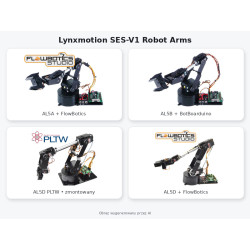
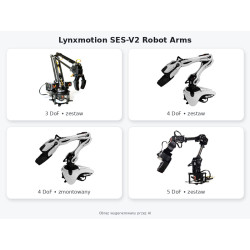
The Lynxmotion SES-V2 Robot Arms are a series of compact, modular robotic arms designed primarily for education, programming, prototyping, research and development, and hobby applications.
The design utilizes the SES-V2 Servo Erector Set V2 system (a second-generation modular robot system) and configurable LSS servos (Lynxmotion Smart Servos).
Individual arm components can be expanded or modified by adding additional joints, grips, sensors, electronic modules, and other end-effectors.
The smart servos provide real-time information about position, velocity, voltage, current, and temperature, among other things.
Lynxmotion SES-V2 Robot Arms – Series Description
The Lynxmotion SES-V2 Robot Arms are a series of compact, modular robotic arms designed primarily for education, programming, prototyping, research and development, and hobby applications.
The design utilizes the SES-V2 Servo Erector Set V2 system (a second-generation modular robot system) and configurable LSS servos (Lynxmotion Smart Servos).
Individual arm components can be expanded or modified by adding additional joints, grips, sensors, electronic modules, and other end-effectors.
The smart servos provide real-time information about position, velocity, voltage, current, and temperature, among other things.
The parameters of each servo can be individually configured, including maximum speed, range of motion, angular acceleration, and positioning stiffness. Communication is via a text-readable, bidirectional LSS serial protocol with selectable baud rates.
The arms can be used on a lab bench, mounted on a mobile robot, or integrated with the Lynxmotion Conveyor HD.
The design utilizes anodized aluminum, carbon fiber tubing, and G10 composite, among other materials. The servos have metal housings and gears.
The kits include an LSS Adapter interface for communication with a computer, Arduino, Raspberry Pi, XBee module, or other serial communication device.
The arms can be powered by the included 12V power supply or a 3S 11.1V LiPo battery with an XT60 connector, which is sold separately.
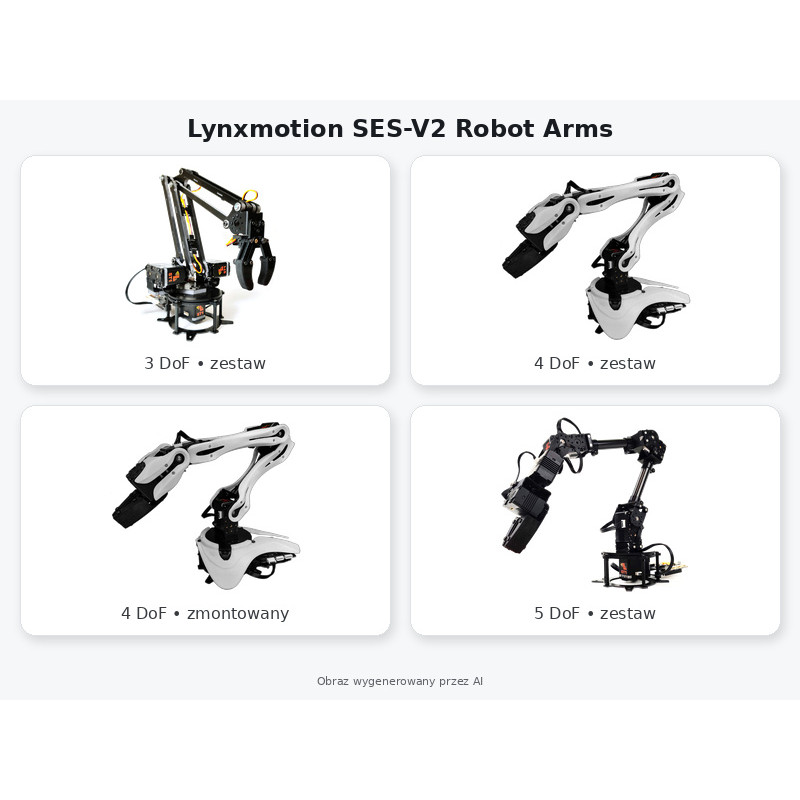
Available Models
LSS-3DOF-KT – SES-V2 Robotic Arm 3 DoF Kit
Self-assembly version.
Three degrees of freedom and an end effector.
LSS-4DOF-KT – SES-V2 Robotic Arm 4 DoF Kit
Self-assembly version.
Four degrees of freedom and an end effector.
LSS-4DOF-AS – SES-V2 Robotic Arm 4 DoF Assembled
Factory-assembled version of the 4 DoF arm.
Design parameters and drives are the same as the 4 DoF Kit.
LSS-5DOF-KT – SES-V2 Robotic Arm 5 DoF Kit
Self-assembly version.
Five degrees of freedom and an end effector, including wrist rotation.
DoF stands for Degrees of Freedom, which is the number of independently controlled axes of motion. The manufacturer provides the gripper drive separately, so for example "4 DoF + gripper" means four arm axes and an additional gripper drive.
Model Specifications
Lynxmotion SES-V2 3 DoF Robotic Arm Kit
Number of axes: 3 degrees of freedom and a gripper.
Design: Four-bar mechanism keeps the end effector parallel to the work surface.
Maximum horizontal reach: 380 mm.
Maximum vertical reach: 210 mm.
Arm weight: 634 g.
Payload capacity: The manufacturer does not provide an official payload value for this model.
Frame: G10 composite.
Gripper: Lightweight parallel gripper with RC servo.
Gripper opening according to the specifications table: 34 mm.
Gripper opening according to the manufacturer's description and functions section: 40 mm.
The gripper can be mounted vertically or horizontally.
Base servo: 1 × LSS-ST1.
Arm servo: 2 × LSS-ST1.
Static torque of each LSS-ST1: 14 kg·cm.
Maximum speed of the LSS-ST1: 360°/s.
Gripper servo: LRC.
Gripper servo static torque: 1.5 kg·cm.
Gripper speed: 0.10 s/60° at 6 V.
Output power supply: 12 V DC, 6 A, XT60 connector.
Input power supply for the included power supply: 110–240 VAC, 50/60 Hz.
Communications interface: LSS Adapter.
Additional electronics: LSS-2IO module controlling the standard gripper servo and LSS-5VR 5 V regulator.
Built-in protection mechanisms include current, temperature, and voltage monitoring.
Data note: The manufacturer's documentation is inconsistent regarding the gripper opening range. The description specifies 40 mm, while the specifications table specifies 34 mm.
Lynxmotion SES-V2 4 DoF Robotic Arm Kit / Assembled
Number of axes: 4 degrees of freedom and gripper.
Available versions: LSS-4DOF-KT assembly kit or LSS-4DOF-AS assembled version.
Maximum horizontal reach: 404.12 mm.
Maximum vertical reach: 505.44 mm.
Declared payload at maximum reach: 100 g.
Weight: 650 g according to manufacturer's documentation.
Gripper: V-shaped design.
Gripper opening range: 0° to 180°.
Number of intelligent servos: 5.
Base: LSS-ST1, static moment 14 kg·cm.
Arm: LSS-HT1, static moment 29 kg·cm.
Elbow: LSS-HT1, 29 kg·cm static torque.
Wrist: LSS-ST1, 14 kg·cm static torque.
Gripper: LSS-ST1, 14 kg·cm static torque.
Maximum servo speed: 360°/s.
Output power: 12 V DC, 6 A, XT60 connector.
Input power from included power supply: 110–240 VAC, 50/60 Hz.
Construction: Anodized aluminum, carbon fiber components, and metal mounting hardware.
Built-in safety features include overcurrent, overtemperature, and overvoltage protection.
With a 100 g payload at full extension, the arm and elbow servos may heat up quickly.
The load capacity increases as the distance from the base increases. Base rotation may be mechanically limited by cable management.
Tonearm covers are no longer available.
Lynxmotion SES-V2 5 DoF Robotic Arm Kit
Number of axes: 5 degrees of freedom and gripper.
Maximum horizontal reach: 457.74 mm.
Maximum vertical reach: 559.06 mm.
Declared payload at maximum reach: 100 g.
Manufacturer's stated weight: 650 g.
Gripper: V-shaped design.
Gripper opening range: 0° to 180°.
Number of intelligent servos: 6.
Base: LSS-ST1, static moment 14 kg·cm.
Arm: LSS-HT1, static moment 29 kg·cm.
Elbow: LSS-HT1, static moment 29 kg·cm.
Wrist tilt: LSS-ST1, static moment 14 kg·cm. Wrist Rotation: LSS-ST1, 14 kg·cm static torque.
Gripper: LSS-ST1, 14 kg·cm static torque.
Maximum Servo Speed: 360°/s.
Output Power: 12 V DC, 6 A, XT60 connector.
Input Power Supply: 110–240 VAC, 50/60 Hz.
Can be powered by a 3S 11.1 V LiPo battery.
Built-in safety features include overcurrent, overvoltage, and overtemperature protection.
With a 100 g payload at full extension, the arm and elbow servos can heat up quickly.
The additional wrist rotation axis allows for better control of the gripping object's orientation than the 4 DoF model.
Software Required for Operation
SES-V2 arms do not require a specific program – they can be controlled from the manufacturer's application or directly by custom software using the LSS protocol.
Control requires an external master device, such as a computer, Arduino, Raspberry Pi, or other controller communicating via the serial port. The kits do not include an on-board computer that executes complete user programs.
LSS Configuration Software
This software is used to detect and configure intelligent servos.
It allows you to assign IDs to individual drives.
It allows you to change servo settings.
It allows you to update the firmware.
It is particularly useful when first setting up a DIY kit, as the drive IDs must correspond to their positions in the arm's structure.
LSS FlowArm
A graphical application for direct arm control.
It allows you to control a virtual arm model using drag-and-drop.
It allows you to enter rectangular and cylindrical coordinates.
It includes virtual joysticks.
It allows you to record and playback movement sequences. It supports manual learning mode, in which the user moves the physical arm and the application records its position.
It allows for logging commands and data to a CSV file.
According to the manufacturer's documentation, the application is designed for Windows 7 or newer.
The manufacturer provides FlowArm configurations for 3 DoF, 4 DoF, and 5 DoF models, although the older application description explicitly mentions only the 3 DoF and 4 DoF models.
FlowBotics Studio
The development platform used to create the LSS FlowArm application.
It is not required for standard arm control using the pre-built FlowArm application.
It is required if you want to modify the FlowArm interface or create your own graphical control applications.
Programming Your Own Applications
The manufacturer provides examples and libraries for Arduino.
Control examples in Python are available.
The 4 DoF and 5 DoF models can be supported by the open-source ROS 2 package – Robot Operating System 2 [a middleware system for creating robotic software].
The ROS 2 package allows you to control the physical arm or a simulated model of it.
In the official ROS 2 example, the manufacturer specifies Ubuntu 20.04 and ROS 2 Galactic; however, this is an older reference configuration, and compatibility with your current ROS 2 version should be verified before implementation.
The Lynxmotion SES-V2 Robot Arms are a series of compact, modular robotic arms designed primarily for education, programming, prototyping, research and development, and hobby applications.
The design utilizes the SES-V2 Servo Erector Set V2 system (a second-generation modular robot system) and configurable LSS servos (Lynxmotion Smart Servos).
Individual arm components can be expanded or modified by adding additional joints, grips, sensors, electronic modules, and other end-effectors.
The smart servos provide real-time information about position, velocity, voltage, current, and temperature, among other things.