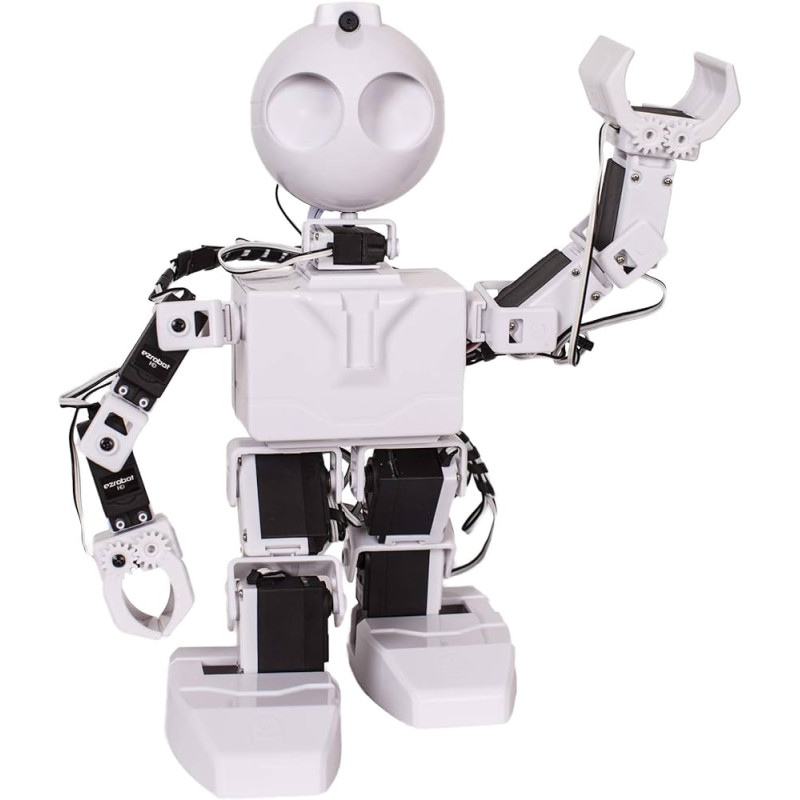
The JD-Humanoid Robotics Kit by EZ-Robot is a compact, programmable humanoid robot designed primarily for learning robotics, programming, automation, and the fundamentals of artificial intelligence. The robot moves on two legs and can perform programmed gestures and motion sequences, walk, dance, grip lightweight objects, and respond to visual input and voice commands. The manufacturer recommends the kit for users aged 10 and above.
JD-Humanoid Robotics Kit
The JD-Humanoid Robotics Kit by EZ-Robot is a compact, programmable humanoid robot designed primarily for learning robotics, programming, automation, and the fundamentals of artificial intelligence. The robot moves on two legs and can perform programmed gestures and motion sequences, walk, dance, grip lightweight objects, and respond to visual input and voice commands. The manufacturer recommends the kit for users aged 10 and above.
JD is equipped with a camera, a movable head, two gripper hands, programmable RGB eyes, and digital servo motors with metal gears. The robot is controlled by an EZ-B v4 controller and communicates with a computer via Wi-Fi. Advanced functions such as image recognition, speech recognition, artificial intelligence models, and script execution are primarily handled by Synthiam ARC software running on an external computer.
The kit has been designed as a modular educational platform. Its structural components use the EZ-Clip system, which allows parts to be connected and replaced without soldering. STL files for the robot’s components are available in ARC, enabling users to print replacement parts or create custom structural modifications.
Specifications
Model: JD-Humanoid Robotics Kit.
Manufacturer part number: KI-0100.
Construction type: bipedal humanoid robot.
Intended use: STEM education, programming, robotics, and experimental projects.
Recommended user age: 10 years and above.
Number of degrees of freedom: 16 DOF.
Controller: EZ-B v4 Smart Robot Controller.
Primary connectivity: Wi-Fi.
Alternative controller communication: USB/UART with the appropriate cable or interface.
Number of supported servo/digital outputs: 24.
Number of ADC analog inputs: 8.
Controller communication interfaces: 3 × UART and I²C.
Camera support: yes, dedicated EZ-Robot camera connector.
Audio support: yes, through the controller and ARC software.
Built-in camera: yes, installed in the robot’s head.
Camera functions in ARC: video streaming, object tracking, colour tracking, face tracking, motion tracking, and selected image-recognition functions.
Robot eyes: 18 programmable RGB LEDs.
Head movement: up/down and left/right, controlled by two micro servo motors with metal gears.
Actuators: HDD digital servo motors.
HDD servo gearing: metal gears.
HDD servo bearings: dual ball bearings.
HDD servo stall torque: 19 ± 0.20 kg·cm at 7.4 V.
HDD servo speed: 0.22 ± 0.01 seconds per 60° at 7.4 V.
Lever servo rotation range: 180°.
HDD servo operating voltage: 4.8 to 8.4 V.
HDD servo operating current: approximately 1,400 ± 30 mA at 7.4 V.
HDD servo stall current: approximately 3,000 ± 50 mA at 7.4 V.
Declared servo operating temperature range: –10°C to +50°C.
Battery: 7.4 V, 1,300 mAh lithium-polymer battery.
Charger: LiPo balance charger.
Charger-supported batteries: 7.4 V and 11.1 V.
Charger power supply: compatible with 120 V and 240 V electrical networks using the included power supply/cable.
Assembled robot dimensions: approximately 15 × 13 × 33 cm.
Robot weight: approximately 1.33 kg.
Package dimensions: approximately 27 × 27 × 16.5 cm.
Shipping weight: approximately 2.27 kg.
Kit Contents
1 × EZ-B v4 Smart Robot Controller.
1 × humanoid robot head with camera, RGB LEDs, and movement mechanism.
1 × humanoid torso with two arm servo motors and space for the controller and battery.
6 × HDD lever servo motors.
2 × grippers.
1 × left robot foot.
1 × right robot foot.
1 × LiPo battery.
1 × LiPo balance charger.
2 × 6-inch spiral cable wraps.
1 × USB Wi-Fi adapter/antenna.
Software Required for Operation
The primary software platform is Synthiam ARC, or Autonomous Robot Control.
ARC is used to connect to the EZ-B v4 controller, control servo motors, create movements, operate the camera and sensors, manage audio, and execute programs and scripts.
Programming environments are available at different difficulty levels, including RoboScratch, Blockly, JavaScript, and Python.
A ready-made JD project is available and includes port configuration, robot poses, and sample movements.
ARC Free may be used free of charge for personal, educational, and hobby purposes, but it includes limitations on the number of functions, plug-ins, movement poses, speech-recognition phrases, and image resolution.
ARC Pro is intended, among other purposes, for business use and removes most of the limitations of the free version.
ARC Runtime is free of charge but is mainly intended for running completed projects and does not provide full project-editing functionality.
Full project creation and configuration are currently intended primarily for Windows.
On Mac computers, ARC may be run using Windows installed through Boot Camp or in a virtual machine such as Parallels or VMware.
Mobile control options are also available, but they do not replace the full ARC computer environment for more advanced projects.
Advantages
Modular construction enabling relatively quick assembly, disassembly, and robot reconfiguration.
No soldering required for standard kit assembly.
Genuine humanoid design with bipedal movement and 16 degrees of freedom.
Digital servo motors with metal gears provide greater durability than typical small servo motors with plastic gears.
Built-in camera supports projects involving image recognition and image tracking.
Programmable RGB eyes can be used to create animations and indicate the robot’s operating status.
Two grippers enable the robot to lift and carry lightweight objects.
Users can create custom poses, gestures, movement sequences, dances, and walking patterns.
The software is suitable for both beginners and users familiar with Python or JavaScript.
Ready-made projects and movements reduce the time required for initial setup.
The robot can be expanded with additional sensors and devices using digital, analog, I²C, or UART ports.
STL files for structural components are available, making it easier to manufacture replacement parts and custom modifications.
The kit may be used in robotics, computer science, automation, programming, and human–robot interaction classes.
Disadvantages
The robot is highly dependent on an external computer and ARC software. The EZ-B v4 controller handles hardware control and communication, but more complex logic, image processing, speech recognition, and most artificial intelligence functions are performed by the computer.
The full development environment is focused on Windows. macOS users must run Windows in a virtual machine or through Boot Camp.
The free version of ARC has limitations that may become noticeable in more advanced projects.
Commercial use requires an appropriate ARC version and licence, as the free version is intended for personal, hobby, and educational use.
Speech recognition does not use the microphone indicated in the robot head specifications. The standard ARC module uses the computer’s default audio input, so an external microphone or headset may be required.
Servo motors and gears may require periodic position checks, and the robot may need servo-position calibration in ARC.
Walking performance depends on correct assembly, servo calibration, battery charge level, and the type of surface.
The kit is relatively expensive compared with simple educational platforms based on Arduino or micro.
Limitations
JD is not an autonomous robot equipped with a fully capable onboard computer. For most advanced applications, it requires an active connection to a computer running ARC.
In direct Wi-Fi connection mode, the computer may be connected to the network created by the robot, which can make simultaneous Internet access more difficult. The kit includes an additional USB Wi-Fi adapter that may help maintain two separate connections.
Wi-Fi interference may affect connection stability and control latency.
A battery voltage drop caused by the simultaneous operation of multiple servo motors may interrupt the connection or restart the controller.
Power outputs on the EZ-B v4 controller are not all regulated in the same way. When additional sensors are connected, their voltage requirements must be checked because the supply voltage on some ports may match the battery voltage.
Standard EZ-Robot servo motors must not be powered above the voltage permitted for the relevant model.
The LiPo battery requires proper storage, supervised charging, and the use of a balance charger.
The manufacturer does not specify a clear operating time per battery charge on the product page. Actual operating time must be verified for the specific program and movement intensity.
The lifting capacity of the fully assembled robot and its grippers is not specified. The 19 kg·cm rating refers to the torque of an individual servo motor and must not be interpreted as the lifting capacity of the robot’s arm or the entire robot.
The camera and grippers are intended for educational use. The robot should not be expected to provide the accuracy, repeatability, or reliability of an industrial robotic manipulator.
Functions described by the manufacturer as AI or machine learning depend on the ARC modules used, the computer configuration, and, in some cases, external services and additional subscriptions.
Hardware Requirements
Computer running Windows 10 or later.
Minimum 2 GB RAM according to the current Synthiam ARC requirements.
At least 8 GB RAM recommended for more complex projects.
Minimum 500 MB of available disk space.
At least 1 GB of available disk space recommended.
Wi-Fi card or adapter capable of connecting to the EZ-B v4 controller.
A second network adapter may be useful when the computer needs to maintain simultaneous connections to the robot and the Internet.
Computer microphone, headset, or external microphone if speech recognition is required.
An external microphone is recommended in noisy environments because servo noise and room echo may cause incorrect recognition of voice commands.
Access to an electrical outlet for battery charging.
A sufficiently large, flat, and stable area for testing robot walking and movements.
For Mac computers: the ability to run Windows through Boot Camp or a compatible virtualisation environment.
Internet access may be required to download ARC, additional features, updates, and selected cloud services.
Product Assessment
The JD-Humanoid Robotics Kit is an interesting educational platform for schools, universities, teaching laboratories, robotics clubs, and individual users who want to combine programming with practical work on a physical humanoid robot. Its main advantage is the relatively easy transition from simple block-based programming to Python and JavaScript scripts, together with the ability to work with movement, vision, audio, and additional sensors within a single environment.
The JD-Humanoid Robotics Kit by EZ-Robot is a compact, programmable humanoid robot designed primarily for learning robotics, programming, automation, and the fundamentals of artificial intelligence. The robot moves on two legs and can perform programmed gestures and motion sequences, walk, dance, grip lightweight objects, and respond to visual input and voice commands. The manufacturer recommends the kit for users aged 10 and above.