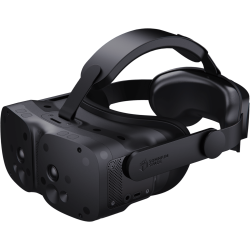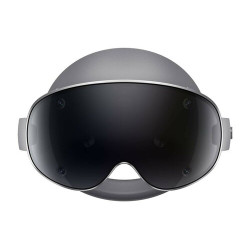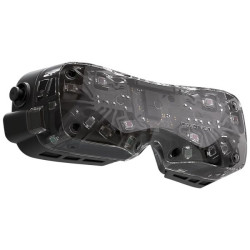
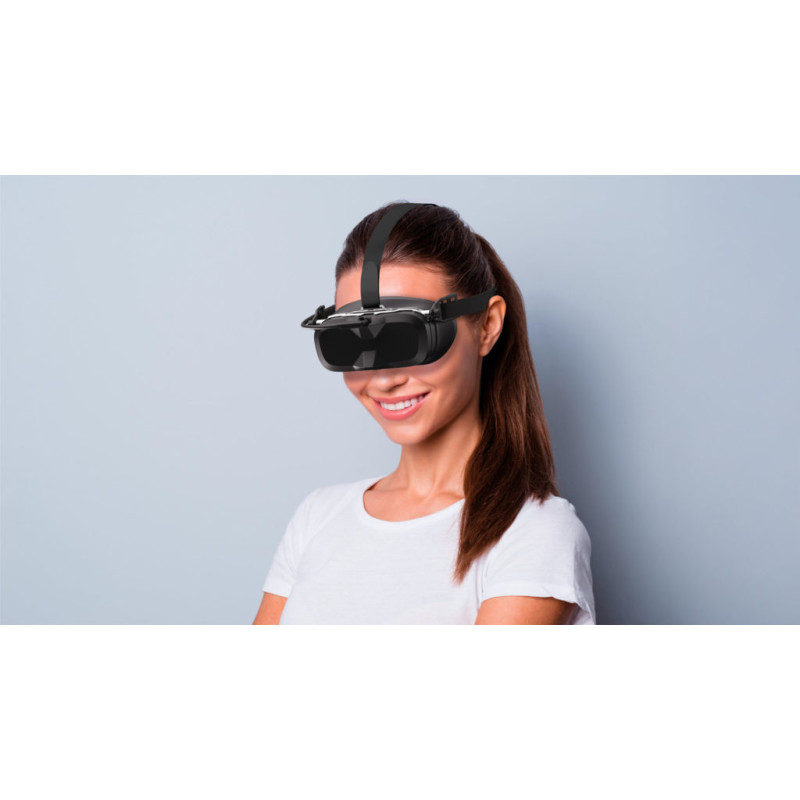
Shiftall MeganeX 8K Mark II is a premium wired PC VR headset designed for demanding SteamVR users, simulator enthusiasts, 3D content creators and professional applications. The device weighs only 179 g without the head strap and uses two micro-OLED displays with a resolution of 3552 × 3840 pixels per eye. The headset supports 10-bit HDR, refresh rates of up to 90 Hz, motorised interpupillary distance adjustment and diopter adjustment from 0 to –7 D.
Shiftall MeganeX 8K Mark II – Ultra-Lightweight PC VR Headset with 4K Micro-OLED Displays
Shiftall MeganeX 8K Mark II is a premium wired PC VR headset designed for demanding SteamVR users, simulator enthusiasts, 3D content creators and professional applications. The device weighs only 179 g without the head strap and uses two micro-OLED displays with a resolution of 3552 × 3840 pixels per eye. The headset supports 10-bit HDR, refresh rates of up to 90 Hz, motorised interpupillary distance adjustment and diopter adjustment from 0 to –7 D.
MeganeX 8K Mark II is the successor to the MeganeX superlight 8K. In the new version, the manufacturer improved cable-connection durability, communication stability with the computer and SteamVR, comfort around the nose, cooling performance and Lighthouse tracking when looking downward.
Important explanation of the “8K” designation
The name “8K” refers to the combined resolution of both displays, which is 7104 × 3840 pixels, or approximately 27.27 million pixels in total. Each eye receives a separate image with a resolution of 3552 × 3840 pixels.
It is therefore not equivalent to the standard 8K UHD video resolution of 7680 × 4320 pixels on a single display. The term “8K” should be understood as a commercial designation referring to the total pixel count of both panels.
Who is this product for?
– Advanced PC VR users.
– Flight and racing simulator enthusiasts.
– Users looking for very high resolution, deep blacks and accurate colour reproduction.
– Developers of SteamVR applications, 3D designers and users of Blender, Unity and other design environments.
– Companies conducting design reviews, product presentations and VR training.
– Laboratories and research institutions using professional positional tracking systems.
– Users who already own SteamVR base stations and compatible controllers.
Is this a niche product?
MeganeX 8K Mark II can be regarded as a niche premium product. It is intended for a relatively narrow group of users who prioritise low weight, image quality and precise SteamVR tracking over standalone operation, simple configuration and a lower purchase price.
Its niche character is mainly determined by:
– the requirement for a powerful computer,
– the need for SteamVR base stations,
– the lack of controllers in the standard package,
– the absence of standalone operation,
– graphics card compatibility limited to selected NVIDIA GeForce RTX models.
The term “niche” does not imply low quality. In this case, it describes a specialised device aimed at experienced PC VR users and professional applications.
Key information before purchase
– MeganeX 8K Mark II is not a standalone device. It requires a computer running Windows 11.
– Operation requires a DisplayPort 1.4 connection and USB 2.0.
– The manufacturer requires an NVIDIA GeForce RTX 3070 or newer graphics card based on the Turing, Ampere or Ada architecture.
– The manufacturer explicitly states that the device does not work with AMD Radeon graphics cards.
– Positional tracking uses SteamVR Lighthouse and requires at least one properly configured Base Station 1.0 or 2.0.
– Controllers and base stations are not included in the standard package.
– The headset is compatible with GripVR, FlipVR, Valve Index and HTC Vive controllers, among others.
– The package includes an X2 dongle that allows two SteamVR controllers to be connected.
– The headset does not include built-in speakers. Headphones or another audio solution can be connected through USB-C.
– The manufacturer does not specify integrated eye tracking or built-in passthrough cameras.
– Hand tracking is available through an optional Hand Tracker module based on Ultraleap technology.
– Wireless operation is not supported.
What is included?
– MeganeX 8K Mark II headset,
– soft light blocker,
– forehead support,
– soft head strap,
– 3 m USB-C cable,
– 1 m USB-C cable,
– DisplayPort cable,
– power adapter,
– converter box,
– X2 dongle for SteamVR controllers,
– adapter for mounting the headset on a handheld grip or monopod,
– safety information,
– warranty card.
Base stations, controllers, headphones, the optional hard head strap, Face Mount Kit and prescription lens inserts are not included as standard.
Advantages
– Very low headset-module weight of 179 g.
– Two 1.35-inch micro-OLED displays.
– Resolution of 3552 × 3840 pixels per eye.
– Approximately 27.27 million pixels in total.
– Support for 10-bit colour depth and HDR in compatible SteamVR applications.
– Manufacturer-declared contrast ratio of 1,000,000:1.
– 95% coverage of the DCI-P3 colour space.
– Very good black reproduction resulting from self-emissive OLED panels.
– Pancake lenses developed in cooperation with the Panasonic Group.
– Motorised IPD adjustment in the 58–72 mm range.
– Diopter adjustment from 0 to –7 D without additional lenses for users with typical myopia.
– Support for magnetic prescription lens inserts for users with astigmatism, hyperopia or refractive errors outside the built-in adjustment range.
– Three mounting options: the included soft strap, an optional hard strap and an optional Face Mount Kit.
– Flip-up mechanism allowing the headset to be raised without removing the entire device.
– Two integrated microphones with beamforming.
– USB-C port for headphones, microphones, face trackers or hand-tracking devices.
– SteamVR Lighthouse tracking capable of operating accurately even in poorly lit rooms.
– Compatibility with the professional ART optical tracking system when using the appropriate marker.
– Official STEP and STL files are available for designing custom accessories and mounting components.
Limitations and requirements
– No standalone operating mode.
– No wireless video transmission.
– No controllers included.
– No base stations included.
– No built-in speakers.
– No integrated eye tracking.
– No built-in hand tracking; an additional module is required.
– No mixed reality cameras or passthrough functionality.
– Official compatibility is limited to selected NVIDIA GeForce RTX graphics cards.
– The manufacturer explicitly excludes AMD Radeon graphics cards.
– The minimum requirements specified by the manufacturer may be sufficient to start the device, but fully using its native resolution in demanding simulators may require a considerably more powerful computer. This is an inference based on the headset’s very high resolution.
– A maximum refresh rate of 90 Hz may be limiting for users who require 120 Hz or 144 Hz modes.
– The manufacturer does not publish an official field-of-view value on the product page, making direct comparison with competing models more difficult.
– The “8K” designation may be misleading because it does not mean a resolution of 7680 × 4320 pixels per eye.
Applications
– PC VR games and applications running through SteamVR.
– Flight simulators.
– Racing and automotive simulators.
– 3D model design and visualisation.
– Design reviews and product presentations.
– Virtual prototyping.
– Procedural training.
– VR application development in Unity and Blender.
– Work with professional design software, including Autodesk VRED.
– Trade-show demonstrations and 3D content presentations.
– Research into ergonomics and human-computer interaction.
– Professional tracking systems and motion simulators using ART.
Suitability for consumers
– High suitability for advanced PC VR enthusiasts who prioritise image quality and very low headset weight.
– Particularly attractive for simulator users who spend long periods in VR and require clear instruments, text and indicators.
– Diopter adjustment may be a major advantage for users with myopia, because in many cases it allows the headset to be used without glasses or additional lens inserts.
– Low suitability for beginner users looking for a complete system with controllers, standalone operation and simple setup.
– The lack of integrated audio, base stations and controllers increases the actual cost of a complete VR setup.
Suitability for education
– Medium suitability for standard schools and universities.
– The high price and requirement for a computer, cables, base stations and controllers limit the practical deployment of large numbers of headsets.
– High suitability for specialist design, aviation, automotive and engineering laboratories.
– The high resolution may support the display of small elements, text, instruments and detailed 3D models.
– Motorised IPD adjustment and diopter correction make it easier to share the headset between multiple users.
– Three mounting options allow the device to be adapted to different types of classes and levels of physical activity.
Suitability for laboratories and research
– Medium to high suitability, particularly for research involving image perception, ergonomics, VR interfaces and user behaviour.
– High resolution, low weight and precise IPD adjustment may be valuable in long-duration experiments.
– The USB-C port allows external sensors to be connected, including face- and hand-tracking devices.
– Available CAD files may simplify the development of custom mounts, sensors and research-station components.
– ART integration increases the headset’s suitability for large tracking spaces and motion simulators.
– The lack of integrated eye tracking limits its use in studies requiring gaze-direction recording.
– The manufacturer does not present the headset as certified measurement equipment. Results obtained from external sensors require validation for each specific research project.
Suitability for healthcare
– Potential suitability for training and research, but without confirmed medical certification.
– Low weight and high resolution may be useful in medical simulations, personnel training and anatomical-model visualisation.
– IPD and diopter adjustment can make it easier to fit the headset to different users.
– The manufacturer does not define MeganeX 8K Mark II as a medical, diagnostic or therapeutic device.
– The product should not be presented as medical equipment without appropriate certification and validation of the complete solution.
Suitability for industry and design
– High suitability for design, visualisation and 3D model reviews.
– The manufacturer officially identifies industrial, design, training and research applications.
– Support for 10-bit HDR in Autodesk VRED may be particularly useful for designers requiring accurate colour reproduction.
– Low weight may improve comfort during long design sessions.
– Optional 5 m and 10 m cables allow larger demonstration and training installations to be created.
– ART integration enables use in large spaces, motion simulators and test vehicles.
– The lack of passthrough cameras means physical controls and workstation components are not automatically visible while wearing the headset.
Suitability for military and defence applications
– Potential suitability for stationary simulators and visualisation, but without official military positioning.
– High resolution and low weight may be beneficial in simulation, procedural training and technical visualisation.
– ART integration allows the headset to be used in motion simulators or test vehicles.
– The manufacturer does not declare MeganeX 8K Mark II to be a military product.
– No information is provided about MIL-STD compliance, environmental resistance, water or dust protection, or approval for operational use.
– CE conformity confirms compliance with relevant European market requirements, but it is not equivalent to military certification.
– The device should be treated as a component of a professional simulation system rather than as equipment intended for field deployment.
Is MeganeX 8K Mark II the right choice?
MeganeX 8K Mark II may be a suitable choice when the key requirements are:
– very low headset weight,
– high image resolution,
– deep blacks provided by micro-OLED displays,
– accurate colour reproduction,
– diopter adjustment without additional lenses,
– precise SteamVR Lighthouse tracking,
– long simulator sessions,
– design and industrial applications,
– connection of additional sensors and accessories.
Another product may be more suitable when the main requirements are:
– standalone operation without a computer,
– wireless use,
– controllers and tracking included in the package,
– support for AMD Radeon graphics cards,
– integrated eye tracking,
– integrated hand tracking,
– colour passthrough or mixed reality,
– refresh rates of 120 Hz or higher,
– official medical or military intended use.
Technical specifications
Display and optics
– Displays: 2 × 1.35-inch micro-OLED.
– Resolution: 3552 × 3840 pixels per eye.
– Combined resolution: 7104 × 3840 pixels.
– Total pixel count: approximately 27.27 million.
– Colour depth: 8-bit or 10-bit.
– HDR: supported in compatible SteamVR applications.
– Contrast ratio: 1,000,000:1.
– DCI-P3 colour-space coverage: 95%.
– Refresh rate: 72 Hz, 75 Hz or 90 Hz.
– Lenses: pancake.
– Field of view: no official value provided by the manufacturer on the product page.
– IPD adjustment: motorised, 58–72 mm.
– Diopter adjustment: 0 to –7 D.
– Prescription correction: optional magnetic lens inserts available from third-party suppliers, including VR Optician.
Tracking
– Head tracking: 6DoF SteamVR Lighthouse.
– Supported base stations: SteamVR Base Station 1.0 and 2.0.
– Eye tracking: no integrated function specified by the manufacturer.
– Hand tracking: optional Hand Tracker module with Ultraleap SIR170 technology.
– Optional hand-tracking range: up to 75 cm.
– Hand-tracking field: 170° × 170°.
– Professional tracking: optional ART marker support.
Audio
– Microphones: two built-in microphones with beamforming.
– Speakers: none.
– External audio: headphones or another audio device connected through USB-C.
– USB-C microphone support: yes.
Connectivity
– Computer connection: DisplayPort 1.4 and USB 2.0.
– Headset-side connection: USB-C.
– Interface module: included converter box.
– Expansion port: USB-C, USB 2.0.
– Expansion-port power: up to 5 V / 2.1 A.
– Standard USB-C cable: 3 m.
– Optional cables: 5 m and 10 m.
– Wireless connectivity: none.
Mounting
– Soft strap: included.
– Flip-up mechanism: yes.
– Face Mount Kit: optional.
– Adjustable hard strap: optional.
– Monopod adapter: included.
– Adapter thread: 1/4-20 UNC.
Weight
– Headset-module weight: 179 g.
– The weight does not include the head strap, light blocker, cables or optional mounting components.
Minimum computer requirements
– Operating system: Windows 11.
– Processor: Intel Core i3-8100T, AMD Ryzen 3 2300X or equivalent.
– RAM: 8 GB.
– Graphics card: NVIDIA GeForce RTX 3070 or newer.
– Supported NVIDIA architectures: Turing, Ampere and Ada.
– AMD Radeon graphics cards: not supported according to the manufacturer.
– Video connection: DisplayPort 1.4.
– USB: USB 2.0.
– Platform: SteamVR.
Certification and intended use
– Official intended use: consumer and professional PC VR applications, design, research, training and simulation.
– CE Declaration of Conformity: yes, for MeganeX 8K Mark II and the included X2 dongle.
– Declared medical certification: no information provided.
– Declared military intended use: no information provided.
– Declared MIL-STD compliance: no information provided.
– Declared IP protection rating: no information provided.
– Industrial or field durability: not confirmed by the manufacturer.
Shiftall MeganeX 8K Mark II is a premium wired PC VR headset designed for demanding SteamVR users, simulator enthusiasts, 3D content creators and professional applications. The device weighs only 179 g without the head strap and uses two micro-OLED displays with a resolution of 3552 × 3840 pixels per eye. The headset supports 10-bit HDR, refresh rates of up to 90 Hz, motorised interpupillary distance adjustment and diopter adjustment from 0 to –7 D.