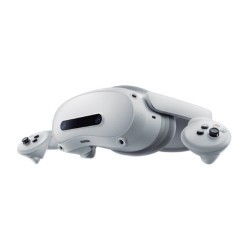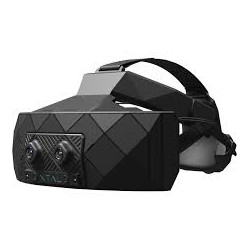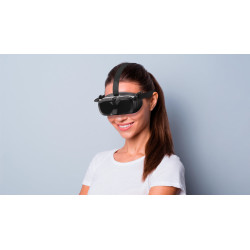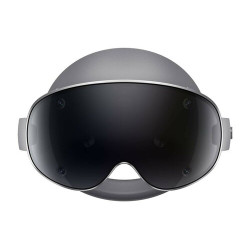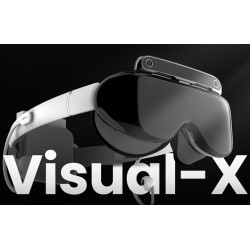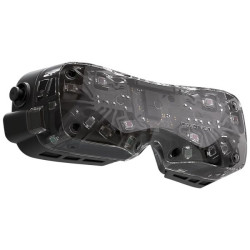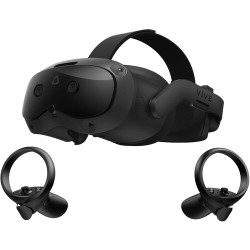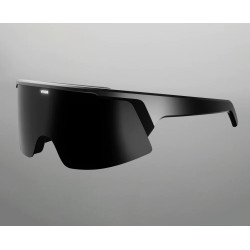
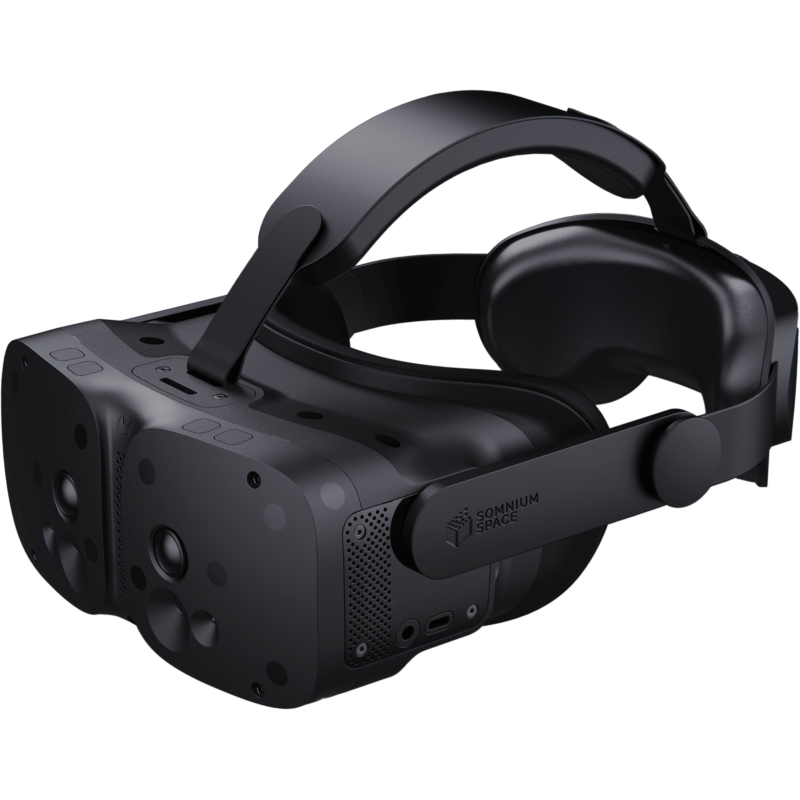
Somnium VR1 is a premium wired PC VR headset developed for demanding enthusiasts, simulator users, research laboratories and professional applications. The device offers a resolution of 2880 × 2880 pixels per eye, a wide field of view, QLED Mini-LED displays with local dimming and an extensively modular design. Depending on the selected version, the headset may include eye tracking, hand tracking and mixed reality cameras.
device unavailable
Somnium Space VR1 – Niche, Modular Premium PC VR Headset
Somnium VR1 is a premium wired PC VR headset developed for demanding enthusiasts, simulator users, research laboratories and professional applications. The device offers a resolution of 2880 × 2880 pixels per eye, a wide field of view, QLED Mini-LED displays with local dimming and an extensively modular design. Depending on the selected version, the headset may include eye tracking, hand tracking and mixed reality cameras.
Somnium VR1 was designed, developed and is manufactured in the European Union, in the Czech Republic. The manufacturer emphasises the openness of the platform, extensive configuration options and the absence of additional licence fees for the device’s core features.
Why is Somnium VR1 a niche product?
Somnium VR1 should be regarded as a niche product, rather than a direct alternative to mass-market standalone headsets such as Meta Quest or Pico. This is due to several factors:
– it is a wired PC VR headset requiring a powerful computer,
– full positional tracking requires external SteamVR Lighthouse base stations,
– controllers must be purchased separately,
– the device is offered in expensive, highly specialised configurations,
– individual versions are aimed at simulator enthusiasts, developers, laboratories and professional system integrators,
– configuring SteamVR, OpenXR, eye tracking and foveated rendering requires more technical knowledge than operating a typical consumer headset.
The term “niche” does not imply low quality. In this case, it describes a product intended for a relatively narrow group of users who deliberately prioritise high resolution, a wide field of view, software openness and expandability over simplicity and mobility.
Models offered by the manufacturer
The official product range includes three regularly available versions and a separate military edition:
Somnium VR1 Visionary Edition – VR + ET
– the entry model among the currently offered versions,
– full virtual reality functionality,
– integrated 120 Hz eye tracking,
– support for dynamic foveated rendering,
– gaze-direction analysis and heatmap generation,
– no integrated hand tracking or mixed reality cameras.
Somnium VR1 Titan Edition – VR + ET + HT
– full virtual reality functionality,
– 120 Hz eye tracking,
– 120 Hz Ultraleap hand tracking,
– Ultraleap Enterprise licence included with the device,
– no mixed reality cameras.
Somnium VR1 Ultimate Edition – VR + ET + HT + MR
– the most advanced consumer-professional version,
– eye tracking,
– Ultraleap hand tracking,
– colour mixed reality,
– passthrough and real-world masking functions,
– support for CAD models used to define visible physical cockpit or workstation elements,
– two six-metre AOC cables required for the complete VR and MR configuration.
Somnium VR1 Military Edition
– an official version intended exclusively for professional pilot training and military applications,
– marked by the manufacturer as TAA compliant,
– not sold through the standard Somnium Space online store,
– sales and support are handled exclusively by VRgineers.
Abbreviations: ET means Eye Tracking, HT means Hand Tracking and MR means Mixed Reality.
TAA compliance relates to product origin requirements applicable to certain United States public-sector procurements. It is not a mechanical-durability certificate and does not indicate compliance with MIL-STD environmental standards.
Who is this product for?
– Demanding PC VR enthusiasts.
– Flight and racing simulator users.
– Users of DCS World, Microsoft Flight Simulator, iRacing and other advanced simulators.
– SteamVR and OpenXR application developers.
– Laboratories conducting research into perception, gaze behaviour and human-computer interaction.
– Companies building simulators, digital prototypes and training workstations.
– Users requiring extensive hardware and software configuration options.
– In the Military Edition: professional pilot training centres and military organisations.
Key information before purchase
– Somnium VR1 is not a standalone device. It requires a Windows computer.
– Its high resolution and wide field of view place significant demands on the graphics card, particularly in simulation applications.
– Full six-degrees-of-freedom tracking uses the SteamVR Lighthouse system. The manufacturer recommends at least two Base Station 2.0 units.
– Base Station 1.0 units are also supported, although tracking quality and coverage may be more limited.
– Base stations and controllers are not included as standard.
– The manufacturer recommends Valve Index controllers, although HTC Vive controllers and other Lighthouse-compatible devices are also supported.
– The computer connection is wired and uses a detachable six-metre AOC, or Active Optical Cable.
– Wireless operation is not currently available. The manufacturer only identifies it as a potential future feature.
– Eye tracking, hand tracking and mixed reality capabilities depend on the selected headset version.
Advantages
– High resolution of 2880 × 2880 pixels per eye.
– Image density of up to 35 PPD, or pixels per degree.
– QLED Mini-LED Fast LCD displays.
– Brightness of up to 210 nits.
– 576 local-dimming zones per eye.
– Manufacturer-declared HDR contrast ratio of up to 20,000:1.
– Actual undistorted field of view of 130° horizontal and 105° vertical.
– Rendered field of view of up to approximately 140° horizontal, although the actual visible field also depends on facial anatomy and eye position.
– Dual aspheric lens system for each eye.
– Wide IPD adjustment range of 57–76 mm.
– Support for 72 Hz and 90 Hz, as well as experimental 120 Hz and 144 Hz modes.
– Advanced local dimming providing improved black levels compared with conventional LCD panels.
– Open-source 120 Hz eye-tracking software.
– Support for static and dynamic foveated rendering.
– Gaze analysis and heatmap generation.
– Titan and Ultimate versions include integrated Ultraleap hand tracking operating at 120 Hz with a 170 × 170° field of view.
– Ultimate Edition includes mixed reality, passthrough, application-independent masking and support for CAD models representing physical workstation elements.
– Three USB-C 3.2 Gen 2 ports for accessories.
– Four modular mounting points.
– Available CAD files for designing and 3D-printing custom mounts and accessories.
– Magnetic attachment for optional prescription lens inserts.
– Integrated stereo microphones.
– 3.5 mm audio connector for external headphones.
– Detachable cable that can be replaced without replacing the entire headset.
Limitations and requirements
– Very high price compared with mainstream consumer devices.
– Requires a powerful computer, base stations and controllers.
– No standalone operating mode.
– No wireless connection in the current version.
– No integrated headphones; users must provide their own audio solution.
– Accessing the device’s complete functionality requires configuration of drivers, the Somnium VR1 Tool, SteamVR or the dedicated OpenXR environment.
– Not every application supports dynamic foveated rendering or all OpenXR functions.
– The 120 Hz and 144 Hz modes are described by the manufacturer as experimental.
– Hand tracking is only available in the Titan and Ultimate versions.
– Mixed reality is only available in the Ultimate version.
– SteamVR Lighthouse remains the officially supported six-degrees-of-freedom positional tracking system.
Applications
– PC VR gaming.
– Flight and racing simulators.
– Professional and enthusiast simulation workstations.
– Procedural training.
– Visualisation of cockpits, vehicles and machinery.
– Product design and prototype evaluation.
– Eye-tracking research and gaze analysis.
– Human-computer interaction research.
– Development of SteamVR and OpenXR applications.
– Mixed reality with visible physical cockpit components.
– Pilot training and military applications using the dedicated Military Edition.
Suitability for consumers
– High suitability for advanced PC VR and simulator enthusiasts.
– It is particularly well suited to users who prioritise a wide field of view, high resolution and extensive configuration options.
– Visionary and Titan editions may be attractive to users of DCS World, Microsoft Flight Simulator, iRacing and other simulators supporting SteamVR or OpenXR.
– Low suitability for the average consumer looking for an affordable, standalone and easy-to-use system.
– This is not a simple plug-and-play headset, particularly when using the dedicated OpenXR runtime, dynamic foveated rendering and external Lighthouse tracking.
Suitability for education
– Medium suitability for standard schools and general education.
– The price, requirement for external base stations and more complex configuration limit the practicality of deploying large numbers of headsets.
– High suitability for specialist universities, technical laboratories and training centres.
– The headset may be used for education in design, simulation, aviation, automotive engineering, 3D graphics and XR application development.
– Versions with eye tracking may support analysis of attention and the way trainees perform specific procedures.
Suitability for laboratories and research
– High suitability for specialist VR and XR laboratories.
– Open-source eye-tracking software allows research teams to adapt the algorithm to their own projects.
– A 120 Hz eye-tracking frequency, heatmaps and dynamic foveated rendering may support perception and user-behaviour research.
– The modular design, USB-C ports and mounting points make it possible to attach additional sensors and custom accessories.
– Ultimate Edition supports mixed reality research and interaction with physical workstation components. (store.somniumspace.com)
– The manufacturer does not present Somnium VR1 as certified measurement equipment or a medical device. Using eye-tracking results as scientific data requires validation of the device and methodology for the specific research project.
Suitability for healthcare
– Potential research and training suitability, but without confirmed medical certification.
– High resolution, eye tracking and support for custom software may be useful in perception research, rehabilitation, ergonomics or healthcare personnel training.
– However, the manufacturer does not declare Somnium VR1 to be a medical, diagnostic or therapeutic device.
– The headset should not be presented as medical equipment without separate validation and appropriate certification of the complete solution.
Suitability for industry and business
– Medium to high suitability, particularly for design, simulation and visualisation.
– The wide field of view may support analysis of cabins, cockpits and operator workstations.
– Ultimate Edition allows virtual content to be combined with visible elements of a physical workstation.
– CAD model support may allow selected physical controls, panels or cabin components to remain visible.
– The modular design makes it easier to adapt the headset to prototype or specialist workstations.
– The lack of a declared IP protection rating or industrial-durability certification means the device is best used in controlled laboratories, offices and training rooms.
Suitability for military and defence applications
– Confirmed official military use applies specifically to the Somnium VR1 Military Edition.
– The manufacturer describes this model as intended exclusively for professional pilot training and military applications.
– Military Edition is marked as TAA compliant and is available exclusively through VRgineers.
– The regular Visionary, Titan and Ultimate editions should not automatically be presented as certified military equipment simply because they may be used in simulation systems. (store.somniumspace.com)
– The manufacturer does not specify compliance with MIL-STD standards, an environmental-resistance class or an IP protection rating for Military Edition.
– TAA compliance relates to product origin and eligibility for certain US public procurements. It does not confirm resistance to water, dust, extreme temperatures, vibration or impact.
Is Somnium VR1 the right choice?
Somnium VR1 may be a suitable choice when the key requirements are:
– high image resolution,
– a wide field of view,
– simulator applications,
– open and configurable eye tracking,
– dynamic foveated rendering,
– integrated hand tracking,
– mixed reality combined with a physical cockpit,
– modular construction and support for custom accessories,
– extensive control over hardware and software.
Another product may be more suitable when the main requirements are:
– a low purchase price,
– standalone operation without a computer,
– simple configuration for beginner users,
– inside-out tracking without base stations,
– wireless operation,
– easy sharing between a large number of users,
– confirmed medical certification or industrial durability.
Technical specifications
Display and optics
– Displays: QLED Mini-LED Fast LCD.
– Resolution: 2880 × 2880 pixels per eye.
– Image density: up to 35 PPD.
– Brightness: up to 210 nits.
– Local dimming: 576 zones per eye.
– Declared HDR contrast ratio: up to 20,000:1.
– Standard refresh rate: 90 Hz.
– Additional mode: 72 Hz.
– Experimental modes: 120 Hz and 144 Hz.
– Actual field of view: 130° horizontal and 105° vertical.
– Maximum rendered field of view: up to approximately 140° horizontal.
– Lenses: two aspheric lenses per eye.
– IPD range: 57–76 mm.
Tracking
– Positional tracking: SteamVR Lighthouse.
– Supported base stations: Base Station 1.0 and 2.0.
– Recommended configuration: at least two Base Station 2.0 units.
– Controllers: SteamVR Lighthouse-compatible devices, including Valve Index and HTC Vive controllers.
– Additional sensors: integrated inertial measurement units supporting three-degrees-of-freedom operation.
– Eye tracking: 120 Hz in Visionary, Titan and Ultimate editions.
– Hand tracking: Ultraleap at 120 Hz with a 170 × 170° field of view in Titan and Ultimate editions.
– Mixed reality: available in Ultimate Edition.
Software
– Operating system: Windows.
– SteamVR: supported through the dedicated Somnium driver.
– OpenXR: dedicated Somnium OpenXR runtime.
– Foveated rendering: static and dynamic, depending on the application and headset version.
– Reprojection: SteamVR Motion Smoothing, OpenXR Timewarp and experimental Spacewarp.
– Linux: identified by the manufacturer as a potential future option, not as a currently available feature.
Connectivity
– Video connection: DisplayPort 1.4.
– Additional ports: 3 × USB-C 3.2 Gen 2, up to 10 Gb/s.
– Audio: 3.5 mm headphone connector.
– Microphones: integrated stereo microphones.
– Cable: detachable six-metre hybrid AOC cable.
– Ultimate Edition: two AOC cables for the full VR and MR configuration.
– Mounting points: four modular mounts with CAD files available.
Vision correction
– support for magnetically attached prescription lens inserts,
– VR Optician is identified by the manufacturer as the official lens partner.
Manufacturing
– Place of development and manufacture: European Union, Czech Republic.
Certification and intended use
– Regular editions: consumer, simulator, research and professional applications.
– Official military version: Somnium VR1 Military Edition.
– Official intended use of Military Edition: professional pilot training and military applications.
– TAA compliance: confirmed by the manufacturer for Military Edition.
– Declared medical certification: no information provided.
– Declared MIL-STD compliance: no information provided.
– Declared IP protection rating: no information provided.
– Industrial or field durability: not confirmed by the manufacturer.
Somnium VR1 is a premium wired PC VR headset developed for demanding enthusiasts, simulator users, research laboratories and professional applications. The device offers a resolution of 2880 × 2880 pixels per eye, a wide field of view, QLED Mini-LED displays with local dimming and an extensively modular design. Depending on the selected version, the headset may include eye tracking, hand tracking and mixed reality cameras.