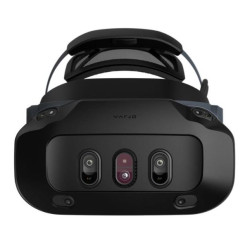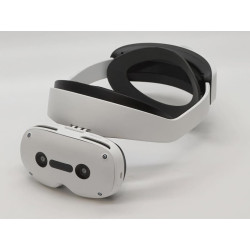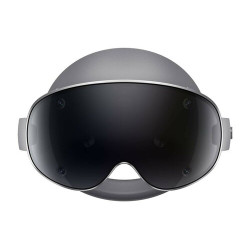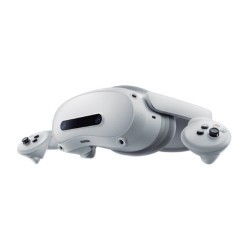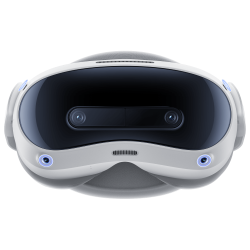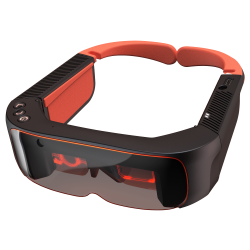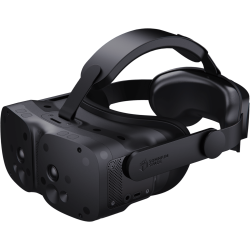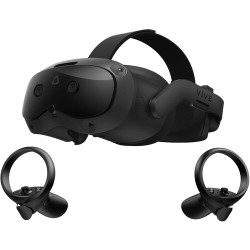
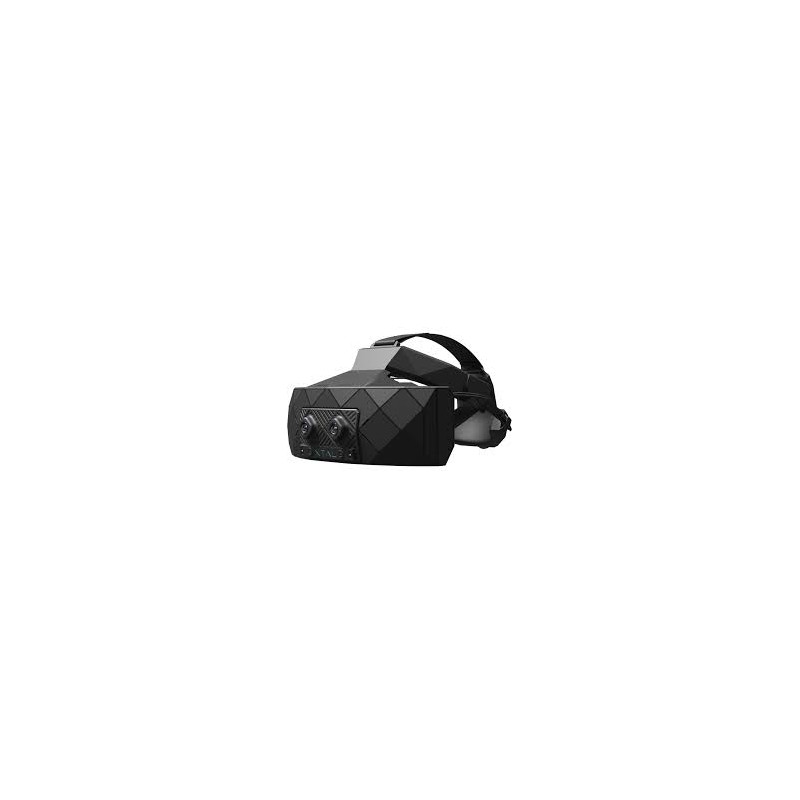
VRgineers XTAL 3 VR is a professional wired virtual reality headset designed primarily for civil and military pilot training and for building advanced simulation environments. The device offers a resolution of 3840 × 2160 pixels per eye, a very wide field of view, integrated eye and hand tracking, and compatibility with multiple professional positional tracking systems.
VRgineers XTAL 3 VR – Professional VR Headset for Pilot Training and Simulation
VRgineers XTAL 3 VR is a professional wired virtual reality headset designed primarily for civil and military pilot training and for building advanced simulation environments. The device offers a resolution of 3840 × 2160 pixels per eye, a very wide field of view, integrated eye and hand tracking, and compatibility with multiple professional positional tracking systems.
The manufacturer officially positions XTAL 3 VR for professional aviation and defence training. The headset is also marked as TAA compliant. However, this does not mean that the device is declared compliant with military environmental resistance standards or intended for direct field use.
Who is this product for?
– Civil and military pilot training centres.
– Manufacturers and integrators of flight simulators.
– Armed forces and defence organisations building stationary training systems.
– Airlines, aviation schools and crew training centres.
– Laboratories studying operator behaviour, perception, gaze direction and task execution.
– Industrial companies using advanced visualisation, digital prototyping and simulation environments.
– Professional simulator users requiring a wide field of view and high instrument readability.
Key information before purchase
– XTAL 3 VR is not a standalone device. It requires a Microsoft Windows computer and a sufficiently powerful graphics card.
– The manufacturer does not publish minimum processor, graphics card or RAM requirements on the product page. The workstation must be selected according to the software used, rendering resolution and simulation complexity.
– The headset can operate with SteamVR Lighthouse or professional tracking systems such as ART, OptiTrack, Polhemus and Vicon.
– The standard headset configuration includes SteamVR tracking sensors, but the manufacturer does not clearly state on the product page whether base stations are included in the basic package.
– The exact package contents, additional sensors, tracking system, cables, software and integration services should be confirmed before purchase.
– The product is offered through an individual quotation process. The manufacturer does not publish a standard retail price.
– XTAL 3 VR is a fully virtual-reality model. It does not include an integrated mixed-reality camera module. This functionality is available in the separate XTAL 3 NEO model.
Advantages
– Very high resolution of 3840 × 2160 pixels per eye.
– Two fast-switching 4K LCD displays designed for VR applications.
– Wide default field of view of 140° horizontal and 90° vertical.
– Maximum experimental field of view of up to 180° horizontal and 120° vertical.
– Integrated eye tracking for gaze analysis and heatmap generation.
– Support for foveated rendering, which renders the highest image quality in the area where the user is looking.
– Integrated Ultraleap sensor for hand tracking and interaction with a virtual cockpit without standard VR controllers.
– Automatic interpupillary distance adjustment in the 56–74 mm range.
– Support for individually manufactured prescription lens inserts.
– Compatibility with multiple consumer and professional positional tracking systems.
– Support for SteamVR, OpenXR, Unity, Unreal Engine and C++ libraries.
– Hardware, firmware and software customisation options for project-specific requirements.
– Official positioning for professional pilot training, including civil and military applications.
Limitations and requirements
– The headset weighs 600 g without the head strap, making it considerably heavier than the lightest consumer VR headsets.
– Full 4K-per-eye resolution is available at 75 Hz.
– Operation at 120 Hz requires a lower QHD resolution per eye.
– The maximum field of view values of 180° × 120° are described by the manufacturer as experimental. The default values are 140° × 90°.
– The device is wired and requires a computer connection.
– Professional tracking systems, workstations, simulation software and cockpit components may require separate purchase and integration.
– This is not a plug-and-play product intended for beginner VR users.
– The design is optimised primarily for professional training stations rather than mobile use.
– The lack of an integrated mixed-reality camera module limits the ability to view a physical cockpit while wearing the headset. For such use cases, XTAL 3 NEO may be the more suitable model.
Applications
– Aircraft and helicopter pilot training.
– Procedural, situational and mission training.
– Fighter aircraft, transport aircraft and civil aviation simulators.
– Multi-crew training.
– Analysis of instrument scanning procedures and pilot behaviour.
– Debriefing based on heatmaps and eye-tracking data.
– Ground vehicle and machinery simulators.
– Research into perception, human-machine interfaces and operator workload.
– Industrial visualisation, vehicle design and 3D model reviews.
– Integration with physical controls, cockpits and training stations.
Suitability for consumers
– Low suitability for the average home user.
– The product requires an advanced computer workstation, tracking system configuration and suitable software.
– Its 600 g weight, wired design and quotation-based sales model mean that it is not a direct alternative to mainstream consumer VR headsets.
– Medium suitability for advanced flight-simulation enthusiasts with an appropriate budget, powerful computer and fixed simulator setup.
– The manufacturer supports platforms including Microsoft Flight Simulator, X-Plane 11/12, Prepar3D, Aerofly FS and FlyInside.
Suitability for education
– Medium suitability for general school education.
– Cost, integration requirements and the need for a powerful computer may limit its use in standard classrooms.
– High suitability for specialised aviation schools, technical universities and operator training centres.
– The wide field of view and high resolution can support instrument training, procedural learning and spatial orientation.
– Eye tracking can help assess whether a trainee observes the correct instruments and environmental elements in the proper sequence.
– The manufacturer officially positions the device as professional training equipment rather than a standard classroom tool.
Suitability for laboratories and research
– High suitability for research requiring a wide field of view, high resolution and gaze-direction analysis.
– Integrated eye tracking can be used to record visual scanning patterns, generate heatmaps and analyse operator behaviour.
– Support for OpenXR, Unity, Unreal Engine and C++ libraries facilitates integration with custom research applications.
– Compatibility with ART, OptiTrack, Polhemus and Vicon systems increases its usefulness in professional motion-tracking laboratories.
– The manufacturer does not present XTAL 3 VR as a certified medical device or diagnostic instrument.
– Use in medical, psychological or ergonomic research requires independent validation of the complete research setup and methodology.
Suitability for military and defence applications
– High suitability for stationary training and simulation.
– The manufacturer clearly states that XTAL 3 VR was developed with input from civil and military pilots and is intended for professional flight training.
– The headset can be used in fighter aircraft, helicopter, vehicle and full-mission training simulators.
– High resolution helps preserve the readability of symbols, indicators and cockpit elements.
– The wide field of view supports environmental observation without excessive head movement.
– Eye tracking can help instructors analyse cockpit scanning, procedural performance and situational awareness.
– The product is marked by the manufacturer as TAA compliant and is offered for professional and military customers.
– The manufacturer does not declare compliance with MIL-STD standards, a specific IP protection rating, or resistance to water, dust, shock or extreme temperatures on the product page.
– XTAL 3 VR should therefore be treated as a professional component of a training system or simulator rather than as equipment intended for direct operational use in the field.
Suitability for civil aviation
– Very high suitability.
– This is one of the primary application areas identified by the manufacturer.
– The headset can support the training of passenger aircraft, transport aircraft, business aviation and helicopter pilots.
– It may be used for procedural learning, cockpit familiarisation, emergency training and preparation for full-flight simulators.
– The manufacturer states compatibility with commercial simulation platforms such as X-Plane, Prepar3D and Microsoft Flight Simulator.
Suitability for industry and design
– Medium to high suitability, depending on the project.
– High resolution and a wide field of view can support design reviews, vehicle visualisation, ergonomic analysis and digital prototype presentations.
– The manufacturer offers hardware and software customisation for specific applications.
– References shown on the manufacturer’s website include automotive and industrial companies, although the current model is primarily positioned for professional pilot training.
Is XTAL 3 VR the right choice?
XTAL 3 VR is suitable when the main priorities are:
– a very wide field of view,
– high readability of instruments and symbols,
– professional eye tracking,
– analysis of trainee behaviour,
– integration with a physical cockpit or simulation station,
– compatibility with professional software and tracking systems,
– the ability to customise the device for a specific project.
Another product may be more suitable when the main requirements are:
– standalone operation without a computer,
– wireless connectivity,
– low weight and mobility,
– a simple multi-user setup,
– mixed reality with passthrough cameras — in this case, XTAL 3 NEO should be considered.
Technical specifications
Image and optics
– Resolution: 3840 × 2160 pixels per eye.
– Displays: two fast-switching 4K LCD panels.
– Refresh rate: 75 Hz at 4K resolution per eye.
– High-refresh-rate mode: 120 Hz at QHD resolution per eye.
– Default field of view: 140° horizontal and 90° vertical.
– Maximum experimental field of view: 180° horizontal and 120° vertical.
– Lenses: custom-developed non-Fresnel lenses.
– Image correction: chromatic aberration and barrel distortion correction algorithms.
– IPD adjustment: automatic, 56–74 mm.
– Prescription correction: custom prescription lens inserts available.
Tracking
– Eye tracking: integrated.
– Eye-tracking frequency: native 120 Hz, up to 210 Hz maximum.
– Eye-tracking functions: gaze analysis and heatmap visualisation.
– Hand tracking: integrated Ultraleap infrared sensor.
– Default positional tracking: SteamVR Lighthouse.
– Other supported systems: ART, OptiTrack, Polhemus, Vicon and custom solutions.
Advanced functions
– Foveated rendering.
– Timewarp.
– Hardware, software and firmware customisation.
– Integration of additional sensors and modules.
– Integration with pilot helmets.
Connectivity
– Option 1: 5 m VirtualLink cable.
– Option 2: DisplayPort 1.4, USB 3.2 Gen 2 and 12 V / 3 A power supply.
– Cable length: 5 m.
Software
– Operating system: Microsoft Windows.
– Drivers and runtimes: SteamVR and OpenXR.
– Engines: Unity, Unreal Engine and other engines supported through plugins.
– C++ libraries: DirectX, OpenGL and Vulkan.
Supported simulation environments
– Commercial: Prepar3D, X-Plane 11 and 12, Microsoft Flight Simulator, Aerofly FS and FlyInside.
– Professional: Prepar3D, X-Plane 11 and 12, Bohemia Interactive Simulations VBS3, VBS4 and Blue IG, MAK, multiSim, Metrea and Aechelon Technology solutions.
Dimensions and weight
– Weight without head strap: 600 g.
– Headset dimensions: 293 × 123 × 113 mm.
Certification and intended use
– Official intended use: professional civil and military pilot training.
– TAA compliance: yes, according to the manufacturer.
– Declared medical certification: no information provided.
– Declared MIL-STD compliance: no information provided.
– Declared IP protection rating: no information provided.
– Classification as military equipment: the manufacturer does not provide such a classification directly on the XTAL 3 VR product page.
XTAL 3 NEO Mixed Reality headset, headset mixed reality dla pilotów, profesjonalne szkolenie pilotów VR i MR, immersyjna rzeczywistość mieszana, technologia MR w szkoleniu lotniczym, kamery passthrough w kokpicie MR, wysoka wierność obrazu 4K i 8K, szerokie pole widzenia 180 stopni, zaawansowane maskowanie 3D, śledzenie dłoni Ultraleap, kompensacja śledzenia głowy, poprawa pamięci mięśniowej w treningu, czytelne panele instrumentów MR, usprawnione scenariusze treningowe, personalizowane obiektywy MR, modułowe rozwiązania symulatorów lotu, wysokiej klasy symulacje kokpitowe, eye tracking w symulatorze, systemy pozycyjnego śledzenia, VRgineers dla lotnictwa cywilnego i wojskowego, profesjonalne rozwiązania XR dla pilotów, XR headset dla lotnictwa, system szkoleniowy pilotów VR i MR, VRgineers XTAL 3 NEO opis, professional aviation mixed reality gear, pilot training virtual i mixed reality, Mixed reality headset for pilots, professional VR and MR pilot training, immersive mixed reality, MR technology in flight training, MR cockpit passthrough cameras, high-fidelity 4K and 8K image, wide 180-degree field of view, advanced 3D masking, Ultraleap hand tracking, head tracking compensation, improved muscle memory in training, clear MR instrument panels, improved training scenarios, personalized MR lenses, modular flight simulator solutions, high-end cockpit simulations, eye tracking in the simulator, positional tracking systems, VRgineers for civil and military aviation, professional XR solutions for pilots, XR headset for aviation, VR and MR pilot training system, VRgineers XTAL 3 NEO description, professional aviation mixed reality gear, pilot training virtual and mixed reality
VRgineers XTAL 3 VR is a professional wired virtual reality headset designed primarily for civil and military pilot training and for building advanced simulation environments. The device offers a resolution of 3840 × 2160 pixels per eye, a very wide field of view, integrated eye and hand tracking, and compatibility with multiple professional positional tracking systems.