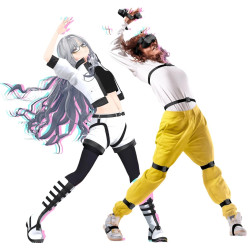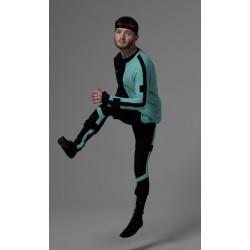
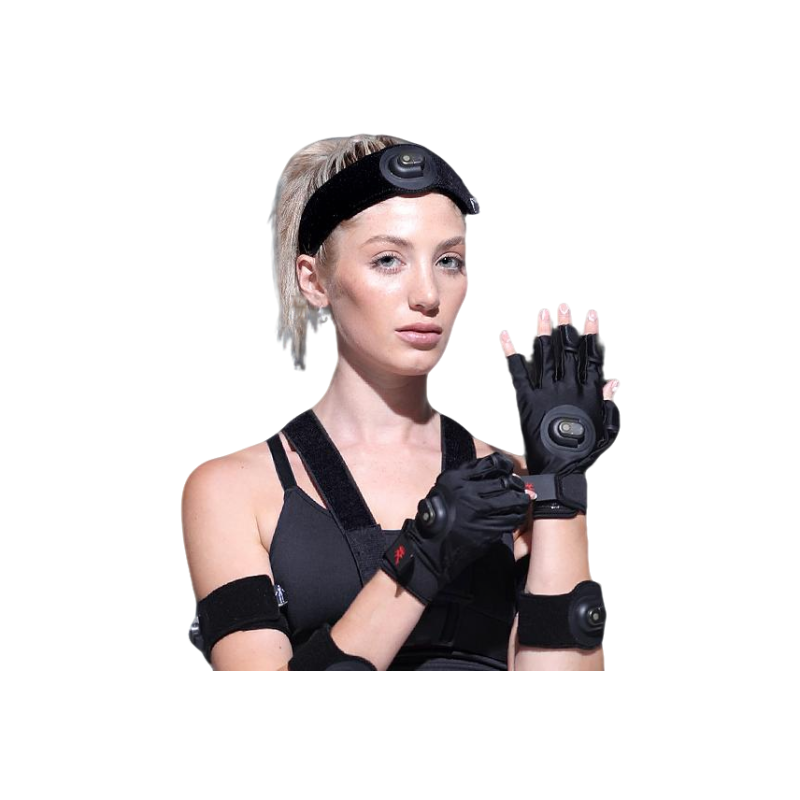
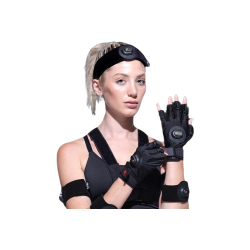
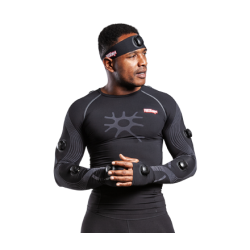
The Noitom Perception Neuron is a family of portable motion capture systems. The solution utilizes small inertial measurement unit (IMU) sensors placed on the user's body. The sensors record the orientation and movement of individual body parts, and software transforms the measurement data into an animated digital skeleton.
The system can capture the movement of the entire body, and with appropriate configurations, also the hand and fingers. Data can be recorded, analyzed, exported to popular animation formats, or transmitted in real time to graphics engines, 3D applications, virtual reality environments, and research software.
Noitom Perception Neuron is a family of portable motion capture systems designed to capture human movement. The solution uses small IMU — Inertial Measurement Unit — sensors placed on the user’s body. The sensors record the orientation and movement of individual body parts, while the software converts the measurement data into an animation of a digital skeleton.
The system can capture full-body movement and, with the appropriate configuration, also hand and finger movements. The data can be recorded, analysed, exported to popular animation formats or streamed in real time to game engines, 3D applications, virtual reality environments and research software.
Noitom’s current portfolio includes, among others, the wireless PN 3 and PN Studio systems, the wired PN Link system and the PN Hybrid solution, which combines inertial measurements with optical positioning.
Key system versions
Perception Neuron 3
PN 3 is the basic, lightweight and portable wireless system in the Perception Neuron family. The manufacturer positions it as an entry-level solution intended, among others, for animators, game studios, film production, virtual broadcasting and education.
The full configuration uses up to 27 wireless inertial sensors, enabling the capture of body and hand movements. The current version, presented by the manufacturer as an edition upgraded in 2025, offers improved resistance to magnetic interference.
Perception Neuron Studio
PN Studio is a more advanced system intended for professional applications, more dynamic movements, more accurate analysis and operation within a larger capture area.
The manufacturer indicates applications including, among others:
biomechanical analysis;
ergonomics;
sports;
visual effects;
film production;
stage performances;
virtual characters and digital humans;
research on humanoid robots;
teleoperation and training robots based on human movement.
Perception Neuron 3 specifications
Sensors
type: wireless, nine-axis MEMS inertial sensors;
measurement components: gyroscope, accelerometer and magnetometer;
built-in AHRS orientation calculation system;
number of sensors in the full set: up to 27;
dimensions of a single sensor: approximately 27.9 × 16.2 × 11.6 mm;
weight of a single sensor: approximately 4.1 g;
communication with the computer: receiver connected via USB Type-C;
possibility of using a Type-C-to-USB adapter;
operating time: approximately 3.5 hours;
charging time: approximately 1 hour;
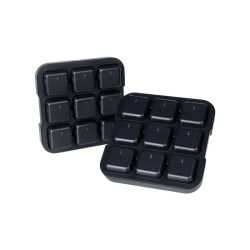
the charging station supports up to six sensors simultaneously.
Capture capabilities
full-body movement;
hand and selected finger movements, depending on the configuration;
indoor and outdoor operation;
no need to install motion capture cameras;
operation independent of lighting conditions;
no marker occlusion problem typical of camera-based systems, where markers are blocked by other people or objects;
simultaneous motion capture of up to three users in the Axis Studio environment, according to the manufacturer.
Optional equipment
gloves for capturing hand movements;
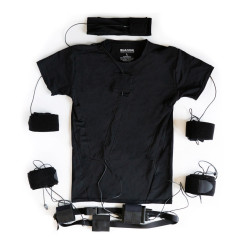
flexible sensor mounting straps;
a fitted compression suit stabilising the position of the sensors;
additional sensors and charging stations;
transport case.
A compression suit can improve measurement stability by limiting sensor movement relative to the body during rapid motion.
Perception Neuron Studio specifications
PN Studio sensor
number of body sensors in the standard configuration: 17;
additional spare sensor: 1;
motion capture gloves: one pair;
sensor dimensions: 43 × 33 × 20 mm;
sensor weight: 15.8 g;
battery capacity: 280 mAh;
declared operating time: up to 10 hours;
gyroscope range: ±2000°/s;
accelerometer range: up to ±30 g for hand and foot sensors and ±8 g for the remaining sensors;
internal processing frequency: 500 Hz;
output frequencies: 60, 90, 96, 100, 120 or 240 Hz;
declared minimum angular resolution: 0.02°;
declared static accuracy:
roll: 0.7°;
pitch: 0.7°;
yaw: 2°;
wireless communication frequency band: 2400–2483 MHz;
operating voltage: 5 V;
sensor current consumption: approximately 40 mA.
Capture area and multiple users
The manufacturer declares that PN Studio can be used within an area of up to approximately 1,000 m², capturing the movements of up to five people, including their hands, and tracking up to 20 props. Such a configuration may require an appropriately prepared system, radio infrastructure and additional components. Therefore, this parameter should not automatically be considered applicable to the basic single-user set.
The system can be expanded into a hybrid solution combining inertial and optical tracking, but the manufacturer indicates that this extension is configured individually.
Software required for operation
Axis Studio
The primary software for PN 3 and PN Studio is Noitom Axis Studio. The software receives data from the sensors, reconstructs the movement of the human skeleton and enables:
user configuration and calibration;
real-time movement preview;
recording of motion capture sessions;
editing the lengths of skeleton segments;
correcting the contact of the feet and other body points with the ground;
automatic data optimisation;
noise reduction;
animation export;
real-time motion streaming to other software;
export of kinematic parameters, such as joint angles, acceleration and angular velocity.
Supported formats and integrations
Axis Studio enables export, among others, to the following formats:
BVH — Biovision Hierarchy, used for storing skeletal animation;
FBX — Filmbox, commonly used in 3D graphics, animation and film production.
The manufacturer also supports real-time data streaming or integration with environments such as:
Unity;
Unreal Engine;
Autodesk MotionBuilder;
Autodesk Maya;
Cinema 4D;
Notch;
Reallusion iClone;
applications using OSC;
custom applications using the SDK or API.
The scope of integration may depend on the Axis Studio version, the plugin version and the specific system model.
Computer requirements
At a minimum, operation requires:
a compatible computer;
an available USB or USB Type-C port for the receiver;
Axis Studio software installed;
drivers and up-to-date firmware;
the appropriate plugins when data is to be transferred to an external application;
sufficient processor and graphics performance to support the target 3D environment.
The manufacturer provides Axis Studio, drivers, firmware, SDK packages, documentation and selected plugins in its download section.
The public international website currently does not present the up-to-date minimum processor, RAM and graphics card requirements for all variants in a sufficiently clear and unambiguous manner. Therefore, before purchase, the requirements for the specific Axis Studio version and the application being used should be confirmed, rather than relying on outdated parameters from earlier manuals.
Key advantages
Mobility
The system does not require the construction of a permanent studio with multiple cameras and can be moved between rooms, laboratories and locations.
Independence from lighting conditions
Inertial sensors do not capture images using cameras, so the measurement is not directly dependent on lighting quality.
Reduced occlusion issues
The sensors are placed on the user’s body, so they do not need to remain visible to cameras. This makes it easier to capture rotations, movement in confined spaces and certain movements performed close to other objects.
Real-time capture
Movement can be displayed immediately on a digital character or streamed to Unity, Unreal Engine or another compatible application.
Full-body and hand tracking
With the appropriate configuration, a single solution can capture both full-body movement and finger movements.
Open integration capabilities
The SDK, API, data streaming and support for standard formats facilitate the development of custom research, training and interactive applications.
Lower entry threshold than large optical systems
PN 3 can be a suitable solution for universities, small studios and laboratories that do not require a complete optical studio.
Disadvantages and limitations
Measurement drift
Inertial motion capture systems may gradually lose orientation or position accuracy during longer sessions. This issue may require recalibration or data correction.
No independent, precise global position measurement
IMU sensors are very effective at measuring the orientation and dynamics of body segments, but they do not automatically provide the same level of precise absolute positioning in space as a properly configured optical system.
This may result, among other things, in:
the digital character shifting relative to the ground;
errors in foot positioning;
problems with accurately reproducing contact with objects;
the need to use additional positioning or a hybrid system.
Sensitivity to metal and magnetic fields
Current versions are presented as being more resistant to magnetic interference, but the term “anti-magnetic” does not mean complete immunity to every source of interference. Large metal structures, motors, magnets, high-current cables and other sources of electromagnetic fields may still affect measurements.
Requirement for correct sensor placement
A displaced, loose or incorrectly assigned sensor causes errors in movement reconstruction. The result depends on:
correct sensor placement;
secure attachment;
proper calibration;
an accurate skeleton model;
maintaining the same configuration across subsequent sessions.
User preparation time
Putting on the full system, checking the sensors and performing calibration takes more time than starting a recording with a standard camera.
Limited PN 3 operating time
The declared operating time of approximately 3.5 hours may be insufficient for an all-day training session or a long production session without additional charging time.
Need for data processing
Motion capture data often requires:
filtering;
foot-contact correction;
removal of sudden data spikes;
skeleton adjustment;
retargeting to the target character;
manual correction of selected animation segments.
No force measurement
The system captures movement but does not independently measure:
ground reaction forces;
pressure;
muscle activity;
joint loads;
physiological parameters.
Such research requires additional equipment, for example force plates, EMG — electromyography — or pressure sensors.
Organisational and operational requirements
Before starting work, it is necessary to:
charge all sensors;
assign the sensors to the appropriate body parts;
put on the straps, gloves or suit;
connect the receiver to the computer;
launch Axis Studio;
check communication and battery status;
enter or verify the user’s body measurements;
perform calibration;
carry out a short movement test;
only then begin the actual recording.
For research applications, it is also necessary to document:
the software and firmware versions;
sensor placement;
the calibration method;
the sampling frequency;
environmental conditions;
the presence of metal structures;
the data-filtering method;
the number of recalibrations;
the procedure for synchronisation with other devices.
Selection recommendation
PN 3 is worth choosing when:
mobility and low weight are the main priorities;
the system is intended for education, animation or prototyping;
motion is captured from one user or a small group;
sessions do not last all day;
a relatively simple wireless system is required;
budget is a significant constraint.
PN Studio is worth choosing when:
fast and dynamic movements are being captured;
a higher data output frequency is required;
more comprehensive hand tracking is needed;
the system is intended for use in a laboratory, sports or professional production;
longer sessions are required;
work with multiple users is planned;
future expansion into a hybrid system is anticipated.
An optical or hybrid system will be more suitable when:
very accurate global positioning is required;
precise measurement of contact with objects is necessary;
the study requires accurate reconstruction of trajectories in space;
the results are intended to support clinical decisions or certified measurements;
strong magnetic interference is present;
validation against a laboratory reference system is planned.
The Noitom Perception Neuron is a family of portable motion capture systems. The solution utilizes small inertial measurement unit (IMU) sensors placed on the user's body. The sensors record the orientation and movement of individual body parts, and software transforms the measurement data into an animated digital skeleton.
The system can capture the movement of the entire body, and with appropriate configurations, also the hand and fingers. Data can be recorded, analyzed, exported to popular animation formats, or transmitted in real time to graphics engines, 3D applications, virtual reality environments, and research software.