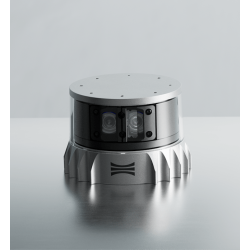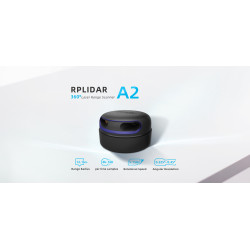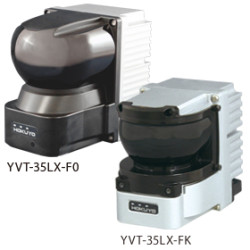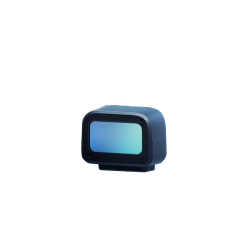
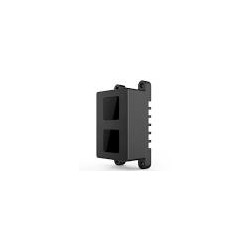
The Hypersen HPS-3D160 Pro is an industrial, all-solid-state 3D LiDAR using ToF (Time-of-Flight) technology. The sensor emits infrared light pulses and uses their return time to determine the distance to objects in its field of view. Unlike traditional scanning LiDARs, the device does not use mechanically rotating elements.
The HPS-3D160 Pro utilizes an 850 nm VCSEL light source and a 160 × 60 resolution measurement array, allowing for 9,600 measurement points in a single frame. The data can be used to create depth maps and 3D point clouds.
The Hypersen HPS-3D160 Pro is an industrial, all-solid-state 3D LiDAR using ToF (Time-of-Flight) technology. The sensor emits infrared light pulses and uses their return time to determine the distance to objects in its field of view. Unlike traditional scanning LiDARs, the device does not use mechanically rotating elements.
The HPS-3D160 Pro utilizes an 850 nm VCSEL light source and a 160 × 60 resolution measurement array, allowing for 9,600 measurement points in a single frame. The data can be used to create depth maps and 3D point clouds.
The device's field of view is 76° horizontal x 32° vertical, and the maximum measurement frequency is approximately 35 Hz and can be adjusted. The sensor allows for the definition of up to 16 ROI (Region of Interest) groups, with each group encompassing multiple measurement areas.
The measurement range depends on the reflectance of the tested object:
0.25–3 m for an object with a reflectance of 10%,
0.25–8 m for an object with a reflectance of 90%.
For a range of approximately 0.25–2 m, the manufacturer states a measurement error of ±2 cm, while for longer distances, up to 8 m, it is approximately ±1% of the measured distance. The sensor is designed to operate in ambient light up to 80,000 lux.
The HPS-3D160 Pro supports the following measurement modes:
Simple-HDR,
Auto-HDR,
Super-HDR.
HDR (High Dynamic Range) allows for a wider measurement range in situations where objects with significantly different reflectance properties are present in a single image. The device also has built-in data processing, filtering, and compensation algorithms.
Technical data
Measurement technology: ToF
Construction: Solid-state / no moving parts
Resolution: 160 × 60
Point count: 9600 points/frame
Field of view: 76° × 32°
Range: 0.25–8 m, depending on the object's reflectivity
Accuracy: Up to ±2 cm
Frequency: Up to 35 Hz, adjustable
Wavelength: 850 nm
Power supply: DC 12–24 V
Power consumption: Approximately 3–5 W according to the current product page
Operating temperature: -10°C to +55°C
Storage temperature: -40°C to +85°C
Dimensions: 78 × 40 × 30 mm
Weight: Approximately 110 g
Ingress protection: IP67
Interfaces: USB, USB-IO, LAN, and optional RS-232
Standard optically isolated input/output: 1 input/1 output.
Available Models and Versions
In the current Hypersen catalog, the 3D Solid-state LiDAR family includes two basic models:
HPS-3D160 Pro
Resolution: 160 × 60,
9600 points per frame,
FOV: 76° × 32°,
Range: up to 8 m.
HPS-3D640
Resolution: 640 × 480,
307,200 points per frame,
FOV: approximately 68° × 55°,
Range: up to 5 m for a target with 90% reflectivity.
The HPS-3D640 provides significantly greater spatial resolution, while the HPS-3D160 Pro offers a greater claimed maximum range.
HPS-3D160 Pro Variants
The manufacturer's documentation for the Pro version also identifies the following variants:
HPS-3D160-U Pro,
HPS-3D160-L Pro,
HPS-3D160-I Pro.
The differences primarily concern the communication interfaces and I/O. Version 1.5 documentation indicates LAN, USB, and USB-IO options, as well as different isolated I/O configurations for the U, I, and L variants.
It should be noted, however, that the current Hypersen website no longer lists the U, L, and I as separate products, but instead lists a single HPS-3D160 Pro model with available USB, RS-232, USB-IO, and LAN interfaces.
Software Required for Operation
The sensor itself has a built-in processor and data processing algorithms, so basic distance calculations are performed directly by the device. However, communication software or integration via an SDK is required to communicate with a computer, industrial system, or custom application.
1. Hypersen Client Software
The manufacturer provides documentation for a dedicated computer application described as:
HPS3D-160-pro Client Software
This software is used for communication with the sensor, parameter configuration, and measurement data display, among other things. The official Hypersen download center includes the "HPS3D-160-pro Client Software Operation Manual."
The application is also referred to as HPS3D_Client / HPS-3D160.exe in the documentation for the USB version. A suitable device driver may be required for USB connectivity in Windows.
2. HPS3D SDK
The HPS3D SDK – Software Development Kit – is used to integrate the sensor with custom software.
The manufacturer's documentation confirms the availability of the SDK for:
Windows,
Linux,
SCM – Single-Chip Microcomputer, i.e., microcontroller-based systems.
The manufacturer also provides the HPS 3D-160-pro SDK User Manual.
The SDK allows the user's application to communicate directly with the LiDAR and receive measurement data, instead of using a pre-built PC application.
3. Linux / Raspberry Pi
The HPS-3D160 can also be integrated with computers running Linux, including the Raspberry Pi. Available implementations use the HPS3D SDK, which is compiled directly for Linux.
4. Communication Protocol
Hypersen also provides documentation for the HPS-3D-160 Simple Communication Protocol V1.1. This allows for integration of the sensor into your own system without the need for a manufacturer's graphical application.
What is actually required?
For standard computer operation, the simplest solution is:
HPS-3D160 Pro + USB/LAN interface + Hypersen client software.
For integration with a custom application, robot, AGV, automation system, or industrial computer, the following is used:
HPS-3D160 Pro + HPS3D SDK or communication protocol.
Therefore, there is no need to constantly use the dedicated Hypersen software. After integration, the device can transmit data directly to the user's application.
Typical Applications
The HPS-3D160 Pro can be used in applications such as:
mobile robots and AGV/AMR,
obstacle detection and avoidance,
industrial automation,
security zone control,
person and object presence detection,
determining the location and dimensions of objects,
access control systems,
warehouse space monitoring,
transport and logistics systems,
applications using depth maps or 3D point clouds.
The Hypersen HPS-3D160 Pro is an industrial, all-solid-state 3D LiDAR using ToF (Time-of-Flight) technology. The sensor emits infrared light pulses and uses their return time to determine the distance to objects in its field of view. Unlike traditional scanning LiDARs, the device does not use mechanically rotating elements.
The HPS-3D160 Pro utilizes an 850 nm VCSEL light source and a 160 × 60 resolution measurement array, allowing for 9,600 measurement points in a single frame. The data can be used to create depth maps and 3D point clouds.