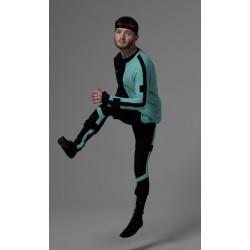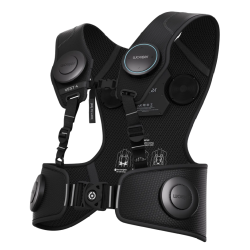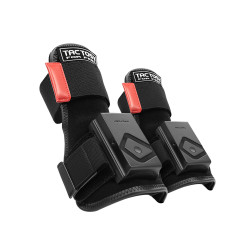
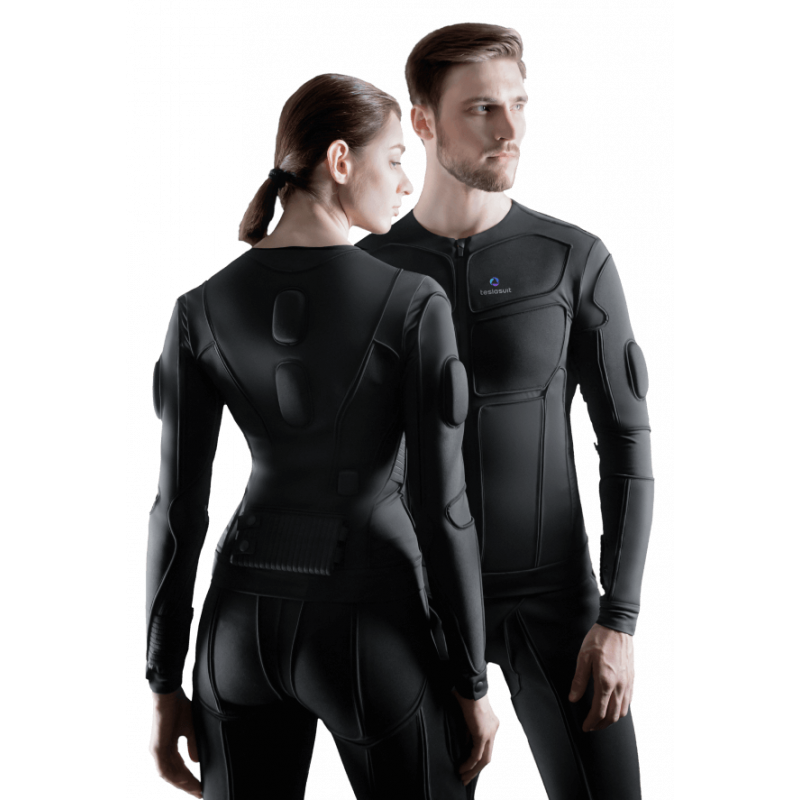
TESLASUIT Dev Kit is a professional, two-piece smart textile suit designed for advanced simulations, XR training, and research and development projects. It combines three main systems:
full-body haptic feedback based on electrostimulation,
full-body motion capture,
measurement of selected biometric parameters.
TESLASUIT Dev Kit – Haptic Suit with Motion Capture and Biometrics
Teslasuit – UK manufacturer
TESLASUIT Dev Kit is a professional, two-piece smart textile suit designed for advanced simulations, XR training, and research and development projects. It combines three main systems:
full-body haptic feedback based on electrostimulation,
full-body motion capture,
measurement of selected biometric parameters.
The device is not a standalone VR headset or a consumer gaming accessory. It is a B2B development platform requiring a Windows computer, dedicated software, application integration, and calibration and security procedures. The manufacturer currently offers the device exclusively to business customers.
Key Features
1. Whole-Body Haptic Feedback
TESLASUIT uses electrical impulses acting on nerves and muscles to simulate sensations associated with events in a digital environment. The system utilizes, among other things:
EMS – Electrical Muscle Stimulation,
TENS – Transcutaneous Electrical Nerve Stimulation,
FES – Functional Electrical Stimulation used to trigger or support specific movements.
The suit offers 80 haptic channels, an adjustable frequency range of 1–150 Hz, and a current intensity of up to 150 mA. Parameters must be individually calibrated for each user.
The system can simulate, among other things:
contact with a virtual object,
impact or pressure,
vibrations and impulses,
location of an event on the body,
tension or activation of selected muscle groups,
feedback signaling incorrect movement execution.
However, it should not be considered a full force feedback system. The suit lacks a rigid exoskeleton and cannot physically stop a limb, lift a weight, or reproduce real-world mechanical resistance.
2. Motion Capture
The motion capture system utilizes 14 IMU (Inertial Measurement Unit) modules. Each module contains an accelerometer, a gyroscope, and a magnetometer. Data is recorded at up to 100 frames per second, and the system can operate in 6-axis or 9-axis modes.
Possible applications include:
controlling an avatar in a virtual environment,
recording whole-body movements,
analyzing posture and biomechanics,
assessing the ergonomics of performed activities,
comparing user movement with reference movement,
recording animations for games and visualizations,
analyzing sports or professional technique.
The IMU-based system does not require external cameras or optical markers. Furthermore, magnetometers can be susceptible to interference from metal structures, electric motors, and strong electromagnetic fields. The manufacturer indicates that changing environmental conditions may require recalibration.
3. Biometrics
The built-in photoplethysmography (PPG) system enables heart rate measurement and analysis of heart rate variability. The sensor operates at a frequency of up to 200 samples per second and uses light with a spectral sensitivity range of 455–955 nm.
The data can be used to:
observe the body's response to stress,
analyze exercise load,
adjust simulation difficulty,
correlate movement with physiological response,
conduct user behavior research.
On the manufacturer's current website, the SpO₂ measurement, or blood oxygen saturation, is marked as a "coming soon" feature. Therefore, it should not be assumed that it is currently available or ready for production use without written confirmation from the manufacturer.
Software Required for Operation
TESLASUIT Control Center
A basic application used for:
detect and connect the suit,
manage the connection,
update the firmware,
calibrate the haptic system,
calibrate the motion sensors,
monitor the device status.
TESLASUIT Studio
A set of tools enabling the use of suit data and testing of individual systems, including:
avatar movement preview,
haptic effects configuration,
biometric data preview,
session recording,
data analysis and export.
TESLASUIT SDK
The SDK, or Software Development Kit, is a package of libraries, programming interfaces, and examples enabling the integration of the suit with your own application. The manufacturer also provides plugins for:
Unity and
Unreal Engine.
The officially tested versions of the Unity plugin listed by the manufacturer are 2019.3, 2020.3, 2021.1, and 2022.1. This information may no longer be current with the latest versions of Unity, so compatibility with a specific engine version must be confirmed before starting a project.
Operating System
The manufacturer states that it supports Windows only. The instructions refer primarily to Windows 10. I have not found clear, up-to-date confirmation of the full compatibility of all components with Windows 11, so this should be checked as part of a pre-deployment test.
TESLASUIT Dev Kit is a professional, two-piece smart textile suit designed for advanced simulations, XR training, and research and development projects. It combines three main systems:
full-body haptic feedback based on electrostimulation,
full-body motion capture,
measurement of selected biometric parameters.