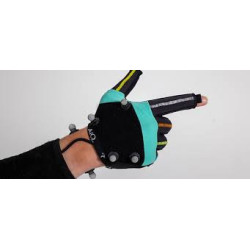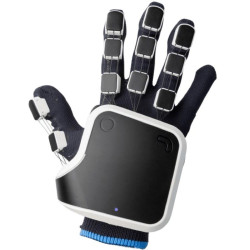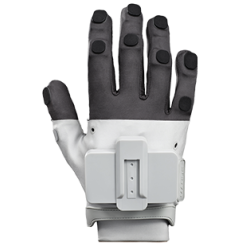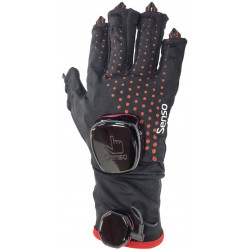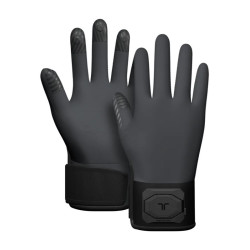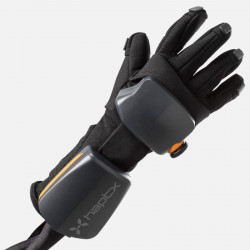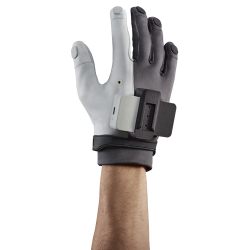
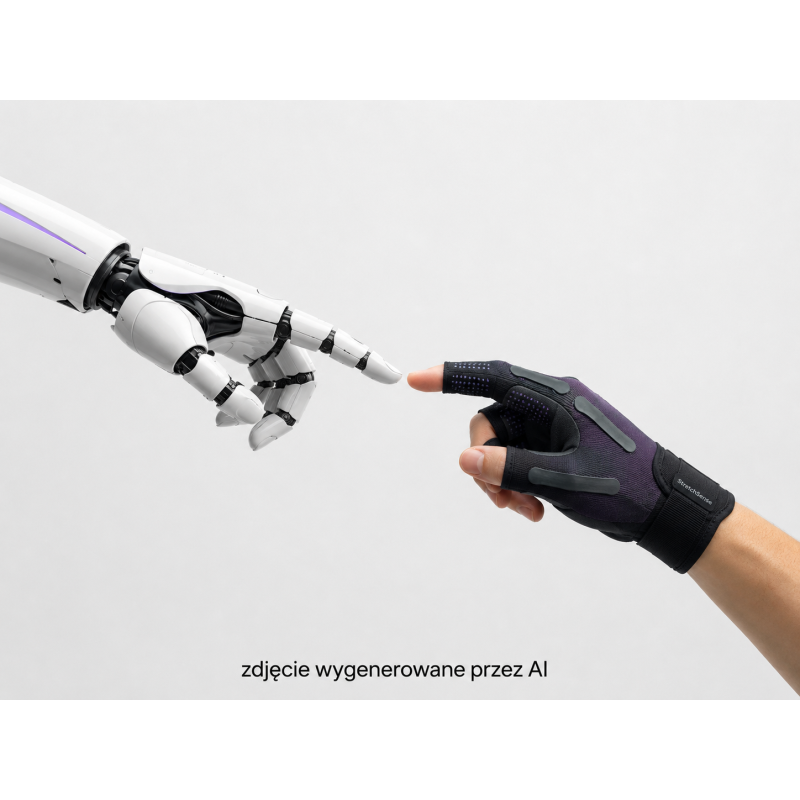
The StretchSense XR Reality Glove with Spatial Tracking is a wireless pair of gloves designed to precisely track finger and hand movements, as well as hand position in space. Each glove utilizes 32 flexible sensors that measure finger flexion and splay, while an integrated spatial tracking system maps the hand's position and orientation in six degrees of freedom (6DoF), i.e., movement in the X, Y, and Z axes, and rotation around each axis. The solution is designed for VR/XR, motion capture, simulation, training, robotics, teleoperation, animation, and human-computer interaction research.
Announcement - Estimated sales Q4 2026
StretchSense XR Reality Glove with Spatial Tracking
The StretchSense XR Reality Glove with Spatial Tracking is a wireless pair of gloves designed to precisely track finger and hand movements, as well as hand position in space. Each glove utilizes 32 flexible sensors that measure finger flexion and splay, while an integrated spatial tracking system maps the hand's position and orientation in six degrees of freedom (6DoF), i.e., movement in the X, Y, and Z axes, and rotation around each axis. The solution is designed for VR/XR, motion capture, simulation, training, robotics, teleoperation, animation, and human-computer interaction research.
Technical Specifications
Product Type: Pair of gloves for tracking hand and finger movements.
Number of sensors: 32 stretch sensors per glove, for a total of 64 sensors per pair.
Recorded movements: finger flexion, finger splay, and full hand articulation.
Spatial Tracking: Integrated 6DoF hand position and orientation tracking.
Spatial Tracking Technology: Ultrasound system, as per product description.
Hand Motion Sampling Rate: Up to 120 Hz.
Declared Latency: Less than 10 ms.
Connectivity: Bluetooth, without a dedicated USB receiver.
Declared Connection Range: Up to 5 meters.
Power Supply: Built-in rechargeable batteries.
Charging: USB-C.
Declared Operating Time: Up to 20 hours without active haptics.
Construction: Lightweight, textile, knit, with exposed fingertips. Cleaning: The manufacturer specifies that the textile components are machine washable.
Haptics: Optional rumble feedback.
Controls: Configurable gestures as controller buttons and a virtual joystick based on thumb movement or wrist orientation.
Declared platform hardware compliance: CE, FCC, and RoHS.
Product sizes: XS, S, M, and L.
Sizing
Circumference should be measured around the base of the fingers:
XS: 15.0–16.3 cm.
S: 16.3–18.0 cm.
M: 18.0–20.0 cm.
L: 20.0–23.5 cm.
Fitness is particularly important, as misalignment of the sensors relative to the joints can affect the calibration and accuracy of the hand mapping.
Software Required for Operation
For games and standard PCVR applications
The basic application software is the StretchSense XR Game App. The app allows you to:
connect the gloves via Bluetooth Low Energy (BLE),
calibrate hand articulation,
train gestures,
configure the joystick,
emulate controller buttons,
transmit motion to SteamVR, OpenVR, or OpenXR.
The official instructions are for Windows computers and include the C:\Program Files and AppData paths.
Depending on the application, you may need:
Steam and SteamVR,
OpenXR environment,
Meta Quest Link or Virtual Desktop for PCVR applications running with the Meta Quest headset,
a compatible VR application or game,
Bluetooth on your computer.
This product should not be considered a confirmed, standalone accessory that works natively without a computer on the Meta Quest or Pico headset. The documentation primarily describes the PCVR model, i.e., running applications on a computer and transmitting the image to the headset.
For application development and integration,
The manufacturer declares support for:
StretchSense SDK,
OpenXR,
SteamVR - to be confirmed,
Unity,
Unreal Engine,
Blender,
custom applications,
VRChat - to be confirmed,
REST-based and WebSocket-based APIs.
Calibration
The gloves require individual calibration:
finger articulation,
control gestures,
neutral position,
digital or analog joystick.
StretchSense recommends recalibration at the beginning of each session, as the material and sensor position on the hand can change. Gestures should also be trained in several variations, for example, with a relaxed and tense hand, to reduce accidental activations.
The StretchSense XR Reality Glove with Spatial Tracking is a wireless pair of gloves designed to precisely track finger and hand movements, as well as hand position in space. Each glove utilizes 32 flexible sensors that measure finger flexion and splay, while an integrated spatial tracking system maps the hand's position and orientation in six degrees of freedom (6DoF), i.e., movement in the X, Y, and Z axes, and rotation around each axis. The solution is designed for VR/XR, motion capture, simulation, training, robotics, teleoperation, animation, and human-computer interaction research.