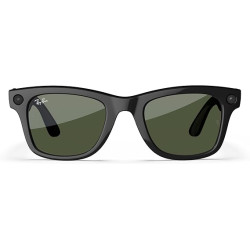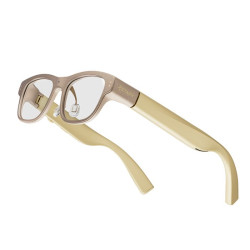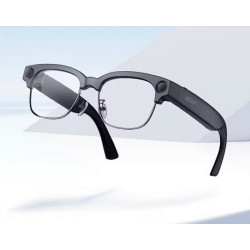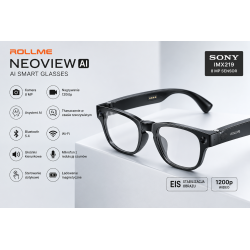
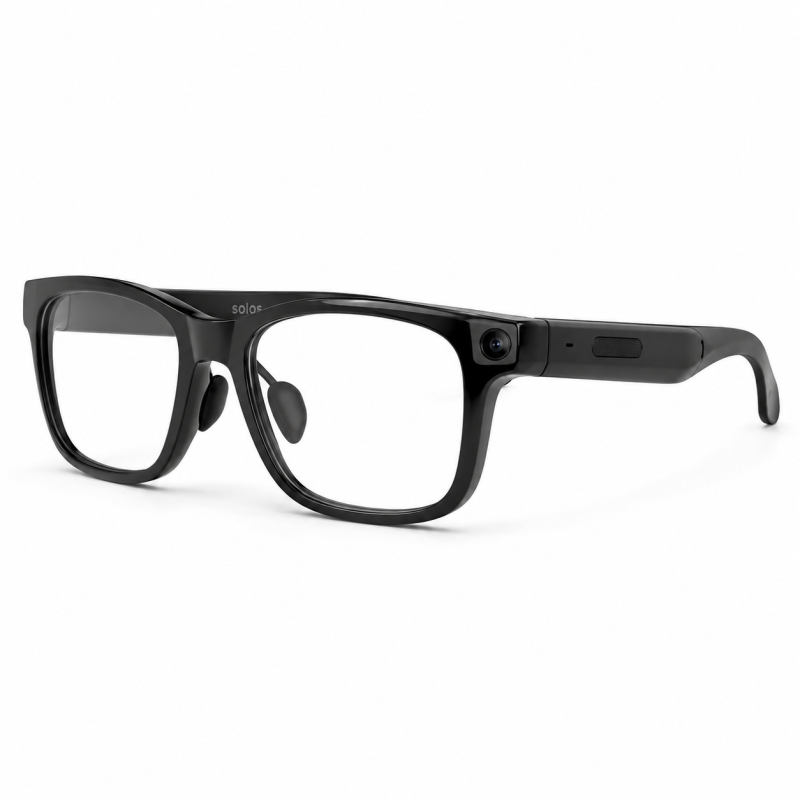
The Solos AirGo V2 Prime 1 and Prime 2 are essentially the same smart glasses in terms of electronics and features. They differ primarily in size, frame shape, and color options. These glasses feature a camera, microphones, open-ear speakers, and artificial intelligence and translation functions, but are not augmented reality glasses with a display in the lenses. Therefore, they do not project the translation in front of the user's eyes—the text appears on the phone's screen, and the translation can be played back aloud.
The glasses are available for purchase exclusively through the manufacturer's online store.
Solos AirGo V2 Prime 1 and Prime 2
The Solos AirGo V2 Prime 1 and Prime 2 are essentially the same smart glasses in terms of electronics and features. They differ primarily in size, frame shape, and color options. These glasses feature a camera, microphones, open-ear speakers, and artificial intelligence and translation functions, but are not augmented reality glasses with a display in the lenses. Therefore, they do not project the translation in front of the user's eyes—the text appears on the phone's screen, and the translation can be played back aloud.
Polish is supported by the app, SolosChat, and SolosTranslate. However, it cannot be definitively confirmed that the Polish translation will remain available free of charge after the one-year Premium period ends, as the manufacturer does not specify which seven languages are included in the free plan.
Solos AirGo V2 are smart glasses designed for:
taking photos and recording videos from the user's perspective,
making phone calls,
listening to music and announcements without covering your ears,
using an artificial intelligence assistant,
recognizing objects and scenes using the camera,
translating conversations and speech,
streaming live video,
reading out announcements and reminders.
The glasses use directional open-ear speakers, placed in the temples and directing sound towards the ears. The manufacturer clearly states that this is not bone conduction technology. This allows the user to hear both the sound from the glasses and the surroundings simultaneously.
The built-in camera can take 16MP photos and record footage described by the manufacturer as "2K FHD." The app description also mentions 2K recording at 30 frames per second. The term "2K FHD" is technically imprecise, as Full HD and 2K are not exactly the same resolution standard—it is advisable to verify the actual resolution of test files before professional use.
Technical Specifications
Camera and Image
Photos: 16MP,
Video recording: claimed 2K at 30 fps,
Photo capture and recording directly from the glasses,
Video transfer to a phone via Wi-Fi or a hotspot,
Live video streaming from the user's perspective is possible.
Connectivity
Bluetooth 5.2,
BLE [Bluetooth Low Energy – the energy-efficient version of Bluetooth],
claimed range of approximately 33 feet, or approximately 10 meters in open space,
compatible with Android and iOS.
Controls
Touch-sensitive volume control,
physical or virtual button on the right earcup,
"Hey Solos" voice control,
LED indicator light,
USB-C charging.
Battery Life
The manufacturer states:
approximately 16 hours for photo taking and AI queries,
approximately 10 hours for music streaming,
approximately 7 hours for phone calls,
fast charging: 15 minutes is supposed to provide approximately 3 hours of battery life,
full charge: approximately 1.5 hours.
Durability
The individual Prime 1 and Prime 2 product pages list an IP54 rating:
"5"—partial protection against dust ingress,
"4"—protection against splashes of water from various directions.
This does not indicate resistance to submersion, swimming, or heavy rainfall.
The collection page also displays the IP67 rating, which contradicts the specifications of the specific models. Until written confirmation from the manufacturer, the safer IP54 rating should be used.
Frame and Lenses
Frame material: TR90—light and flexible thermoplastic,
standard plano lenses, meaning no vision correction,
UV protection and some HEV [High-Energy Visible] blue light protection,
AR [Anti-Reflection] coating,
lenses customized for a specific frame can be ordered.
Software Required
The Solos AirGo app and a user account are required to use smart features.
Requirements
iPhone: A current App Store card requires iOS 15.0 or later.
Android: The manufacturer states a minimum of Android 8.0, with the caveat that some features may require a newer version.
Huawei devices using HarmonyOS are not officially supported.
Bluetooth connection,
Internet access for AI features, translation, and information search,
Wi-Fi or a phone hotspot for fast photo and video transfer.
On Android, if you experience problems with speech recognition, you may need to install or activate the system component Speech Recognition & Synthesis from Google and grant the application access to the microphone.
App Features
The app offers features such as:
camera management,
photo and video uploading,
SolosChat,
SolosTranslate,
language model selection,
image and environment recognition,
live streaming,
message management, reminders, and sports features.
SolosChat can use models from the ChatGPT, Claude, and Gemini families, among others. However, you cannot log in to your own ChatGPT, Gemini, or other personal AI account. Queries are handled by the Solos infrastructure and account.
Polish Language Support
Polish App Interface
The current app tab in the Apple App Store lists Polish as one of the interface languages. The app itself is free.
SolosChat in Polish
The SolosChat assistant officially supports Polish as one of over 28 languages. Users can ask questions in Polish and receive voice or text responses.
Translation to and from Polish
SolosTranslate lists Polish among its 28+ supported languages. This means it can translate both to and from Polish, depending on the selected language pair.
How does translation work?
1-to-1 mode – two-person conversation
This mode is used for alternating conversations.
Example: The user speaks Polish and the other person speaks English.
The user holds down the button on the right earcup and speaks Polish.
The translation appears on the other person's end of the app.
The translated text plays through the phone's speaker.
The other person presses their button in the app and responds in English.
The response is translated into Polish.
The Polish message plays through the user's glasses' speakers.
The phone therefore acts as a screen and speaker for the other person.
Instant Translate - Continuous Translation
Instant Translate mode is used for continuous translation in one direction, for example:
a lecture,
a presentation,
a conference,
a guide's speech,
a conversation led primarily by one person.
The user selects the source and target languages, activates the microphone, and the app performs continuous transcription and translation. The text appears on the phone's screen, and the translated message can be played back aloud.
No Captions in the Lenses
The glasses do not have a HUD (Heads-Up Display) or an image projector. This means that the user:
does not see captions on the lenses,
does not receive translation overlaid on the world,
must listen to the translation or look at the phone's screen.
This is the most important difference between AirGo V2 and devices equipped with a real AR (Augmented Reality) display.
Is Polish translation free?
After purchasing the glasses, new users receive 12 months of the Premium plan at no additional cost.
The Premium plan includes 28 language options, and Polish is officially included in the list of 28 supported languages. Therefore, during the annual Premium period, you can use Polish translation within the plan limits.
Manufacturer-provided limits
FREE: 7 languages / 1-to-1 translation: 30 operations per day / Instant Translate: 30 minutes per day
PREMIUM: 28 languages / 1-to-1 translation: 120 operations per day / Instant Translate: 120 minutes per day
ELITE preview: 28 languages / 1-to-1 translation: 600 operations per day / Instant Translate: 600 minutes per day
In 1-to-1 mode, the source and target languages are counted as two translation operations.
What cannot be confirmed
The manufacturer does not provide the names of the seven languages available in the Free plan. Consequently, it is impossible to confirm based on public documentation whether the Polish language will remain available for free after the annual Premium subscription expires.
Safest interpretation:
For the first 12 months: Polish should be available in Premium.
After 12 months: Free translation still exists, but it's unclear whether it includes Polish.
If Polish isn't included in the free seven, a paid Premium subscription will be required.
Advantages:
16MP camera and 2K hands-free recording,
live streaming function,
Polish language support in the app, assistant, and translation,
two translation modes tailored to conversations and presentations,
directional open-ear speakers that don't completely isolate you from your surroundings,
two frame sizes,
adjustable prescription lenses,
fast charging via USB-C,
support for multiple AI models,
voice and touch control,
one year of Premium included in the price of the glasses.
Disadvantages and Risks
No Display
The biggest limitation is the lack of a Heads-Up Display (HUD). Translation doesn't appear in your field of view—you still need your phone for text translation.
Phone and App Dependency
Advanced features require the Solos AirGo app, a manufacturer account, and a phone connection. You can't replace SolosChat with your own ChatGPT app or log in with your personal AI account.
Unclear Subscription
It is unclear whether Polish is included in the free group of seven languages. The official website also lists two different Premium prices.
Privacy
The camera is permanently accessible in the frame, and the app can process data such as location data, IDs, contact information, usage data, and other user-related data. The extent depends on the features enabled and permissions granted.
Limited Resistance
With an IP54 specification, the glasses are suitable for splashes or light rain, but not for immersion or swimming.
Some Technical Specifications Missing
The manufacturer does not provide the device's weight and uses an ambiguous "2K FHD" resolution. The documentation also contains discrepancies regarding resistance, standby time, interface languages, and subscription price.
Privacy Information:
Selected device functions may involve recording images or sound and transmitting data to external services. Before deploying the device within an organization, it is necessary to verify the application configuration, the scope and location of data processing, the legal basis for the intended use, and the requirements regarding the notification of individuals whose data may be recorded.
The Solos AirGo V2 Prime 1 and Prime 2 are essentially the same smart glasses in terms of electronics and features. They differ primarily in size, frame shape, and color options. These glasses feature a camera, microphones, open-ear speakers, and artificial intelligence and translation functions, but are not augmented reality glasses with a display in the lenses. Therefore, they do not project the translation in front of the user's eyes—the text appears on the phone's screen, and the translation can be played back aloud.