
Woojer Vest 4 – when sound becomes tangible. A new dimension of experience for deaf and hard-of-hearing people
Sound does not have to be heard alone. An increasing number of modern technologies show that it can also be felt by the body — through precise vibrations, rhythm and haptic stimuli. This is the idea behind Woojer Vest 4, a haptic vest designed to convert sound into physical sensations distributed across the user's body. According to the manufacturer, Vest 4 offers a 360° immersive experience, 6 haptic zones, dual Bluetooth, a lightweight and breathable design and six Osci™ TRX2 transducers. Series 4 also features faster Bluetooth connectivity, longer battery life compared with the previous generation and improved fit for different body types.
For most audiences, Woojer Vest 4 is associated with gaming, VR, films and music. From an accessibility perspective, however, its potential is much broader. For deaf and hard-of-hearing people, a vest of this kind can become a tool that helps them perceive rhythm, energy, dynamics and the structure of sound through touch, allowing fuller participation in culture, education and entertainment. Importantly, this is not merely a marketing promise. Research into vibrotactile technologies shows that such solutions have real applications in supporting music perception and the reception of audio stimuli by people with hearing loss.
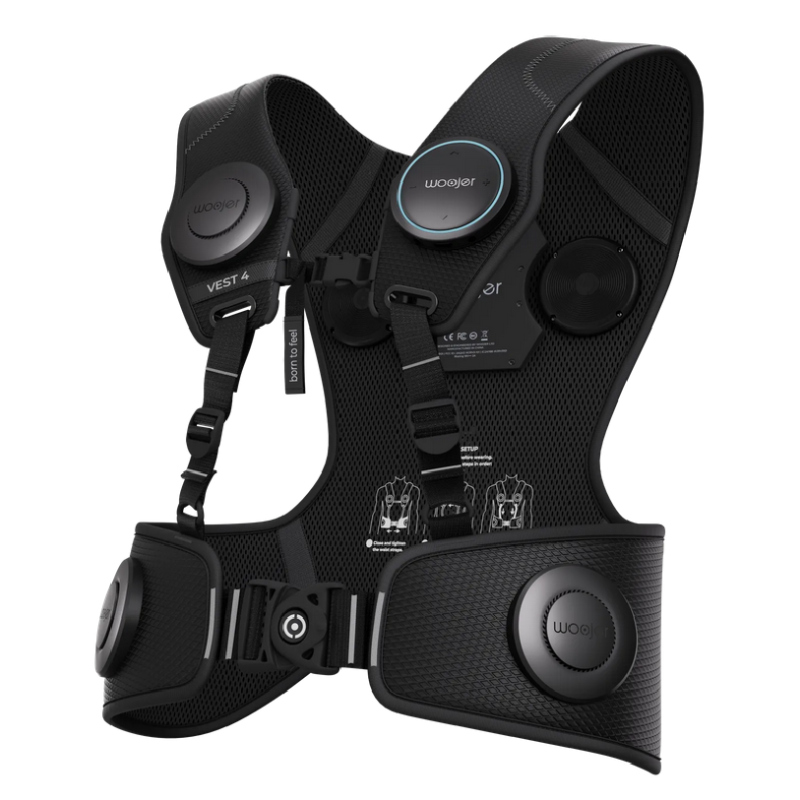
How Woojer Vest 4 works
Woojer Vest 4 does not “cure” hearing loss and does not replace a hearing aid or cochlear implant. Its role is different: the device converts an audio signal into haptic sensations so that low frequencies, pulses, bass impacts and changes in dynamics can be felt physically. In practice, this means that users do not merely watch a film, play a game or listen to music, but also feel climactic moments, rhythm and sonic tension throughout their torso. The manufacturer emphasizes that Vest 4 can be paired with a source device via Bluetooth and also with wireless headphones, increasing its flexibility for use at home, in education and during immersive events.
It is precisely this mechanism that makes Vest 4 potentially interesting for deaf and hard-of-hearing people. In many cases, experiencing music or audiovisual material is based not only on “hearing” tones but also on sensing rhythm, resonance and vibrations. Vibrotactile representation of sound can therefore serve as a bridge between the audio world and tactile perception.
What science says about haptics and deaf or hard-of-hearing people
A review published in Frontiers in Computer Science covered 63 scientific publications on tactile and vibrotactile displays used to support hearing and augment music. The authors indicate that this is a young but dynamically developing field, with particular applications for deaf and hard-of-hearing people.
In turn, a study published in Scientific Reports in 2025 found that vibrotactile stimulation can support music perception in cochlear implant users; the authors also observed improved audiometric outcomes after exposure to music combined with vibratory stimuli. The article expressly notes that evidence is growing that deaf and hard-of-hearing people can benefit from vibrotactile representations of music to improve their understanding and experience of it.
Additional research on perceiving music through touch shows that certain musical features can be effectively recognized through the tactile channel. A 2025 publication described how consonant and dissonant intervals can be perceived under vibrotactile conditions and found no significant difference in the number of correct recognitions between vibrotactile and auditory conditions among people without musical training. This is a very important signal: touch is not merely an “addition” but can convey genuinely useful musical information.
Equally important are studies and implementation projects focusing on educational and artistic practice. A paper published in 2026 noted that music education for deaf and hard-of-hearing people should be based on a multisensory approach in which sound is not only heard but also seen and felt.
Why Vest 4 makes sense specifically for deaf and hard-of-hearing people
The greatest value of Woojer Vest 4 is not in “imitating hearing” but in expanding the ways people experience the audio world. For deaf and hard-of-hearing people, this can mean:
1. Music accessible through the body
Rhythm, beats, bass and changes in dynamics become physically perceptible. This may increase enjoyment of music and facilitate participation in concerts, rehearsals, music classes and multimedia events. Such uses are supported both by research on tactile music augmentation and by examples of implementations in educational and artistic settings.
2. More inclusive cinema, gaming and VR
In films and games, sound carries tension, pace and emotion. A haptic vest makes it possible to experience these elements without relying entirely on hearing. The manufacturer positions Vest 4 as a device for games, films, VR and multimedia, while practical implementations show that similar vests help people with hearing loss become more fully immersed in the experience.
3. Support for education and sensory communication
The Deaf Academy in the United Kingdom reported that Woojer vests were intended to support education and communication and provide therapeutic benefits. Its team emphasized that they give young deaf people access to sound through vibrations and help them experience music, television and games.
4. A tool for creators and DJs with hearing loss
Woojer described the story of Troi Lee from Deaf Rave, who explained that haptic perception of the rhythm and energy of sound enabled him to synchronize his mixes more precisely and experience music more deeply. This is, of course, an individual example rather than a clinical study, but it illustrates the practical potential of this technology well.
Where Woojer Vest 4 may be particularly useful
Vest 4 may find applications in several areas:
Home entertainment – watching films, series and concerts in a more engaging sensory way. The official specification indicates compatibility with mobile devices, computers and wireless audio.
Gaming and VR – experiencing explosions, impacts, the rhythm of gameplay and spatial effects. According to the manufacturer, this is currently the product's main application, but it is also an area where sensory accessibility can make experiences more inclusive.
Music and arts education – supporting lessons, workshops and multisensory experiences in which feeling rhythm and musical structure is important.
Cultural institutions and live events – theatres, concerts, artistic events and festivals can use vibration vests as an accessibility feature. Such implementations have been described, among other places, at the Théâtre de Nîmes, where the vests improved access to performances with strong musical and visual components.
Summary
Woojer Vest 4 is a modern haptic vest that converts sound into impulses perceptible on the user's body. With six haptic zones, Bluetooth connectivity and an immersion-focused design, it can significantly enrich the experience of music, films, games and VR.
For deaf and hard-of-hearing people, its significance may be even greater. Research into vibrotactile technologies indicates that touch can support understanding and experiencing music and may even improve certain aspects of sound perception among cochlear implant users. In practice, this means greater participation, more emotion and improved accessibility of culture, entertainment and education.
Woojer Vest 4 does not replace hearing. But it can make sound more accessible, more tangible and more inclusive. For many users, that is what makes the greatest difference.
April 2026
Opportunity to test the Woojer Vest 4 — inquire at info(@)pronetkrakow.com.pl
Woojer Vest 4, haptic vest, vibration vest, sensory vest, haptic technology, sound haptics, body-based sound perception
sound through vibration, vibrations for deaf people, solutions for hard-of-hearing people, technology for deaf people, technology for hard-of-hearing people, music accessibility for deaf people, sound accessibility, inclusive audio technology, sensory hearing support, music perception through touch, music for deaf people, music for hard-of-hearing people, haptic support for sound perception, haptic vest for music, vibration vest for films and games, feeling bass through the body, experiencing music through vibrations, haptic technology in the education of deaf people, devices supporting people with hearing loss, modern technologies supporting deaf people, VR haptic vest, haptic gaming vest
haptic vest for home cinema, vest for experiencing music, device for experiencing sound, wearable audio technology, music you can feel, sound made accessible in a different way, immersion without barriers, technology without exclusion, sound through touch, a new musical experience, accessibility through haptics, Haptic vest, vibration vest, sensory vest, haptic technology, sound haptics, body-based sound perception, sound through vibration, vibrations for the deaf, solutions for the hearing impaired, technology for the deaf, technology for the hearing impaired, music accessibility for the deaf, sound accessibility, inclusive audio technology, sensory hearing support, music perception through touch, music for the deaf, music for the hearing impaired, haptic support for sound perception, haptic vest for music, vibration vest for movies and games, body-based bass perception, music perception through vibration, haptic technology in deaf education, devices supporting people with hearing loss, modern technologies supporting deaf people, VR haptic vest, haptic vest for gaming
haptic vest for home cinema, vest for music perception, device for sound perception, wearable audio technology, music you can feel, sound accessible in a different way, immersion without barriers, technology without exclusion, sound through touch, a new experience of music, accessibility through haptics