
Brain2Qwerty v2: Meta demonstrates a noninvasive brain–computer interface for converting brain activity into text
Just a few years ago, brain–computer interfaces were associated mainly with implants, neurosurgery and experimental solutions for a very narrow group of patients. By developing the Brain2Qwerty project, however, Meta is showing another direction: reading signals associated with typing without implanting electrodes in the brain. The latest version, Brain2Qwerty v2, is intended to decode natural sentences from noninvasive magnetoencephalography (MEG) recordings in real time.
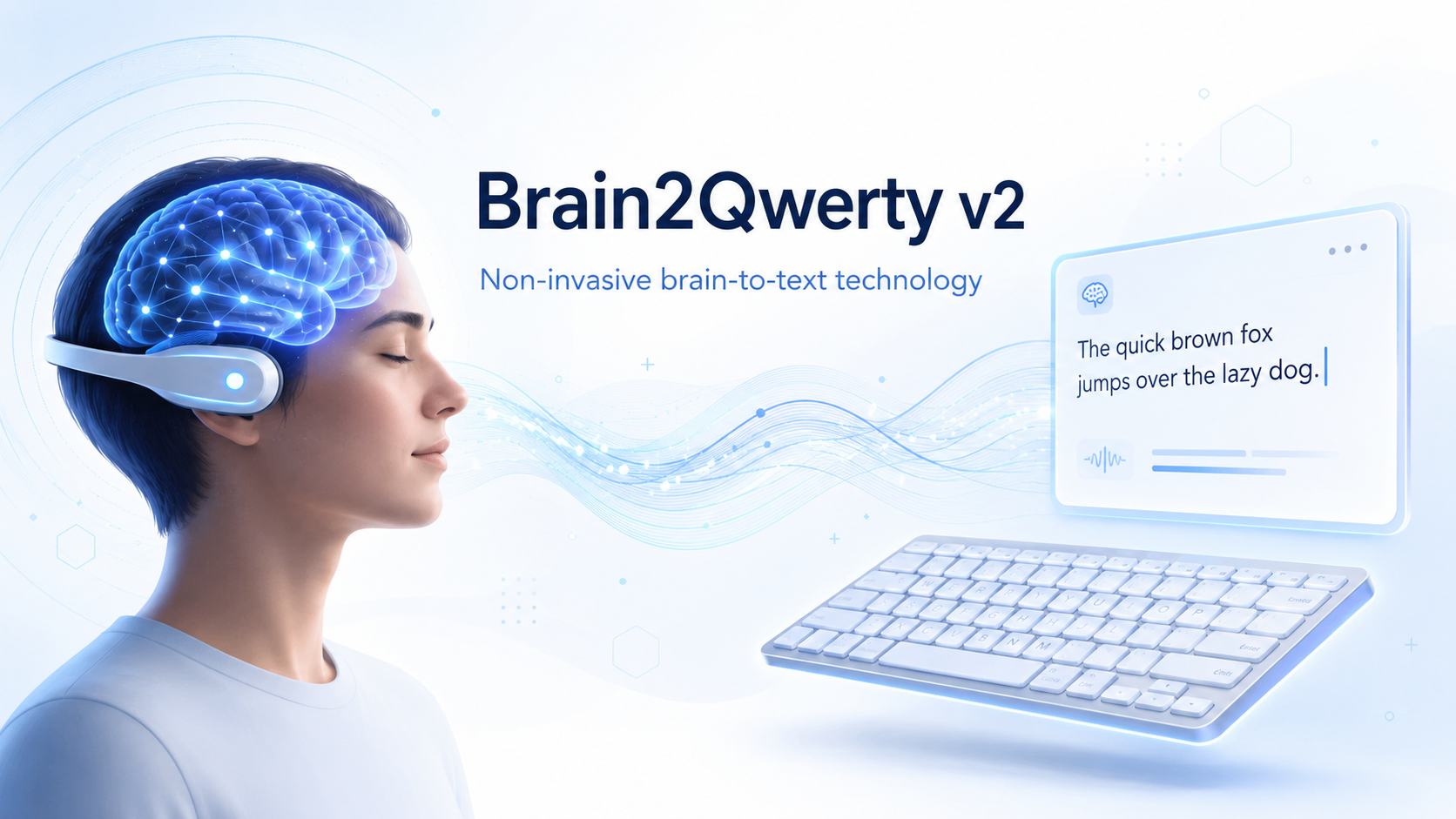
What is Brain2Qwerty?
Brain2Qwerty is an experimental BCI, or brain–computer interface. Its task is to convert brain activity recorded while typing on a QWERTY keyboard into text. The first version analyzed EEG and MEG signals recorded from healthy volunteers who retyped sentences they had previously memorized. The study published in Nature Neuroscience involved 35 healthy participants and showed that MEG performed considerably better than EEG: the average character error rate was 29% for MEG and 65% for EEG, while the best MEG participants achieved a character error rate of 18%.
In practice, this means that Brain2Qwerty does not “read minds” in the everyday sense. The system does not analyze free associations, emotions or private intentions. It reads patterns of brain activity associated with a very specific task: planning and executing finger movements while typing on a keyboard. BinaryVerse AI rightly emphasizes that this is closer to decoding motor intention than reading an internal monologue.
What changes in Brain2Qwerty v2?
Brain2Qwerty v2 is a major step beyond the first version. Meta describes it as the most advanced, complete pipeline for decoding sentences in real time from noninvasive brain activity recordings. Version v1 required knowledge of the moment each key was pressed, so it was not a fully online solution. Brain2Qwerty v2 is intended to generate sentences directly from continuous brain activity recordings.
In the v2 study, Meta used approximately 22,000 sentences collected from nine volunteers. Each participant was recorded for approximately 10 hours while actively typing in an MEG scanner. The model achieved an average word accuracy of 61%, reaching 78% for the best participant. Meta also reports that, for the best participant, more than half of the sentences were decoded with at most one word error.
This is still not the level required for reliable everyday communication, but the result is significant because, according to Meta, earlier noninvasive methods had achieved around 8% word accuracy. Brain2Qwerty v2 therefore shows that combining better MEG signals, large amounts of training data and language models can significantly narrow the gap between noninvasive solutions and implants.
How does the system work?
Brain2Qwerty v1 was based on three stages: a convolutional module analyzing short windows of brain signals, a transformer module taking sentence context into account and a language model helping to correct the output. The Nature Neuroscience description indicated that the model used 500-millisecond windows of MEG or EEG signals spanning the time immediately before and after a keypress.
Brain2Qwerty v2 builds on this concept. According to Meta, the model combines representations at the character, word and whole-sentence levels. It uses deep learning instead of manually designed stages for detecting neural events, along with fine-tuned large language models that help make use of semantic context. Meta also reports that AI agents were used to optimize the pipeline, although the final configurations were selected by engineers.
Why does MEG perform better than EEG?
The difference between EEG and MEG is crucial. EEG, or electroencephalography, measures the brain's electrical activity through electrodes placed on the scalp. This technology is cheaper, more accessible and easier to use outside a laboratory. The problem is that electrical signals are weakened and distorted by the skull and tissues. MEG, or magnetoencephalography, measures magnetic fields generated by neural activity. These signals are less distorted by the skull and can therefore provide cleaner data, but require large, expensive and specialized equipment.
That is why Brain2Qwerty v2 is based on MEG. At the same time, this is the technology's biggest practical limitation. Current MEG systems are large scanners that often require special rooms and laboratory conditions. Meta acknowledges that before the method can reach clinics, two major problems must be solved: improving accuracy and making the equipment smaller and simpler.
Is it a competitor to brain implants?
Brain2Qwerty v2 does not yet replace brain implants. Invasive solutions still achieve greater precision because their electrodes are closer to the source of the neural signal. Their weakness, however, is the need for surgery and the risk of complications such as infection or bleeding. Noninvasive BCIs such as Brain2Qwerty are safer in terms of the procedure, but currently less accurate and harder to deploy outside the laboratory.
The most realistic future application may be helping people who have lost the ability to speak or move, for example after a stroke, a brain injury or during neurological diseases. Meta identifies precisely this direction as the main motivation for the research: restoring communication to people who cannot speak or type in the traditional way.
Key limitations
Despite its impressive results, Brain2Qwerty v2 remains a research project rather than a finished product. First, the studies were carried out on healthy volunteers who were actually typing on a keyboard. It is still unknown whether the system would achieve similar results with paralyzed patients who cannot physically move their fingers and only attempt or imagine the movement.
Second, accuracy is still too low for everyday use without frustrating the user. An average word accuracy of 61% is a major advance, but in medical communication, care or work with nonspeaking people, the margin of error must be much lower. Third, MEG equipment is currently too large and too expensive for home use or integration into consumer devices.
Privacy and ethical issues
Brain2Qwerty is not a technology for freely reading thoughts, but that does not mean privacy can be overlooked. Brain data are among the most sensitive biometric data. Even if the current system decodes only signals associated with intentional typing, the development of such technologies requires clear rules concerning consent, data control, anonymization, processing purposes and a prohibition on commercial use without the user's informed consent. BinaryVerse AI rightly notes that the question “who controls brain data?” will become increasingly important as the accuracy of such systems grows.
Code and open science
Meta released training code for Brain2Qwerty v1 and v2, and the v1 dataset collected by the Basque Center on Cognition, Brain and Language was made available on Hugging Face. The GitHub repository also indicates that the code includes directories for versions v1 and v2, while the v2 data remain under embargo until the publication is accepted.
This matters because openness allows independent research teams to verify results, develop models and evaluate limitations without relying solely on statements from the technology's producer.
Brain2Qwerty v2 is one of the most interesting directions in the development of noninvasive brain–computer interfaces. It is not a mind-reading device or a product ready for home use. It is an advanced research project demonstrating that brain activity associated with typing can be converted into text increasingly effectively without surgically implanting electrodes.
The greatest value of Brain2Qwerty v2 lies in showing a realistic path forward: more data, better language models, more accurate sensors and more practical MEG devices may eventually lead to safer communication systems for people who have lost the ability to speak. Today the technology remains laboratory-based, but its medical potential is great enough to make further developments worth following.
1.07.2026
Source: Binaryverseai, RoadtoVR,
Brain2Qwerty v2, Brain2Qwerty, Meta Brain2Qwerty, Meta AI BCI, noninvasive brain–computer interface, Meta BCI, brain-computer interface, brain–computer interface, MEG BCI, magnetoencephalography, EEG vs MEG, noninvasive BCI, brain signal decoding, converting brain activity to text, AI and the brain, neurotechnology, brain–computer communication, artificial intelligence in neurotechnology, Meta AI Research, decoding speech from the brain, decoding text from the brain, technology for nonspeaking people, future of communication, neuroAI, brain-to-text, brain typing, QWERTY brain interface, MEG vs EEG, implant-free BCI