
3D visualization without VR headsets. Co4Two shows a new direction for design collaboration
For years, 3D visualization has been one of the most important tools used in design, engineering, technical reviews and product concept presentations. It allows an object, installation, machine or space to be viewed before it physically exists. Until now, however, it has often involved a compromise: users either worked with a conventional 2D screen or put on a VR headset that offered greater immersion but limited natural communication with another person. Co4Two seeks to solve precisely this problem.
Co4Two is a shared 3D visualization system designed for two users working simultaneously with the same model. Its most important characteristic is that it does not require VR headsets. Instead, it uses 3D projection, active stereoscopic glasses and spatial tracking of the users' positions. This allows two people to look at the same model, talk to each other, point to elements and analyze a design without the barrier created by a conventional VR headset.
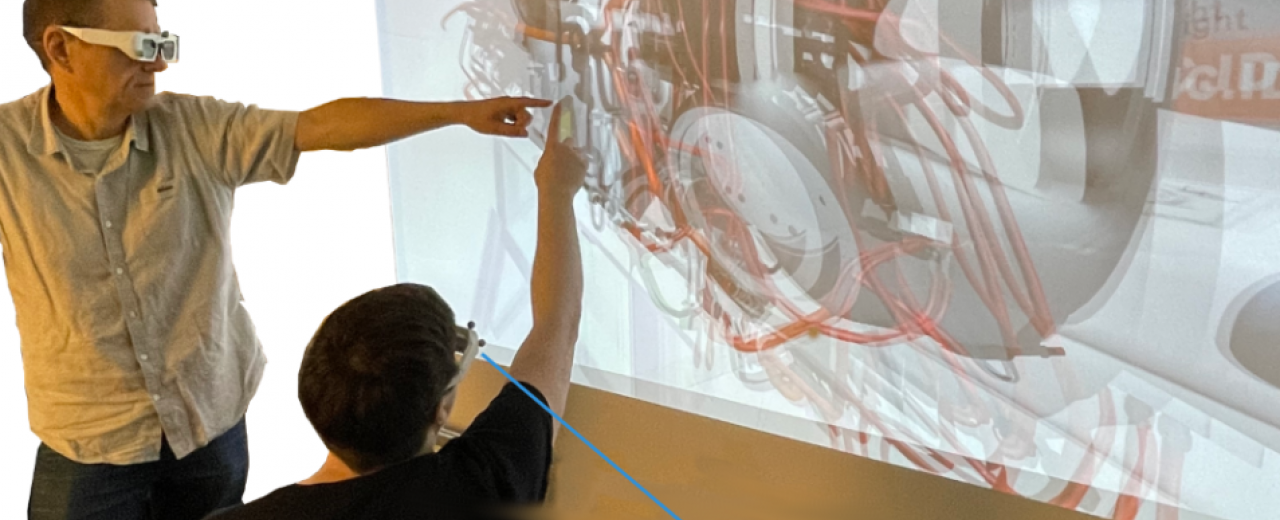
Two people, two viewpoints, one model
The most interesting feature of Co4Two is support for two independent perspectives. Each user sees the 3D scene according to their actual position relative to the projection screen. This means the image is not simply a flat presentation of the model, but a dynamic visualization adapted to the observer's position.
In practice, this is highly significant for teamwork. An engineer, designer, customer or implementation specialist can analyze the same object together, each from their own perspective. They do not need to pass a VR headset between them or switch views on a screen. They can comment on details, compare variants and make decisions faster at the same time.
Technology based on projection and spatial tracking
The Co4Two system is based on several integrated elements. The first is an ultra-short-throw laser projector, which can display an image from a short distance away from the projection surface. The second is a spatial tracking system based on ART's SMARTTRACK3 technology. The third is synchronized active 3D glasses.
This combination makes it possible to create a stable stereoscopic image for two people simultaneously. In collaboration mode, the system uses high-frequency projection, reaching up to 240 Hz, intended to ensure smoothness and reduce the discomfort typical of less stable 3D solutions. Importantly, spatial tracking is integrated with the projection system, simplifying deployment and limiting the need for manual calibration.
An alternative to conventional virtual reality
Co4Two is not an attempt to replace VR headsets in every application. Rather, it addresses scenarios in which shared analysis, conversation and natural interaction between participants are most important. In conventional virtual reality, users are deeply immersed in the digital world but are also partly isolated from their surroundings. In design work, this can be a limitation, particularly when decisions must be made as a team.
3D visualization without VR headsets makes it possible to maintain eye contact, body language and free communication. Meeting participants can see one another, gesture, point to elements of the model and discuss them naturally. This is particularly important in environments where a 3D model is not just an impressive presentation but a real decision-making tool.
Applications in engineering, design and presentations
Co4Two addresses the needs of companies working with advanced 3D models, from industry, automotive and aviation to product design, architecture, technical training and design reviews. The system can be used for CAD model analysis, presenting concepts to customers, evaluating ergonomics, verifying component layouts or discussing design changes.
The advantage of this approach is the ability to move quickly from individual visualization to a shared decision-making process. Two people can simultaneously evaluate the scale of an object, the relative positions of components, service access or potential collisions. Compared with a traditional presentation on a flat screen, this provides a much better sense of space.
Integration with professional software
An important element of the system is compatibility with tools used in professional environments. Co4Two is expected to work with Unity, Unreal Engine, Siemens PLM Teamcenter Visualization, TechViz, ESI IC.IDO, SkyReal, Shariiing Review and Fraunhofer CoVR, among others. This means the solution does not require a complete change to existing work methods but can be incorporated into an established design ecosystem.
This is particularly important for companies that already have their own CAD, PLM, simulation or review processes in place. In such environments, new technology only makes sense when it genuinely improves work rather than forcing an expensive overhaul of the entire workflow.
Co4Two as a tool for better decisions
Co4Two's greatest value lies not in the impressive 3D image itself, but in how the technology supports collaboration. The system allows two users to immerse themselves in a spatial model simultaneously without the isolation typical of VR headsets. This can shorten design meetings, facilitate customer communication and accelerate problem detection at the digital prototype stage.
In this form, 3D visualization becomes not only a presentation tool but also a space for working together. Co4Two shows that the future of immersive technologies need not be limited to individual experiences in VR headsets. In many business and engineering applications, it is equally important—and sometimes more important—for several people to be able to look at the same digital object, discuss it and make decisions naturally.
20.06.2026
Source: Cornershop, VIS4ALL Co4Two, ART SMARTTRACK3
3D visualization, Co4Two, VIS4ALL Co4Two, 3D without VR headsets, 3D collaboration, stereoscopic projection, active 3D glasses, SMARTTRACK3, immersive engineering, 3D design, CAD model review