
PAL Robotics ARI – a humanoid social robot for education, research and user services
ARI is a humanoid social robot developed by PAL Robotics, designed for human–robot interaction, artificial intelligence research, education and user service applications. ARI combines a mobile platform, humanoid torso, moving head and arms, cameras, microphones, speakers, a touchscreen and software systems that enable the development of custom applications.
The robot was designed primarily for Human-Robot Interaction (HRI). It can detect and identify people, recognize speech and user intentions, conduct dialogue and use head and arm movements, animated eyes and lighting elements to communicate with people more naturally.
Unlike stationary social robots, ARI has a mobile base that allows it to move independently through a space. This means it can be used not only as an interactive terminal or assistant, but also as a mobile guide, reception robot or research platform.
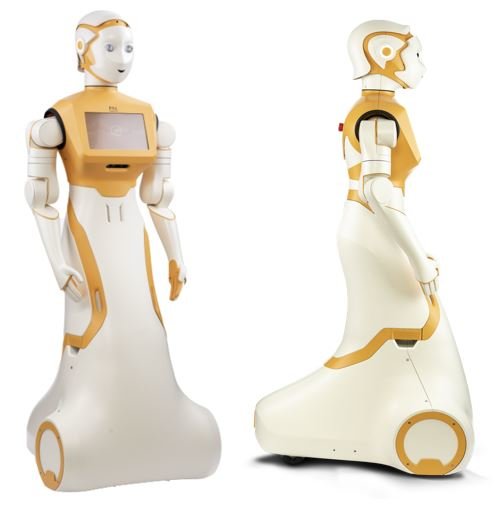
Capabilities of PAL Robotics ARI
Human interaction
ARI is equipped with systems that combine voice, visual and movement-based communication.
The robot can:
detect a person's presence,
identify people and faces,
track the user's position,
analyze head pose and gaze direction,
recognize speech,
analyze the intention behind an utterance,
conduct dialogue,
generate speech using Text-to-Speech,
direct its gaze toward the person speaking,
make gestures with its head and arms,
display animated emotions using LCD screens in its eyes,
use lighting effects as an additional communication element,
display information and multimedia on its touchscreen.
ARI's social perception system uses ROS4HRI-compatible solutions that enable, among other things:
real-time 2D and 3D human skeleton tracking,
six-dimensional head pose estimation – 6D head pose estimation,
facial landmark detection,
eye tracking,
face identification,
combining information from the face, silhouette and other sources into a single model of the observed person.
Applications of PAL Robotics ARI
Education
ARI can serve as an interactive educational tool in schools, universities, laboratories and science centers.
Example applications:
teaching robotics,
teaching programming,
demonstrating how artificial intelligence works,
conducting interactive classes,
language learning,
running quizzes,
presenting multimedia content,
conducting conversation exercises,
Human-Robot Interaction classes,
student projects involving ROS and robotics,
experiments on human–machine communication.
The touchscreen makes it possible to combine the robot's speech with presentations, graphics, forms, games and other interactive materials. PAL Robotics identifies education as one of ARI's primary application areas.
Scientific research
ARI is also a platform for advanced robotics and artificial intelligence research.
It can be used in research on:
Human-Robot Interaction – HRI,
Human-Computer Interaction – HCI,
artificial intelligence,
machine learning,
computer vision,
face recognition,
human behavior tracking,
Natural Language Processing – NLP,
speech recognition,
dialogue systems,
social robot behavior,
autonomous navigation,
multimodal interaction,
assistive robots.
The manufacturer provides developer documentation and an ARI simulator, enabling some research and development work to begin without physical access to the robot.
Artificial intelligence
ARI can serve as a physical interface for AI systems under development.
The platform allows custom algorithms and external systems to be integrated, so the robot can be used, among other things, for:
creating AI assistants,
building chatbots with a physical presence,
experimenting with language processing models,
recognizing images and people,
machine learning,
developing applications using AI and the Internet of Things – IoT,
integration with company systems and network services.
PAL Robotics also offers optional NVIDIA Jetson computing modules for more demanding AI and Machine Learning applications.
Reception and customer service
ARI can work as an interactive reception robot.
It can:
welcome visitors,
answer basic questions,
provide information about a company or institution,
display information on its screen,
show films and promotional materials,
notify staff when a visitor arrives,
indicate the correct location to a user,
guide a user to a selected destination.
PAL Robotics presents reception and visitor services as one of the ARI platform's practical applications.
Trade fairs, conferences and events
ARI can act as an interactive presenter or guide.
Example applications:
presenting products,
answering participants' questions,
indicating stands and event locations,
giving presentations,
displaying marketing materials,
conducting surveys,
games and activities that engage visitors,
serving as an interactive brand ambassador.
The robot's mobility also allows it to move between designated points at an event.
Museums and science centers
ARI can work as an:
interactive guide,
exhibit presenter,
educator,
element of an exhibition about robotics or AI,
information point,
interactive multimedia terminal.
Users can communicate with the robot by voice or use its touchscreen.
Retail and public spaces
ARI can be used in shops, shopping malls and other customer service locations.
It can:
welcome customers,
present product information,
help search for products,
display maps,
present promotions,
answer frequently asked questions,
collect information about users' interactions with the robot.
Healthcare and care
ARI has also participated in projects investigating assistive robots in healthcare.
Potential applications include:
providing information to patients and visitors,
supporting a facility's reception desk,
conducting simple interactions with patients,
reminding people about certain activities,
leading exercises and activities,
research applications involving assistive robots.
ARI should nevertheless be regarded as an assistive, informational and research platform, rather than an autonomous medical device replacing healthcare personnel.
PAL Robotics ARI specifications
Dimensions and construction
height: 165 cm,
width: 53 cm,
depth: 73 cm,
humanoid construction,
mobile robot base,
humanoid torso,
moving head,
two moving arms,
integrated touchscreen.
Degrees of Freedom – DoF
DoF – Degrees of Freedom, the number of independent axes of robot movement:
head: 2 DoF,
mobile base: 2 DoF,
arms: 4 DoF per arm.
Computer
Depending on configuration, the manufacturer offers:
processor: Intel Core i5 / i7 / i9,
RAM: 8 GB / 16 GB / 32 GB,
SSD: 256 GB / 512 GB / up to 1 TB,
optional graphics processor / AI accelerator: NVIDIA Xavier NX or NVIDIA Orin,
CUDA support in configurations equipped with an NVIDIA module.
Operating system and development environment
operating system: Ubuntu LTS,
real-time operating system – Real Time OS,
ROS-based environment – Robot Operating System,
current PAL Robotics documentation covers the ROS 2 environment,
APIs available for hardware and social functions,
ARI simulation model available,
tutorials and developer documentation available.
Display
touchscreen: 10.1 inches,
resolution: 1200 × 800 px,
technology: Projected Capacitive Touchscreen,
ability to display custom multimedia materials,
ability to develop surveys, applications, games and interactive interfaces.
Eyes and visual elements
two LCD screens forming animated eyes,
ability to display different expressions,
synchronization of expressions with robot behavior,
16 RGB LEDs in each ear element,
a ring of 40 RGB LEDs at the back of the robot,
software control of lighting effects.
Camera and perception system
Depending on configuration, ARI can use:
an 8 MP RGB camera in the head,
an Intel RealSense D435i RGB-D camera in the head,
a front-facing Intel RealSense D435i RGB-D camera in the torso,
an Intel RealSense T265 system with stereoscopic fisheye cameras,
optional YDLIDAR TG15 LiDAR,
optional RGB camera near the screen,
optional RGB-D camera near the screen,
optional thermal imaging camera.
Individual sensors depend on the selected robot configuration and optional equipment.
Audio
an array of 4 digital microphones,
ability to locate and process the sound source,
support for speech recognition applications,
2 × 30 W Hi-Fi Full Range speakers,
ability to communicate with the user by voice.
Connectivity
Wi-Fi 802.11ax,
2.4 GHz and 5 GHz bands,
Ethernet 1000 Base-T / Gigabit Ethernet.
Expansion interfaces
The robot's expansion panel offers:
1 × Gigabit Ethernet,
3 × USB 3.0,
1 × USB 2.0,
HDMI,
Audio In/Out,
12 V / 3 A power output,
controls for the optional NVIDIA Jetson module.
Battery
voltage: 24 V,
standard capacity: 40 Ah,
optional configuration: 60 Ah,
declared autonomous operating time: 8–12 hours.
Software
ROS and ROS4HRI
ARI uses the ROS environment, making it a particularly interesting platform for universities, robotics laboratories and research and development teams.
The platform provides access to:
ROS Topics,
ROS Actions,
ROS Services,
ROS Nodes,
sensor APIs,
motion control,
navigation features,
communication,
social perception,
dialogue management,
interaction functions,
knowledge and reasoning systems.
ROS4HRI support enables applications that use an advanced model representing people in the robot's surroundings.
ARI Web User Interface
The robot also has a browser-based user interface that allows some operations to be performed without direct programming.
It enables users to:
modify touchscreen content,
manage the robot's utterances,
prepare custom gestures,
use a motion editor,
configure ARI's behavior.
Integration with external systems
ARI can use local networks and internet services. The manufacturer provides APIs that enable integration with external applications and services.
This makes it possible to develop solutions using, for example:
company information systems,
databases,
reservation systems,
web applications,
AI systems,
IoT,
custom user interfaces,
external data processing mechanisms.
Advantages of PAL Robotics ARI
Mobility – ARI has its own mobile platform, allowing it to move through a space instead of interacting from a single fixed station.
Humanoid form – a moving head, arms, animated eyes and gestures help create more natural human–robot interactions.
Advanced social perception – the platform can use face recognition, tracking of body silhouettes, head position and gaze.
Multimodal interaction – users can communicate with the robot by voice, via the touchscreen and through nonverbal behavior.
Extensive programming capabilities – support for ROS and ROS4HRI makes ARI a particularly valuable platform for universities and research laboratories.
Ability to develop AI applications – optional NVIDIA Xavier NX or Orin modules allow more demanding AI and Machine Learning algorithms to run locally.
Numerous sensors – RGB and RGB-D cameras, microphones and optional LiDAR and thermal imaging camera provide extensive possibilities for developing environmental perception systems.
10.1-inch touchscreen – combines conversation with graphics, films, forms, maps, surveys and applications.
Long operating time – the manufacturer declares approximately 8–12 hours of autonomy, allowing the robot to be used throughout a workday or event.
Integration with external systems – APIs, Wi-Fi, Ethernet and hardware interfaces allow ARI to become part of a larger IT environment.
Broad range of applications – one platform can be used for research, education, AI demonstrations, customer service, reception work, trade fairs and HRI experiments.
Simulator and developer documentation – the ability to work on ARI software in a simulated environment also facilitates teaching and research projects.
Summary
PAL Robotics ARI is a sophisticated humanoid social robotics platform combining mobility, voice communication, a touchscreen, expressive behavior and advanced human perception mechanisms.
A particularly important feature of ARI is its openness to custom application development. Support for ROS and ROS4HRI, comprehensive APIs and the option to use NVIDIA accelerators mean the device can serve both as a ready-to-use user interaction robot and as a research and development platform for artificial intelligence, robotics, HRI and autonomous systems.
As a result, ARI can be used primarily in universities and research laboratories, education, science centers, museums, AI projects, customer service, trade fairs and conferences, as well as projects involving social and assistive robots.
8.08.2026
Source: PAL Robotics
PAL Robotics ARI, ARI robot, humanoid robot, social robot, AI robot, conversational robot, mobile robot, social robot, humanoid robot, Human-Robot Interaction, HRI, human–robot interaction, educational robot, learning robot, robot for universities, robot for laboratories, research robot, robot for research, artificial intelligence robot, AI robot, programming robot, ROS robot, ROS 2 robot, ROS4HRI, autonomous robot, touchscreen robot, face-recognition robot, speech-recognition robot, RGB-D camera robot, LiDAR robot, NVIDIA Jetson robot, NLP robot, HCI robot, customer-service robot, reception robot, information robot, guide robot, museum robot, science-center robot, trade-fair robot, conference robot, presentation robot, healthcare robot, assistive robot, HRI research robot, social robotics, educational robotics, humanoid robotics, artificial intelligence in education, AI research platform, ROS robotics platform,