
Furhat Robot – an advanced social robot for communication, education and AI research
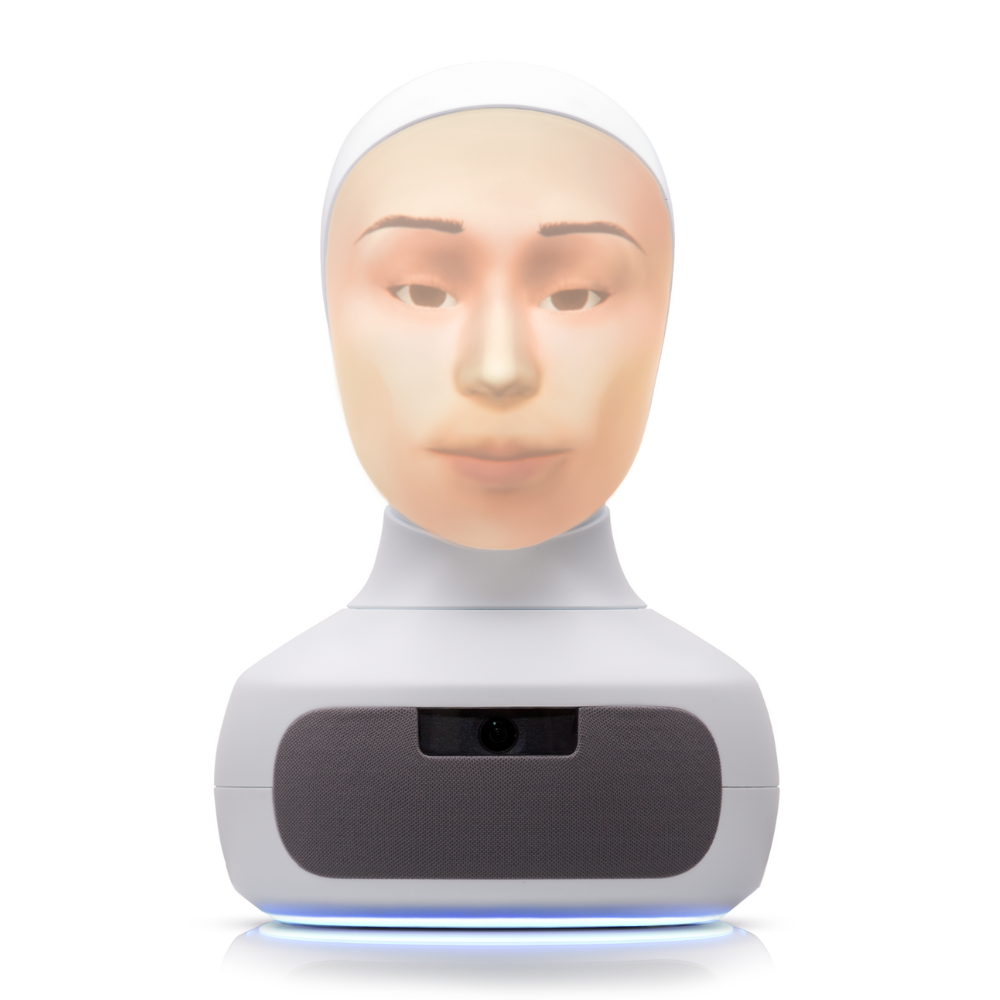
Furhat Robot is an advanced social robotics platform developed by the Swedish company Furhat Robotics AB. The robot was designed primarily to conduct natural interactions with humans — conversations, maintaining eye contact, recognizing participants in a conversation and displaying facial expressions and other nonverbal behaviors. The manufacturer describes its technology as a combination of humanoid robotics and conversational artificial intelligence.
Unlike conventional humanoid robots, Furhat does not focus on locomotion, grasping objects or performing physical tasks. Its main purpose is human–machine communication and Human-Robot Interaction (HRI). The device's design is centered on conversation, facial expressions, eye contact and responding to the behavior of people in front of the robot.
How does Furhat work?
One of Furhat's most distinctive features is its face. Instead of a conventional display, the robot uses a system that projects images onto the inside of a three-dimensional mask. This technology generates moving eyes, a mouth, eyebrows and facial expressions and automatically synchronizes lip movements with speech.
The mask is made of a special polymer blend and is attached magnetically. Combining an interchangeable mask with a digitally projected face makes it possible to create different characters by changing their appearance, age and visual features. The manufacturer offers, among others, an adult mask and, in selected packages, Child and Anime variants.
The robot can blink, smile, frown, nod and direct its gaze toward the person speaking. Some of these behaviors can be controlled by an application, generated automatically by the system or linked to an AI model.
Applications of Furhat Robot
Because of its open development platform, Furhat is not a robot intended for one specific function. It can be programmed for many applications.
Education
Furhat can act as an interactive teacher, educational assistant or practice partner.
Example applications:
foreign-language learning,
conducting language conversations,
pronunciation practice,
interactive lessons,
teaching social skills,
simulating specific behaviors and situations,
research into the learning process,
teaching programming, robotics and artificial intelligence.
The platform is used by universities and research institutions working, among other fields, on Human-Robot Interaction. The manufacturer reports a community of more than 5,000 developers and approximately 200 universities using Furhat technology.
Scientific research and artificial intelligence development
Furhat was designed as a research platform that enables control over many aspects of the robot's behavior.
It can be used in research on:
human–robot interaction,
artificial intelligence,
natural language processing,
verbal and nonverbal communication,
user behavior,
the psychology of interaction,
speech recognition,
gaze behavior,
group communication,
social robotics,
Human-Computer Interaction (HCI).
The SDK also provides features for recording interactions, including events, speech transcripts and voice recordings, which is particularly useful for experiments and research.
Medicine and medical training
Furhat is also used in experimental and research-oriented medical applications.
One example is using the robot as a Virtual Patient. A student can have a conversation with the robot resembling a patient interview, ask questions and practice clinical decision-making. A system using a language model can respond to questions and simulate emotions and different communication styles.
Other projects include:
assisting with the collection of patient information,
conducting medical surveys,
mental health research,
research into communication with children on the autism spectrum,
patient education.
In this context, Furhat should be treated as a communication, training or research tool, not as a diagnostic device replacing a doctor.
Customer service and reception
The robot can be used as an interactive:
receptionist,
concierge,
information point,
customer assistant,
demonstration staff member,
guide,
interface to a company's knowledge base.
For example, Deutsche Bahn tested a Furhat-based solution as a multilingual assistant answering questions about departures, delays, gate locations and passenger facilities.
Presentations, trade fairs and events
Thanks to the ability to create a custom character, voice and personality, Furhat can also serve as a:
trade-fair robot,
interactive presenter,
brand ambassador,
demonstrator of AI-based solutions,
exhibition guide,
interactive feature in a museum or science center.
Example projects include applications developed with Microsoft, Fujitsu and Bandai Namco.
Furhat Robot specifications
Construction
dimensions: 410 × 270 × 240 mm (H × W × D),
weight: 3.5 kg,
eye height: approximately 300 mm,
interchangeable magnetic mask made of a special polymer blend,
image projection system directly onto the three-dimensional mask,
a ring of 88 software-controlled RGB LEDs.
Face projection system
projection technology: Texas Instruments DLP,
projection resolution: 1280 × 720 px,
brightness: 165 lumens,
contrast: 1400:1,
dynamic face rendering,
automatic lip synchronization with speech,
support for animated gestures and facial expressions.
Camera and vision system
RGB camera,
sensor resolution: 3.4 MP,
image stream: 640 × 480 px,
field of view: 120° diagonally,
fixed focus optimized for the interaction area,
automatic exposure control,
face detection,
distance estimation,
spatial modeling of the surroundings,
simultaneous tracking of up to 10 users,
ability to assess participants' engagement,
distinguishing users during an ongoing interaction.
Microphone system
Integrated microphones:
2 digital MEMS microphones,
omnidirectional pickup pattern,
frequency range 100 Hz – 10 kHz,
stereo arrangement with 180 mm spacing.
Included external USB microphone array:
4 digital MEMS microphones,
omnidirectional pickup pattern,
far-field voice pickup up to approximately 5 m,
360° pickup coverage,
DOA – Direction of Arrival, identifying the direction of the sound source,
AEC – Automatic Echo Cancellation,
AGC – Automatic Gain Control,
NS – Noise Suppression.
Speakers
two integrated speakers,
design optimized for human voice frequencies,
diameter: 2.5 inches,
power: 30 W,
full-range design,
aluminum diaphragm.
Head movement
3 DOF – Degrees of Freedom,
Pan / Tilt / Roll movement,
3 high-speed servomotors,
active feedback,
movement resolution: 0.088°,
metal gears.
Computer
Intel Core i5 processor, up to 3.40 GHz,
RAM: 8 GB,
SSD storage: 120 GB,
Intel Iris Plus 640 graphics.
Connectivity and interfaces
Wi-Fi 802.11ac, 2.4 / 5 GHz,
Ethernet 10/100/1000 Mb/s,
2 × USB-A supporting USB 3.0,
1 × USB-C,
support for connecting external microphones, headphones, keyboards and other devices,
support for an external monitor via USB-C.
Languages and voices
support for more than 120 languages,
more than 200 available voices,
integration with voice services from providers such as Microsoft Azure, Amazon and ElevenLabs.
Software and programming
Furhat SDK
The Furhat Software Development Kit enables developers to create their own applications and robot behavior scenarios.
Virtual Furhat is available, allowing applications to be created and tested without a physical robot,
the main conversational framework uses Kotlin running in the Java Runtime Environment,
ability to create custom dialogues and behaviors,
library of ready-made gestures and movements,
interaction recording tools,
ability to switch applications between the physical robot and its virtual counterpart,
Wizard-of-Oz tools are available for manually controlling speech, facial expressions and movements during prototyping or research.
Furhat Remote / Realtime API
The platform enables integration with external applications and systems.
The Remote API can be used with, among others:
Python,
C#,
JavaScript,
Rust,
and other programming languages.
The Realtime API allows data transfer between Furhat and external applications, workflow creation and integration of custom AI models and user interfaces.
FurhatAI Creator
FurhatAI Creator is a tool that uses LLMs – Large Language Models – to create interactive robot characters without traditional programming.
Among the available features are:
defining a character's personality,
choosing a face and voice,
specifying behavior,
adding knowledge sources,
integrating APIs,
creating automated behavior scenarios,
building conversations using LLM models.
Advantages of Furhat Robot
Natural communication with users – combining voice, facial expressions, head movement and eye contact provides a much richer form of interaction than a conventional chatbot or screen-based terminal.
Interaction with multiple people – the vision system can track up to 10 users simultaneously and direct the robot's attention to individual participants in the conversation.
More than 120 supported languages and over 200 voices – enabling multilingual information, educational and research stations.
Extensive customization options – the mask, digital face, voice, personality, facial expressions and behavior can all be changed.
Integration with artificial intelligence and LLM models – the robot can serve as a physical interface for generative AI systems and corporate language models.
Comprehensive SDK and APIs – enabling custom applications and integration with external software, services and AI models.
Virtual Furhat – enabling application development and testing without access to a physical robot.
Prototyping without programming – FurhatAI Creator enables users without advanced programming knowledge to prepare LLM-powered interactions.
A platform designed for HRI research – enabling precise control over robot behavior and recording interaction data.
A wide range of applications – the same platform can be used in education, scientific research, customer service, medicine, training, trade fairs and as an interface to AI systems.
Ability to create different characters on one hardware platform – the interchangeable mask and digital face projection allow the robot's appearance to be adapted to a particular project.
Summary
Above all, Furhat is a platform for creating advanced human–AI interactions, rather than a robot intended to perform physical tasks. Its greatest value lies in combining conversational AI with physical presence, facial expressions, head movement, eye contact and analysis of nearby people.
With its extensive SDK, APIs, support for LLM models and virtual development environment, Furhat can be a particularly interesting solution for universities, research centers, AI and robotics laboratories, educational institutions and organizations developing new ways for people to communicate with artificial intelligence.
7.08.2026
Source: Furhat Robotics
Furhat Robotics, Furhat Robot, social robot, humanoid robot, conversational robot, AI robot, artificial intelligence robot, social robot, conversational robot, Human-Robot Interaction, HRI, human–robot interaction, educational robot, learning robot, research robot, research platform, robot for universities, robot for laboratories, language-learning robot, customer-service robot, reception robot, information robot, trade-fair robot, presentation robot, medical robot, virtual patient, Virtual Patient, medical-training robot, multilingual robot, expressive robot, face-recognition robot, speech-recognition robot, LLM robot, ChatGPT robot, Furhat SDK, FurhatAI Creator, Virtual Furhat, programmable robot, robot with API, NLP robot, HCI robot, AI robot, artificial intelligence in education, social robotics, educational robotics, HRI platform, Furhat Poland,