Subcategories
-
X REALITY
Discover the possibilities of Extended Reality (XR) technology, which encompasses virtual reality (VR), augmented reality (AR), and mixed reality (MR). Our product range includes XR headsets and glasses, haptic gloves and suits, motion capture (MOCAP) systems, controllers, as well as specialized software and accessories. Explore solutions designed for gaming and entertainment, education, training, simulations, and professional applications.
-
Holography and 3D...
Holography and 3D Spatial Visualization
Holographic solutions enable the presentation of 3D models, objects, and visualizations in a way that creates the impression of their presence in real space. Depending on the device, the image can be displayed on a dedicated screen or viewed using a smartphone and stereoscopic optics.
Products in this category support interactive presentations, design, education, training, data visualization, and the demonstration of spatial models. They can utilize motion tracking, user position recognition, and AR/MR (Augmented Reality/Mixed Reality) technologies, allowing users to view and interact with digital content from multiple angles.VR and holography computers are high-performance devices designed for smooth and realistic virtual reality and holographic content. Equipped with powerful processors, advanced graphics cards, and fast RAM, they enable real-time rendering of three-dimensional worlds and the display of complex holograms.
-
AI Glasses
AI glasses are modern, wearable devices that utilize artificial intelligence to support everyday tasks and interactions with the environment. They can analyze images, recognize objects, translate text in real time, deliver notifications, and assist with navigation, while remaining discreet and comfortable to wear.
These solutions are used in work, education, medicine, logistics, and everyday life, offering hands-free information support and intelligent interaction. AI glasses combine augmented reality features with machine learning algorithms, increasing productivity, comfort, and awareness of one's surroundings. -
Glasses with Display...
Glasses with display and wearable monitors are modern devices that allow users to view content without using a traditional monitor, TV, or projector. Their main purpose is to create a private, mobile workspace or multimedia screen that can be connected to a laptop, smartphone, console, handheld gaming device, or other compatible equipment.
This category includes lightweight display glasses, wearable monitors, and XR solutions designed for work, entertainment, presentations, travel, and mobile gaming. Devices of this type allow users to enjoy a large virtual screen displayed directly in front of their eyes, often in Full HD, 1200p, or higher quality, with technologies such as micro-OLED, adjustable brightness, built-in audio, and USB-C or HDMI connectivity.
Glasses with display are useful wherever the user needs a larger workspace but cannot use a traditional monitor. They can be used for hybrid work, travel, training, service and maintenance tasks, presentations, watching movies, playing on portable consoles, working with a laptop, or as a private screen for mobile devices.
Unlike classic AI glasses, whose main functions are environmental analysis, voice assistant support, translation, or image recording, products in this category focus primarily on displaying content. They are practical solutions for users who want to work, watch content, or play on a large screen without carrying an additional monitor.
Glasses with display and wearable monitors are intended for business users, mobile professionals, gamers, content creators, trainers, IT specialists, service technicians, and anyone who needs a compact and private screen available anywhere. -
Wearable AI Terminals
Wearable AI Terminals
Wearable AI Terminals are a new category of wearable devices designed for working with artificial intelligence agents, productivity tools, and programming or creative environments. They are not simply classic smart glasses or typical AI glasses for translation, notifications, or object recognition, but personal AI work interfaces that allow users to manage tasks, issue commands, monitor progress, and approve actions without constantly relying on a computer, keyboard, or monitor.
This category includes lightweight wearable devices equipped with features such as a HUD or waveguide display, microphone, camera, speakers, voice control, gesture control, and systems that work with a local computer, cloud environment, or AI agents. Solutions of this type can support programming, research, application creation, workflow automation, presentations, 3D design, and everyday work with artificial intelligence tools.
Wearable AI Terminals are intended especially for developers, engineers, researchers, digital creators, R&D teams, and users who want to work with AI in a more mobile, natural, and hands-free way. -
Smartglasses – HUD...
Smartglasses – Head-Up Displays, Assisted Reality, and Hands-Free Work
Smartglasses are smart glasses that support hands-free work. They display instructions, documents, notifications, and data directly in the user's field of view, while also enabling video calls, image capture, work recording, and remote expert support.
Solutions in this category are used in manufacturing, service, logistics, warehousing, inspections, training, and field work, among other applications. They include devices with Head-Up Displays (HUDs), assisted reality features, voice control, and business application support. -

AR glasses for games...
AR glasses for games and movies are innovative devices that superimpose digital elements onto the real world, allowing interaction with virtual objects while watching movies or playing games. They make games and movies more immersive—characters, special effects, and directions are displayed directly in the user's field of view.
These solutions combine entertainment with augmented reality technology, allowing you to feel part of the action, react to events in real time, and experience dynamic 3D effects without the need for additional hardware. Perfect for gamers and movie lovers seeking the full experience. -
Personal Cinema and...
Personal Cinema and Head-Mounted Displays
Personal cinema systems and head-mounted displays are devices designed for watching films, viewing 2D and 3D content, gaming and working on a large private screen visible only to the user. They can be used with computers, game consoles, smartphones, media players, cameras and other compatible video sources.
Unlike conventional VR headsets, many devices in this category are not intended for moving around in a virtual environment and do not use motion controllers or positional tracking. Their primary purpose is to provide high image quality, privacy and comfortable content viewing at home, while travelling, in a hotel or in a shared space. -
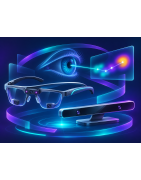
Eye tracking devices
Eye Trackers – Use Unique Features to Deepen Your MindEye tracking devices are technologies that enable precise monitoring of eye movements and the user's gaze. They enable VR, AR, and MR systems, as well as computer applications, to respond to gaze direction, enabling interface control, behavior analysis, and graphic optimization (e.g., foveated rendering).
They are used in games, training, UX/UI research, medicine, psychology, and marketing, enabling greater immersion, intuitive interaction, and accurate analysis of user behavior. They are a crucial tool for gamers, researchers, and professionals working with interactive digital environments. -
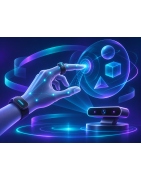
Air Gesture Controllers
Air gesture controllers are innovative devices that allow you to control VR, AR, MR systems, and computers touchlessly using hand movements and gestures in the air. Sensors detect the position, direction, and dynamics of your hands, enabling natural interaction with virtual objects, menus, and applications.
These controllers enhance immersion in games and simulations, support work in VR/AR environments, and improve ergonomics by eliminating the need for traditional buttons or controllers. They are an ideal solution for creators, gamers, and professionals seeking intuitive, touchless interaction with the digital world. -
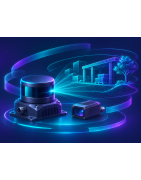
LiDAR
LIDAR (Light Detection and Ranging) is a technology that uses a laser beam to accurately measure distances and create 3D maps of the surroundings. LIDAR systems scan spaces in real time, enabling precise mapping of the shapes, distances, and movements of objects.
LIDARs are used in automotive applications (autonomous vehicles), robotics, drones, surveying, terrain mapping, as well as in VR and AR, where they support position tracking, interaction with virtual objects, and the creation of realistic 3D environments. It is a key technology for advanced navigation systems and immersive digital experiences. -
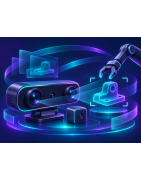
AI/Depth Cameras
AI, VR, and depth cameras are advanced devices that capture three-dimensional images and analyze scenes in real time using artificial intelligence algorithms. VR and depth cameras enable precise motion tracking, create 3D maps of space, and detect the distance and shape of objects.
Such cameras are used in virtual and augmented reality, simulations, gaming, robotics, industry, and security systems. They enable precise interaction with the environment, realistically reproduce motion, and create immersive VR and AR experiences. -
Robots, AI
Robotics is a field of technology that deals with the design, construction, and programming of robots—machines capable of performing tasks automatically or remotely. Robots can be industrial, service, mobile, educational, or humanoid, and their functions include object manipulation, transportation, interaction with humans, and performing repetitive or dangerous tasks.
Modern robots utilize advanced sensors, artificial intelligence, and vision systems, allowing them to respond to their environment and collaborate with humans. Robotics finds applications in industry, medicine, education, logistics, VR/AR, and smart home systems, increasing efficiency, safety, and user comfort. -
Personal AI Wearable...
Personal AI Wearable Assistants
Personal AI Wearable Assistants are a new category of intelligent wearable devices that support users in everyday work, communication, task organization, note-taking, and quick access to information. Unlike traditional smartphones, computers, or mobile applications, devices of this type are worn directly by the user — for example as glasses, a clip, pendant, voice recorder, necklace, or another compact accessory.
Their main purpose is to act as a personal artificial intelligence assistant available in a natural and convenient way. These devices can record voice notes, create conversation summaries, support translations, remind users about tasks, help organize the day, answer questions, analyze context, and work with AI applications and productivity tools.
This category includes solutions designed for users who want to use AI without constantly reaching for a phone, laptop, or tablet. A personal AI assistant can support the user during meetings, travel, field work, business conversations, learning, training, content creation, customer service, and everyday organizational tasks. -

Computer accessories...
Computer accessories encompass a wide range of devices that support everyday computing, such as keyboards, mice, monitors, docking stations, webcams, and headsets. Modern solutions increasingly integrate artificial intelligence (AI) technologies, which enhance comfort, efficiency, and safety.
AI devices can offer features such as intelligent noise reduction during video conferencing, automatic image framing, speech recognition, user behavior analysis, and energy optimization. In business environments, they support productivity, process automation, and improved communication quality, constituting an important element of the modern, digital workplace. -
Biometric scanners
Biometric scanners are professional devices designed to capture and verify a user's unique biometric characteristics, particularly fingerprints. They are used in identification and access control systems, identity registration, administration, security, and forensic applications. Our product range includes devices suitable for both stationary use and mobile identification systems.
-
Security Keys
Secure your digital life with hardware security keys. We offer advanced solutions for protecting online accounts, computers, servers, and workstations—as well as mobile devices—that are not only easy to use but also provide the highest level of security. Our keys are compatible with a wide range of devices and services, making them the ideal choice for anyone seeking a robust two-factor authentication method. Join the community of users who enjoy peace of mind thanks to reliable protection.
-
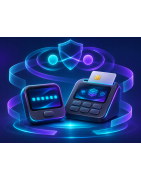
Two-factor authentication
Two-factor authentication
Two-factor authentication comprises solutions that enhance the security of access to accounts and systems by employing two independent methods to verify a user's identity. Products in this category help mitigate the risk of unauthorized access and support data protection across business, administrative, and personal environments. They serve as practical tools for organizations and users seeking a higher level of security during login and authorization processes. -
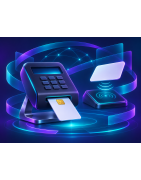
Card readers
Card readers are versatile devices designed to read and process various credentials, such as smart cards, proximity badges, and select mobile solutions. They are well-suited for environments where secure user identification, access control, and integration with authentication systems are essential. This category encompasses professional solutions for office, administrative, and specialized applications.
-
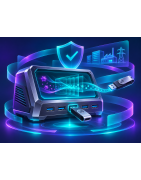
USB decontamination...
USB decontamination stations are used to securely scan, analyze, and clean USB drives and other removable media before allowing them into protected infrastructure. These solutions are designed for OT/ICS environments, isolated networks, critical infrastructure, government, industry, and organizations with heightened security requirements.
-
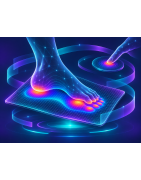
Pressure Mapping
Pressure mapping technology is an advanced sensor system that measures and visualizes the distribution of pressure forces on the surface of the body or objects. It allows for the analysis of which areas are most stressed, which is particularly useful in medicine, rehabilitation, sports, ergonomics, as well as VR and haptic devices.
In the context of VR and haptic devices, pressure mapping technology allows for the adjustment of vibration and haptic responses in vests, suits, and gloves, enhancing realism and immersion. It is a tool for precisely analyzing and optimizing the user experience and improving comfort and safety during interactions. -
Biofeedback,...
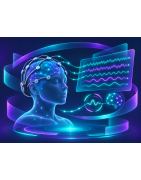
Biofeedback and neurofeedback training utilize real-time monitoring of biological and brain signals to improve concentration, emotional control, reduce stress, and optimize performance. Using specialized sensors, users receive immediate feedback on their physiological state or brain activity and learn to consciously influence these parameters.
Applications include VR and AR, medicine, psychology, sports, education, and mental and relaxation training. It is an effective tool for developing cognitive skills, improving mental health, and increasing performance in work and sports.EEG (electroencephalography) biosignals are electrical signals generated by the brain that can be measured using specialized sensors and electrodes placed on the scalp. EEG analysis allows for real-time monitoring of brain activity, detecting states of concentration, relaxation, stress, and responses to stimuli.
In VR, AR, neurofeedback, medicine, and scientific research, EEG enables brain-computer interaction, device control, and the optimization of training and therapy. It is a powerful tool for studying brain activity and creating intelligent and personalized experiences using immersive technology. -

Sportswear for motion...
Motion monitoring and analysis sportswear is an innovative garment equipped with sensors and activity tracking systems that record body position, force, speed, and range of motion during training. This data can be transmitted to apps or analytical systems to improve technique, optimize performance, and reduce the risk of injury.
Such solutions are used in sports, rehabilitation, VR training, and simulations, allowing athletes and coaches to precisely analyze movement, adapt training, and monitor progress in real time. -
Modern rehabilitation...
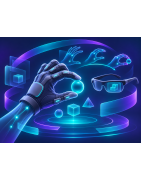
Modern Smart/XR rehabilitation utilizes VR, AR, and MR technologies to support physical, neurological, and cognitive therapy. Thanks to immersive environments, patients can perform exercises virtually, while motion tracking systems and haptic sensors provide precise data on progress and accuracy.
Smart/XR solutions increase motivation, engagement, and therapy effectiveness, enable personalized rehabilitation programs, and enable real-time monitoring of results. This innovative approach combines modern technology with medicine, offering safe, effective, and engaging therapeutic exercises. -
Devices for hazardous...
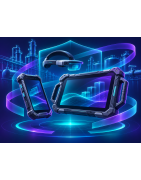
1/21 hazardous area devices are specialized electronic and sensory equipment designed for use in environments with a high risk of explosion, such as those containing flammable gases, vapors, and dust. These products meet stringent safety standards and are certified, ensuring safe use in extreme conditions.
These devices are used in the chemical, petrochemical, and mining industries, and anywhere else requiring the safe operation of electronic equipment in hazardous areas, minimizing the risk of accidents and damage. -
Devices for hazardous...
DZ2/Zone 2/22 hazardous area devices are electrical and sensor equipment designed for use in areas with a potential, but rare, explosion hazard, where flammable gases, vapors, or dust may be present. This equipment meets the relevant standards and has safety certifications, ensuring reliable operation in such conditions.
Applications include the chemical and petrochemical industries, fuel and dust storage facilities, and industrial installations where safety is a priority. DZ2/Zone 2/22 devices minimize the risk of explosion, enabling safe and efficient operation in hazardous areas. -
Tablets digital signature
Digital signature tablets are devices that enable secure and fast electronic signature creation without the need for paper. Thanks to precise touchscreens and gesture recognition technology, signatures mimic the actual movement of the pen, ensuring the authenticity and credibility of the document.
Tablets are used in offices, banking, government, logistics, and anywhere else requiring fast and secure document handling. They facilitate the signing of contracts, forms, and electronic documents, accelerating workflows and eliminating paper workflows. -
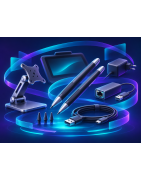
Tablet accessories
Tablet accessories - cables, power supplies, styluses
-

Tablet software
Tablet software that enables digital signatures allows for electronic signing of documents without the need to print them out in hard copy. Users can sign directly on the tablet screen using a stylus or their finger, and the system saves their signature digitally along with additional data such as the date, time, and device identifier.
Such solutions are used in industries such as banking, logistics, insurance, government, and field customer service. They save time, reduce paper costs, and securely archive documents in compliance with applicable regulations. -
3D scanners
3D scanners are designed to scan three-dimensional objects. They allow you to scan objects and buildings, depending on the model and need. They are used in museums, architecture and surveying. By creating grids of points distributed in space, they enable the creation of digital three-dimensional structures. The included software supports data processing and obtaining high-quality models.
-

Handheld scanners
Mobile scanners for handheld scanning have their own memory for storing scans.
Handheld scanners with translation capabilities scan printed text and instantly translate it.
-

Scanner programs
Document and photo scanner software enables the efficient capture, processing, and archiving of digital images and documents. In the case of document scanners, it supports functions such as OCR (text recognition), automatic indexing, PDF file creation, data compression, and integration with DMS and ERP systems.
In the area of photo scanners, the software enables high-quality digitization of photos, negatives, and slides, offering color correction, scratch removal, sharpening, and image retouching. These solutions are used in offices, archives, public institutions, graphic design studios, and anywhere else where efficient and secure digitization of documents and visual materials is crucial. -
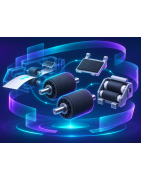
Scanner accessories
Scanner parts include consumables and replacement parts that ensure proper device operation and extend their service life. These include paper separators, document transport rollers, power supplies, drive belts, optical sensors, and CCD modules.
Regular replacement of these components minimizes the risk of failure, improves scanning quality, and maintains smooth operation in offices, archives, and document centers. Properly selected replacement parts also optimize operating costs and ensure reliability during intensive use.